YouTube Ads Cost for B2B SaaS: What Should You Actually Budget?
November 16, 2026


YouTube can get expensive long before it produces an answer that finance or sales can use. Google currently recommends a daily Demand Gen budget of at least ten times the target CPA; for a high-value demo or SQL, that requirement can push spend well beyond a comfortable test.
For a focused B2B SaaS test, we typically model YouTube ads cost at 10,000 per month in net media over 6–8 weeks, with broader programs at $15,000+. We use these ranges for planning, not as market benchmarks.
At Aimers, we have seen both versions of the problem: tests spread so thin that no audience or message receives a fair read, and well-funded campaigns where one video, a weak conversion path, and disconnected CRM data leave the team with plenty of delivery but little evidence. A defensible plan defines what the spend should prove and which signals will trigger scale, repair, or stop.
How Much Do YouTube Ads Cost for B2B SaaS?
YouTube ads cost is the media amount paid through Google Ads for impressions, eligible video views, interactions, or conversion-focused delivery. For B2B SaaS, the useful budget also includes the creative, landing page, tracking, and measurement required to connect delivery to qualified outcomes. Evaluate cost at the auction and pipeline levels.
At $3,000 per month, ask one question: can this message earn qualified attention from this audience in this market? A $5,000–$10,000 budget supports more creative variation, remarketing, and conversion learning. At $15,000+, teams can test broader account universes, markets, or incrementality, provided measurement can carry the load.
These are internal planning scenarios, not results from a single campaign cohort. They reflect what each level can reasonably fund: a concentrated test, structured creative and remarketing learning, or broader market work. As a SaaS PPC agency, we generally work with accounts spending at least $3,000 per month per platform, but that account-fit threshold does not define the right YouTube media budget. For execution detail, use our YouTube Ads best practices for B2B SaaS.
What You Pay For: CPV, CPM, and CPA
CPV is the cost of an eligible TrueView view or interaction. CPM is the cost of 1,000 impressions; vCPM applies to viewable impressions. CPA is usually an optimization target or downstream calculation, not a universal YouTube billing unit. Cheap views can coexist with expensive qualified opportunities, so match the metric to the campaign job before comparing costs.
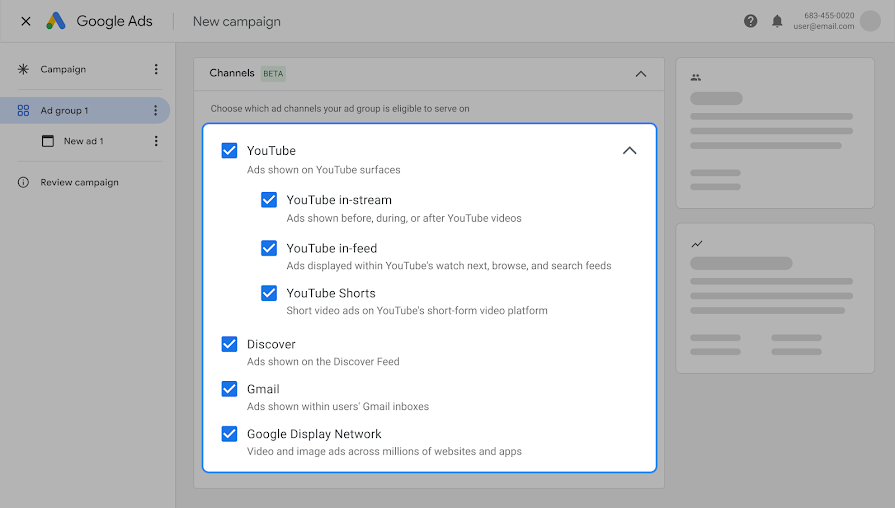
A TrueView in-stream view generally requires 30 seconds, completion of a shorter ad, or an interaction; in-feed and Shorts follow different rules. Video View Campaigns use target CPV, while Video Reach Campaigns use CPM goals. Google is beta-testing automated bidding for eligible Video Reach campaigns, with limited access. It supports Efficient reach, Non-skippable, and Target frequency subtypes, but not Video View campaigns.
AdConversion’s $1.04 million 2023–2024 B2B SaaS sample reported average CPV of $0.05 and CPM of $9. At those rates, $3,000 buys roughly 60,000 views or 333,000 impressions; in a three-times-higher $0.15 CPV scenario, it buys about 20,000 views. These are directional planning inputs, not 2026 prices. Views and impressions are not unique people, so narrow audiences can saturate before the budget is spent.

Video Action Campaigns were upgraded to Demand Gen. Demand Gen can run beyond YouTube, so blended CPA may include other Google surfaces. Before using it in a YouTube budget model, check channel-level reporting and make the scope explicit in our Google Ads management for SaaS.
What Changes YouTube Ad Cost?
There is no single platform price. Audience scarcity and geography affect the auction; objective and inventory define what the campaign buys; frequency, creative supply, and the conversion path determine the delivery required for a qualified outcome. Similar CPMs can still produce very different commercial costs.
Narrow roles and small account lists can saturate quickly. Once incremental reach flattens, “spend more” mostly means “show the same people the ad again.” We build Reach Planner forecasts around the actual geography, dates, audience, and format mix, then refresh them as competition and inventory change. Google does not guarantee those forecasts, and neither should the budget deck.
Creative and the next step matter too. Too few concepts blur audience failure with creative fatigue. If the video wins the click and the page loses it, fix the post-click path before the auction. A strong B2B SaaS offer strategy matches the ask to buyer readiness. Cheap views do not justify scaling until qualified progression follows.
Calculate a Defensible YouTube Ads Budget
Start with the decision the campaign must support, then work backward through volume, unit cost, and learning time. The familiar ‘whatever is left after Search and LinkedIn’ method produces a number, but rarely a useful test.
Define one campaign job and the next meaningful outcome before opening Reach Planner or an in-account forecast. Otherwise, a precise-looking CPM can obscure a weak test design.
Consider a planning scenario, not a benchmark. A team sets $6,000 per month in net media for an eight-week test, about $197 per day and roughly $11,050 across 56 days. It uses one primary prospecting audience, one remarketing layer, and three concepts, then evaluates qualified visits, account fit, assisted demos, and CRM progression. It does not project SQL volume without a historical YouTube-to-SQL rate. Google can vary daily delivery within applicable spending limits, so pacing reports should use the correct window.
As of November 1, 2026, Google’s current Demand Gen performance guide recommends a daily budget of at least 10× target CPA. A $150 demo target therefore implies $1,500 per day, or about $45,600 per 30.4-day month. For Maximize Conversions, Google gives a separate $100-per-day recommendation, about $3,040 per month. These are conversion-bidding inputs, not reach or view minimums. If the required budget is unrealistic, change the objective, consolidate the setup, or delay conversion bidding. Our B2B SaaS paid media budget framework covers the cross-channel trade-off.
What a Minimum Viable YouTube Ads Test Requires
A viable test needs enough concentration to separate signal from noise. For focused B2B SaaS programs, we typically use 6–8 weeks for several concepts to deliver and downstream behavior to appear. That is our operating convention, not a Google rule. Google’s conversion-focused Demand Gen guidance separately recommends waiting for at least 50 conversions before judging the learning phase; it does not determine the duration of a reach or view test.
- One job and one primary ICP audience, large enough to deliver without harmful frequency.
- At least three distinct concepts, plus the aspect ratios required by selected inventory.
- A stage-appropriate offer and page, tested tracking, CRM stages, and sales feedback.
- Weekly delivery and creative reviews, followed by commercial analysis after conversion lag.
At $3,000 per month, the structure should stay deliberately simple. One audience and one question are more useful than extra campaign layers. Creative variation still means different hooks and messages, not three crops of one polished video. These SaaS video ad examples show patterns worth testing.
Add the Costs Outside Media Spend
Media spend gets the biggest number in the budget and usually the most attention. It still covers only Google Ads delivery. The all-in investment must also fund creative, the post-click experience, tracking, tools, and management. Missing layers do not disappear; they usually reappear later as an expensive explanation for weak performance.
Separating these layers shows leadership which risk each dollar addresses. If buyers click but stall, SaaS landing page design or CRO for paid traffic may create more value than another bid adjustment. A campaign can win the auction and lose the business case one click later.
Measure, Scale, Hold, or Stop
Cheap delivery is easy to celebrate too early. We scale only when delivery and downstream quality point in the same direction. Google Ads explains spend, reach, frequency, CPV, and CPM; GA4 shows site behavior; the CRM validates ICP fit, SQLs, opportunities, and sourced or influenced pipeline. A connected marketing analytics and attribution setup keeps platform conversions useful for diagnosis without mistaking them for final business outcomes.
When YouTube Is Not Budget-Ready
Sometimes the right YouTube budget is $0 for now. Hold the launch when:
- the ICP, offer, or next action remains unvalidated;
- high-intent demand capture is still underfunded;
- the team has one video and no refresh plan; or
- the CRM cannot show ICP fit or what happened after the form fill.
Fix these readiness gaps before media begins. Our B2B marketing analytics framework shows how to connect the diagnosis to pipeline and revenue.
Validate Your YouTube Ads Budget Before You Spend It
A workable YouTube ads cost plan funds enough reach, creative variation, conversion signal, and measurement to answer one business question. Before launch, agree on the media ceiling, all-in investment, evaluation window, and scale, repair, or pause conditions. If the reachable audience or conversion signal remains a guess, the budget isn’t finished. Accounts spending at least $5,000 per month on paid ads can get a free PPC audit. We review the objective, audience, creative, landing page, tracking, and assumptions, then say whether the evidence supports launching, narrowing the scope, or waiting.
FAQs
We typically plan $3,000–$10,000 per month in net media for a focused B2B SaaS test and $15,000+ for broader programs. These are planning scenarios, not auction quotes. Audience reach, geography, objective, creative supply, and the qualified outcome determine the defensible budget.

$3,000 can support one focused question in one market: one primary audience, one goal, and several concepts over 6–8 weeks. It is unlikely to support multiple geographies, personas, formats, and offers. For a tiny account list, even less may prevent wasteful frequency.
Our 6–8 week window is an operating convention for a focused test, not a Google minimum. Add the company’s normal conversion lag before judging pipeline, and review delivery, frequency, and creative weekly without repeatedly resetting the setup. Enterprise programs may need mature cohorts or incrementality evidence.
Yes. Include concepting, production, adaptations, and refreshes in the all-in investment, but keep them separate from net media spend. Without enough creative supply, a campaign can keep delivering while the test stops learning, making a superficially efficient CPV much less useful.
Measure YouTube Ads ROI by connecting campaign spend and engagement to qualified leads, SQLs, opportunities, pipeline, and closed-won revenue. Use Google Ads and GA4 for delivery and conversion data, then CRM reporting to evaluate lead quality and downstream outcomes. Keep sourced and influenced pipeline separate, and use incrementality testing where possible to assess whether YouTube generated additional business value.