B2B SaaS Offer Strategy: What to Promote Besides a Demo

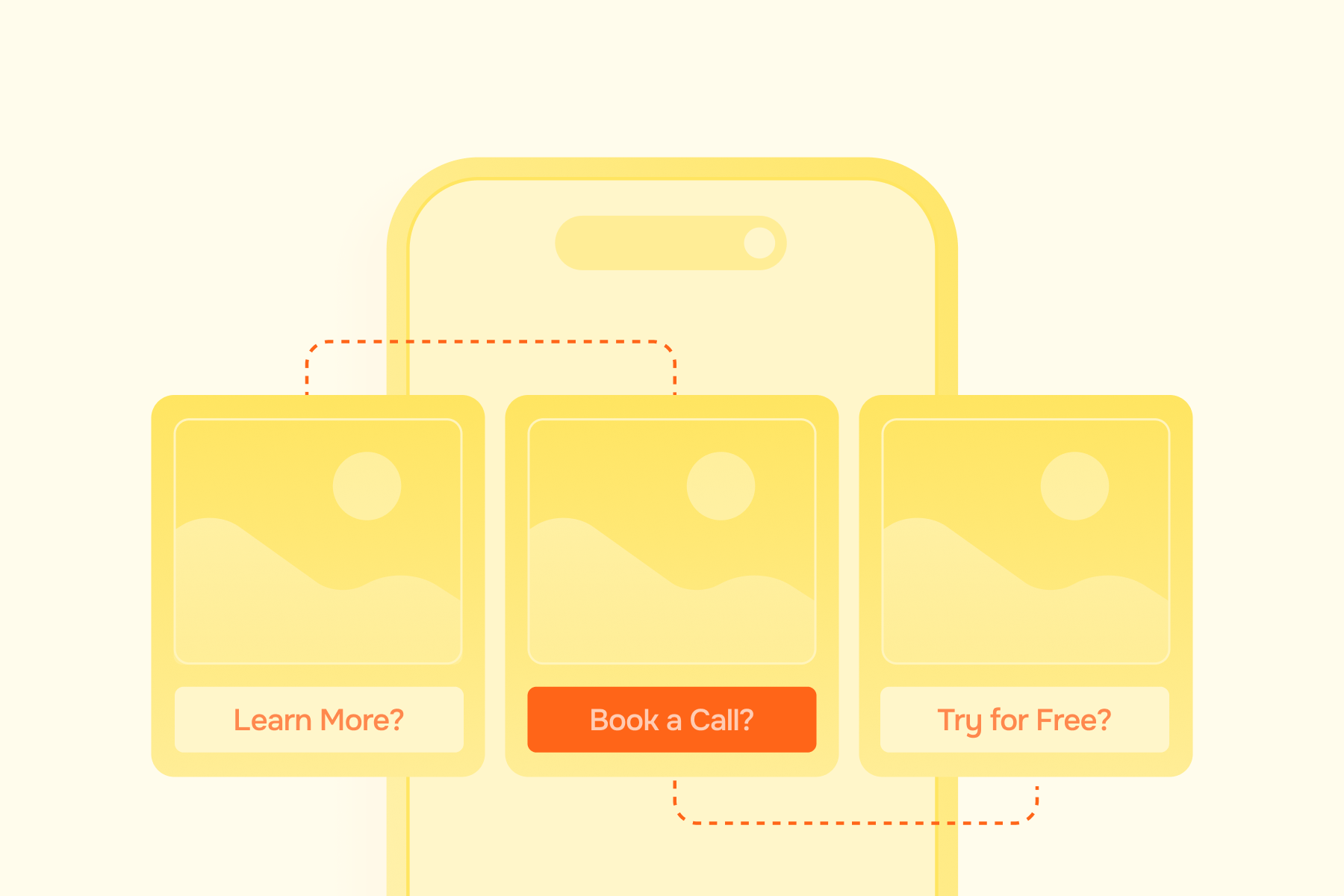
When a B2B SaaS campaign generates clicks but too few qualified conversations, teams usually revisit targeting, bids, creative, or landing page copy. In our work at Aimers, we often find that the problem sits one step earlier: every buyer is being asked to “Book a Demo,” even when many are still sizing the problem or exploring possible approaches.
B2B SaaS companies should promote more than demos because buyers enter the funnel with different levels of awareness, urgency, and willingness to talk to sales. Strong alternatives include ROI calculators, benchmark reports, assessments, interactive product tours, free tools or trials, workshops, and audits. Each one should deliver useful value now and create a credible route toward qualified pipeline.
The balance matters. Gartner’s 2026 survey of 645 B2B buyers found that 67% preferred a sales rep-free experience, while 69% wanted sales reps to help validate AI-generated insights. Buyers value autonomy during research and human expertise when context, confidence, or risk becomes important.
This guide explains how to build a B2B SaaS offer strategy around that reality. We compare 10 SaaS demo alternatives, map them to buyer readiness and channel intent, and show how to evaluate the full conversion path through a focused 90-day test.

Key Takeaways
• Use a demo when buyers are ready to evaluate product fit, pricing, implementation, or risk. Give earlier-stage buyers a lower-commitment way to learn or diagnose.
• Build an offer ladder that moves from context and diagnosis to product proof and tailored validation.
• Match commitment to channel intent, ACV, product complexity, time-to-value, and sales motion.
• Design the ad, landing page, form, fulfillment, and follow-up as one conversion path.
• Judge offers by qualified progression, opportunity creation, pipeline, and acquisition economics, not form volume alone.
What Are B2B SaaS Marketing Offers?
B2B SaaS marketing offers are value exchanges that help buyers take a useful step before purchase. The value may be product access, a diagnosis, financial modeling, practical guidance, or expert input. In return, the buyer commits attention, time, contact details, business data, or access to a current workflow.
At Aimers, we define the offer before writing the ad or landing page. It determines the promise, the proof needed to support it, the form friction we can justify, the follow-up path, and the metric that should guide budget decisions. Changing a button from “Book a Demo” to “Talk to an Expert” does not change the underlying exchange.
Within a B2B SaaS demand generation strategy, offers connect awareness and buying intent to a measurable next step. An offer ladder plans several of those steps at increasing levels of commitment. Qualified progression shows whether the right account then reaches a meaningful state, such as activation, an accepted meeting, an SQL, or an opportunity.
Why “Book a Demo” Cannot Carry the Entire Funnel
A demo cannot carry the entire funnel because it asks every visitor to make the same high-commitment move. It works well when a buyer wants to assess configuration, integrations, security, implementation, or commercial fit. Earlier in the journey, the same request may end the session before the buyer reveals useful intent.
What we often see at Aimers is a measurement gap. Promising researchers leave anonymously, while some low-fit visitors request a demo only to access information the site should have provided. Marketing misses early signals and sales inherits meetings that were never ready for a product conversation.
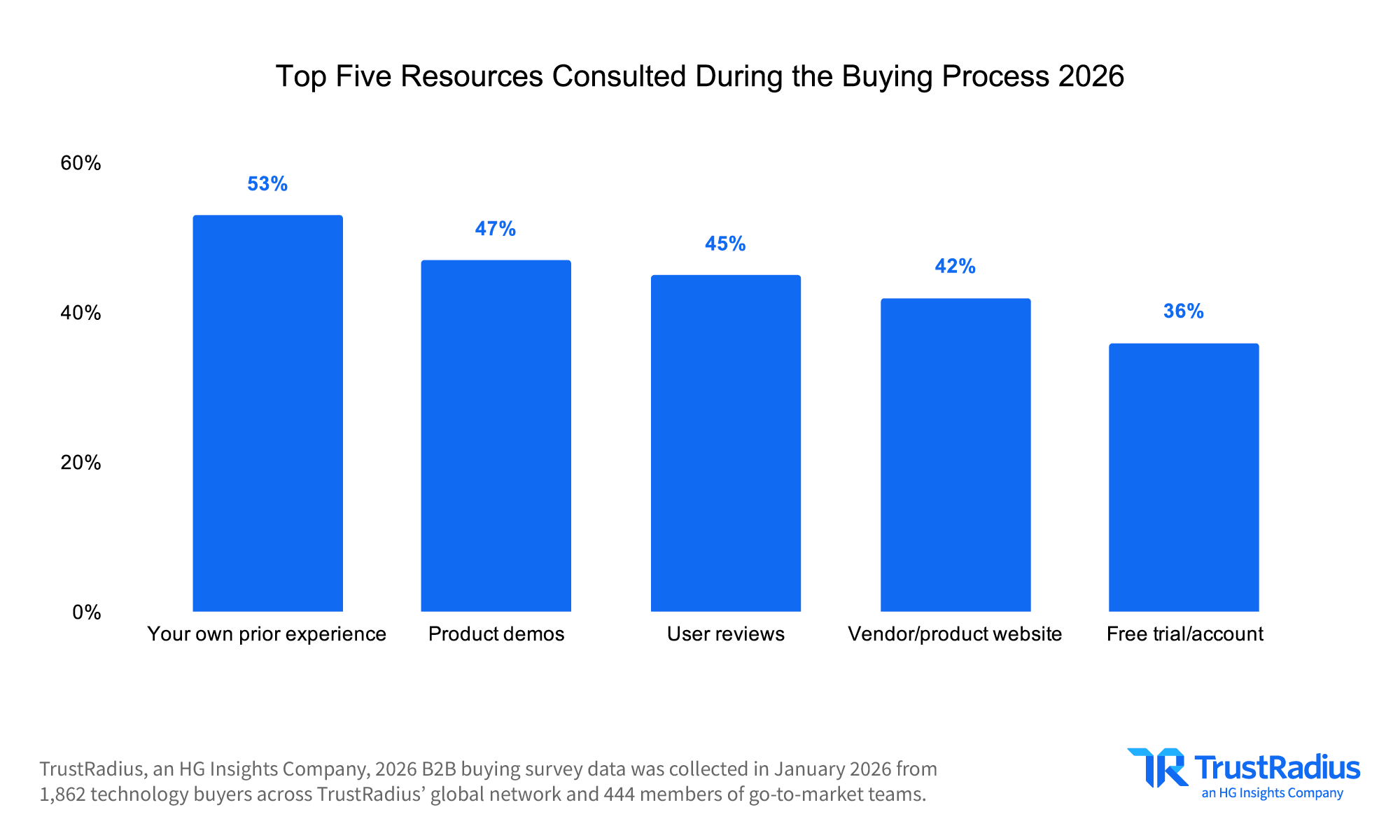
Demos still matter. TrustRadius’s 2026 survey of 1,862 verified technology buyers found that product demos were the second most-used buying resource, consulted by 47% of respondents, behind prior product experience at 53%. Free trials or accounts were used by 36%. The data supports a broader evaluation path, not an anti-demo argument.
Self-service product experiences are also becoming more visible. In Navattic’s vendor-produced 2026 analysis of the same random sample of roughly 5,000 B2B SaaS websites, 18% featured an interactive demo CTA, up from 12% in 2024. “Book a Demo” remained the most common CTA at 61%. These figures describe adoption, not guaranteed performance.
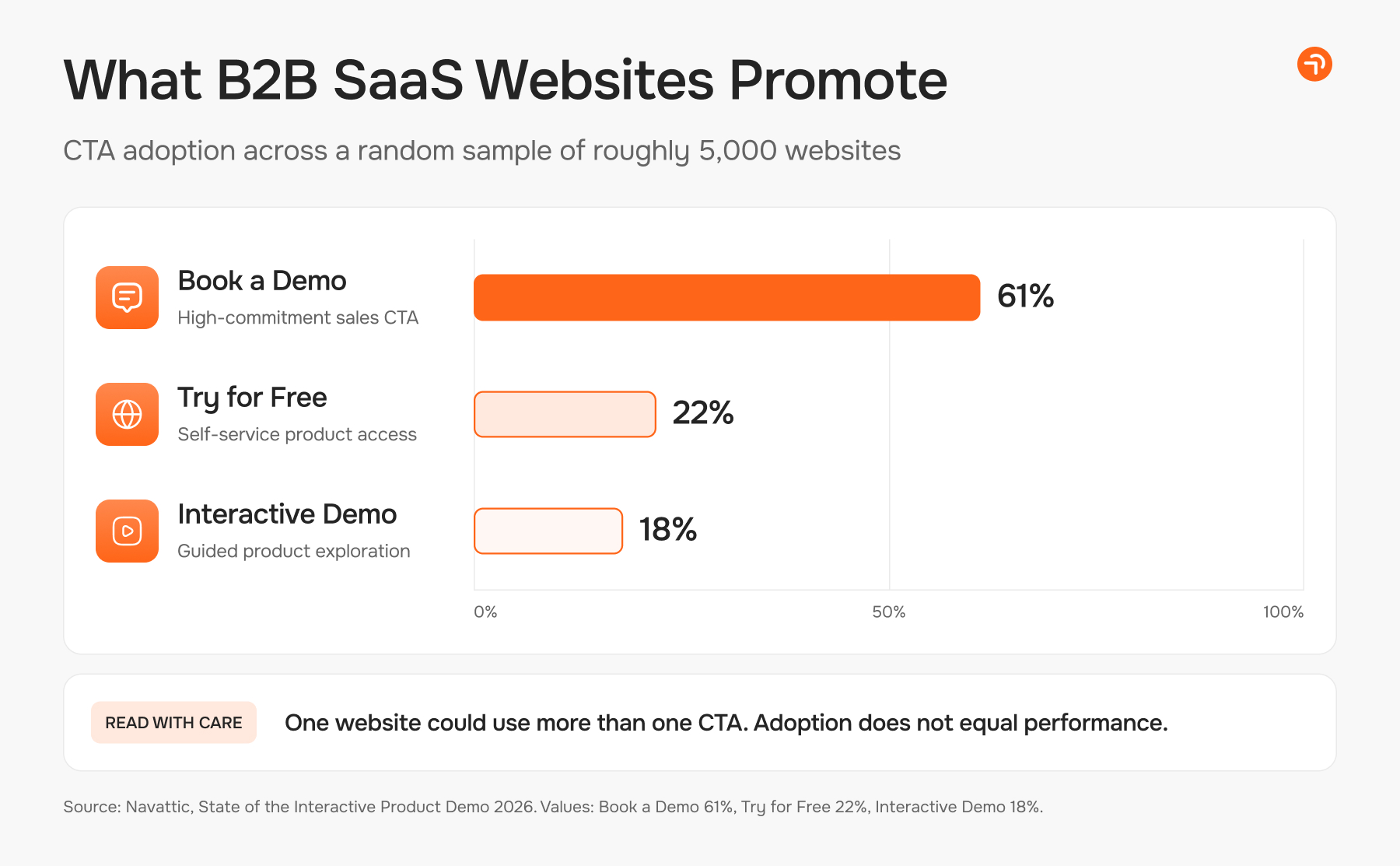
The practical model is a multi-path funnel. Keep the demo visible for strong intent, and give less-ready buyers an offer that resolves their current question. Lower commitment still needs to deliver real value, reveal a useful signal, and lead naturally toward evaluation. Otherwise, the funnel simply trades demo friction for low-quality lead volume.
Build an Offer Ladder Around Buyer Readiness
An offer ladder gives buyers several useful next steps, with commitment increasing as intent and evidence of fit become stronger. It is routing logic, not a rigid nurture sequence. Buyers can enter at any stage, skip steps, or return with a different question after another stakeholder joins the process.
This flexibility matters because preferences form well before seller contact. In 6sense’s 2025 global study of nearly 4,000 B2B buyers, first seller contact occurred 61% of the way through the journey, and the eventual winner appeared on the Day One shortlist in 95% of purchases. Offers help a company become useful during that pre-contact period instead of waiting for a demo request.
Commitment should rise on both sides. As buyers provide more data, access, and stakeholder time, the company should deliver more specificity and expertise. Some offers create demand before the buyer identifies themselves; others capture recognizable interest. Our guide to demand generation vs lead generation explains why both jobs belong in one revenue system.
Each step must earn the next one. Deliver the assessment result before suggesting a review, and show a meaningful workflow before presenting a product demo CTA.
10 SaaS Demo Alternatives and When to Use Each
The strongest SaaS demo alternatives solve different buyer problems and produce different signals. A list of SaaS lead magnets is not yet a strategy. For every concept, define the intended buyer, promised outcome, delivery format, qualification signal, primary KPI, risk, and next step.
1. ROI or TCO Calculator
An ROI or TCO calculator fits problem-aware buyers who recognize a measurable cost, revenue gap, risk, or workload but still need a financial case. Deliver it as an interactive page or editable model with visible assumptions and inputs such as team size, current spend, or transaction volume.
Track completed and saved results, business-case reviews, accepted meetings, and opportunities. Inputs may also reveal account potential. False precision is the main risk. Any ROI calculator SaaS teams promote should make every assumption visible and frame outputs as modeled estimates.
2. Benchmark Report
A benchmark report helps cold ICP audiences decide whether their performance is normal, weak, or worth fixing. It can be an ungated article, downloadable report, dashboard, or custom comparison segmented by company size, industry, region, or maturity.
Watch segment selection, repeat visits, internal sharing, and movement into diagnostic content. Measure progression among ICP accounts rather than downloads alone. These demand generation offers lose value when the methodology is vague or the audience is too broad to have a plausible product need.
3. Self-Assessment or Maturity Scorecard
A maturity assessment helps problem-aware buyers diagnose their current state and prioritize improvements. Use a short questionnaire based on observable behaviors, then return the score immediately with practical recommendations.
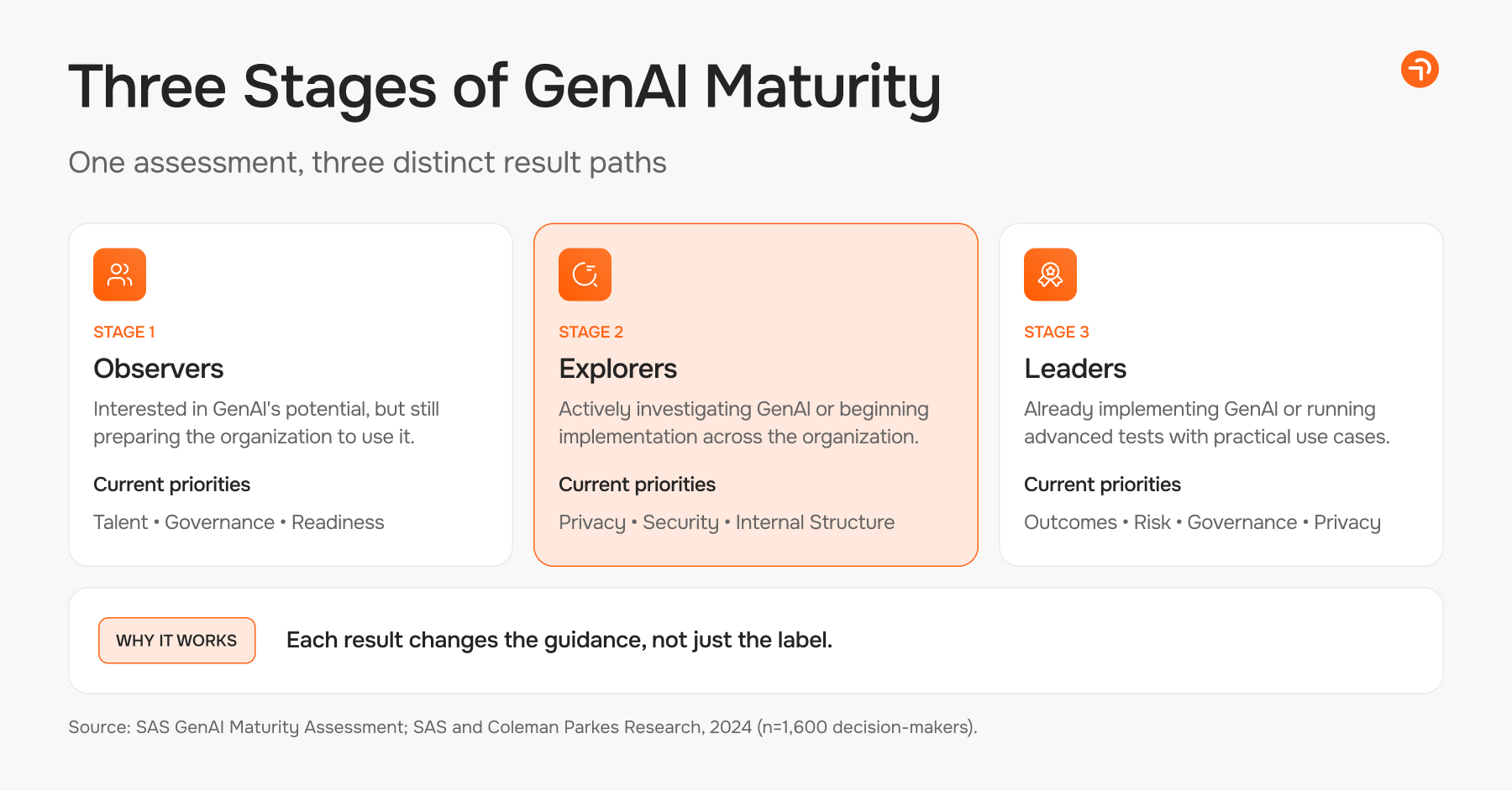
Responses can reveal urgency, use case, process maturity, and readiness for help. Track completion, score bands, results reviews, and SQL progression. Buyers quickly notice when every answer leads to the same product pitch, so the diagnosis must remain credible without a sales call.
4. Interactive Product Tour
An interactive product tour suits buyers who want product evidence without live configuration. Organize it around a role, use case, or workflow rather than a sequence of interface screens. Let the visitor select the path most relevant to them when the product serves several audiences.
Track workflow choice, meaningful engagement, completion, repeat visits, and progression to a trial, meeting, or opportunity. The risk is a polished click-through that shows features without making the outcome clearer.
5. Free Tool, Template, or Checklist
A free tool, template, or checklist works when the product addresses a task buyers already perform manually. Use a generator for an immediate output, a template for a recurring process, or a checklist for a task where missed steps create risk.
Repeat use, saved output, data entry, and visits to related product pages usually signal more than a download. Measure qualified users or accounts that return and progress. The product bridge should feel natural, but the tool must still be useful to someone who never converts.
6. Webinar or Working Session
A webinar fits emerging categories and scalable education. A smaller working session is better when participants should leave with a decision, plan, or completed artifact. Collect role, company, and one relevant challenge only when they improve delivery or follow-up.
Measure qualified attendance, questions, stakeholder participation, and account progression. Registrations alone are weak evidence. The common failure is promising education and delivering a product pitch before the audience receives the advertised value.
7. Comparison or Implementation Guide
A comparison guide helps solution-aware buyers evaluate approaches or vendors. An implementation guide addresses later-stage concerns about security, migration, integrations, resourcing, or rollout. Use a transparent matrix, checklist, or plan that a champion can share with the buying committee.
Track comparison choices, integration interest, repeat visits, and opportunity creation. Explain tradeoffs and methodology instead of forcing every criterion to favor the vendor. Unsupported claims weaken trust and may create legal risk.
8. Audit, Teardown, or Diagnostic Review
A SaaS audit offer works when expert analysis can expose a valuable problem before implementation. Specify what we will inspect, the inputs required, delivery time, and the exact output, such as a prioritized issue list or quantified opportunity assessment.
Willingness to share relevant data is a strong qualification signal. Measure accepted audits that become qualified opportunities and pipeline. Because fulfillment is expensive, set eligibility, scope, ownership, and capacity before promotion. “Free consultation” is too vague to carry the same value.
9. Free Trial or SaaS Sandbox
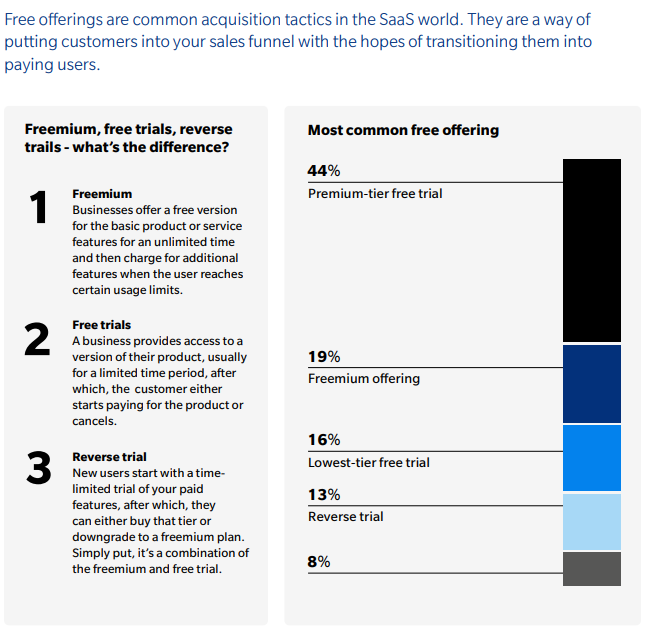
A free trial works when users can reach meaningful value quickly in the real product. A SaaS sandbox is better when buyers need sample data, controlled permissions, or a safe technical environment. The free trial vs demo decision should follow time-to-value, setup effort, complexity, and data sensitivity.
Define the activation event and guide users toward it. Track key feature use, integrations, invited teammates, repeat sessions, PQLs, and activated trial-to-paid conversion. SBI’s 2024 survey of 760 B2B SaaS leaders found premium-tier free trials were the most common free offering at 44%, but the preferred model varied by go-to-market motion.
10. POC, Pilot, or Strategy Session
A POC, pilot, or strategy session belongs near the end of the ladder. These formats fit high-ACV software, technical infrastructure, regulated environments, and decisions that require evidence in the buyer’s own context.
Set entry criteria, owners, scope, success metrics, timeline, and a commercial decision point. Access to data, technical resources, and decision-makers signals readiness. Measure opportunity progression, win rate, cycle time, and expected contract value. Avoid open-ended unpaid implementation disguised as evaluation.
How to Build a B2B SaaS Offer Strategy by Sales Motion
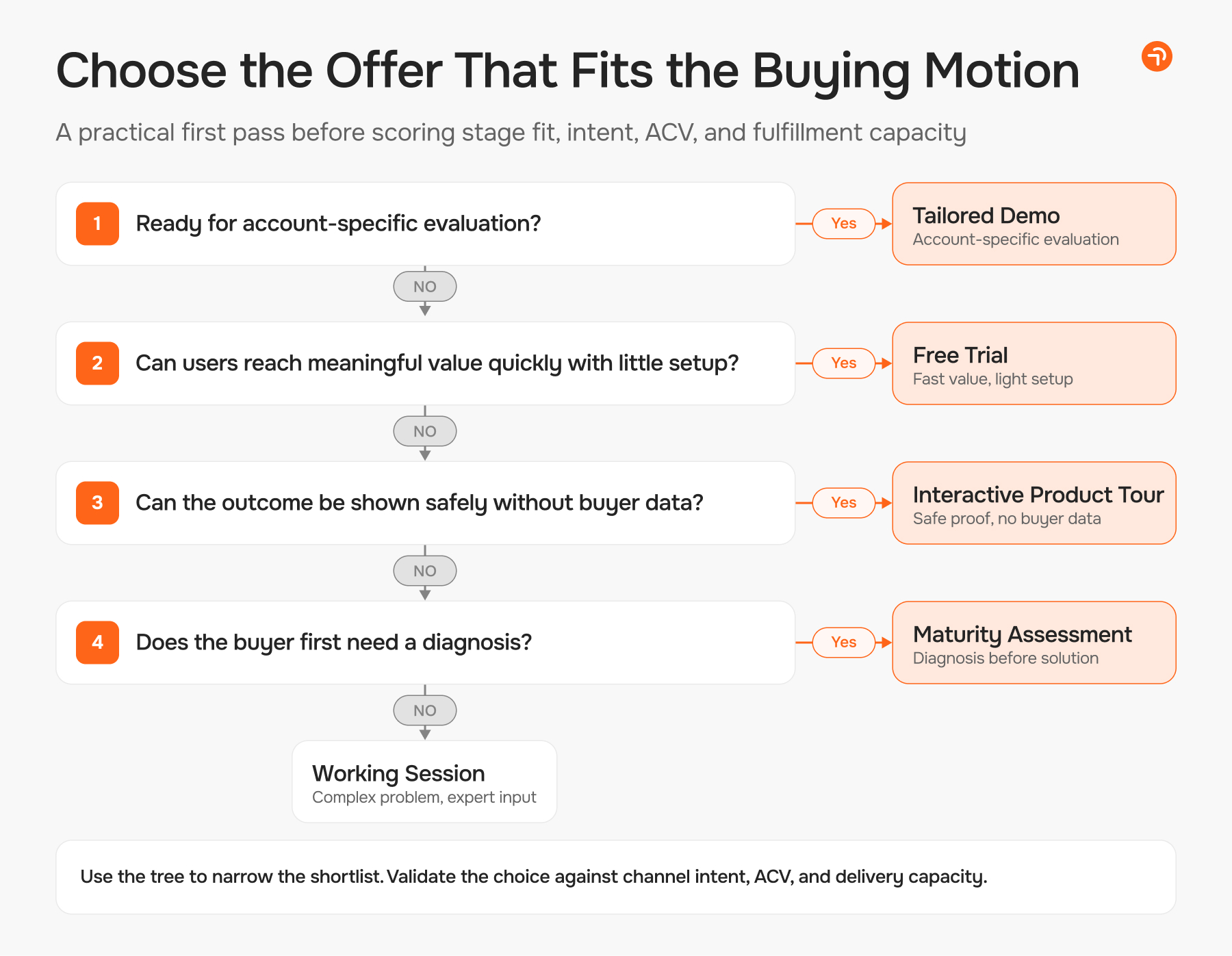
A B2B SaaS offer strategy should reflect how the product is evaluated, bought, and delivered. Sales motion narrows the shortlist by showing how much self-service is realistic, how much fulfillment can cost, and which behavior signals serious intent.
The scorecard exposes weak assumptions; it does not make the decision automatically. A custom audit may score well on relevance and qualification but fail on capacity. A trial may look attractive yet score poorly on stage fit when integrations are required before users can experience value.
Match Offer Commitment to Channel Intent
Offer commitment should rise with observable intent. A branded search, a problem-aware query, and a cold LinkedIn impression may reach the same ICP, but they reveal different readiness.
Consider a cloud cost optimization platform selling to FinOps teams. Cold LinkedIn could promote a benchmark on allocation maturity. Problem-aware Search could use a calculator or assessment that captures monthly spend and allocation coverage. Warm retargeting could promote a technical walkthrough, audit, or demo after the buyer views integrations or completes the diagnostic.
The ICP stays constant; the buyer’s context changes. Retargeting should follow the behavior that created the audience, as shown in our B2B retargeting ad examples. Comparing CPL across these paths would erase the differences in commitment and expected pipeline value.
Build the Landing Page, Form, and Follow-Up Around One Offer
A strong conversion path makes one value exchange easy to understand, complete, and continue. The ad sets the expectation, the page proves the offer, the form collects what that stage requires, and the follow-up delivers the value before introducing the next step.
The page should state the outcome, audience, effort, and delivery method above the fold. Maintain message match from the ad or query, show a real preview, place proof near the decision point, and explain what happens after conversion. A SaaS landing page CTA such as “Get My Benchmark” communicates more than “Submit.” In our SaaS landing page design work, we align the promise, page structure, form, tracking, and post-submit journey before traffic launches.
Native forms follow the same logic. Our LinkedIn Lead Gen Form best practices explain how one purposeful question can improve the signal before a contact enters the CRM.
We saw the effect in our Upper Hand CRO test. The original demo path required visitors to book a call and then complete another form. We tested one page with five fields and a qualifying question, while keeping immediate booking lower on the page. With traffic split 50/50 for three to four weeks, Page View-to-Customer conversion rose from 0.17% to 0.78%, a 4.6x increase, while lead quality remained good.
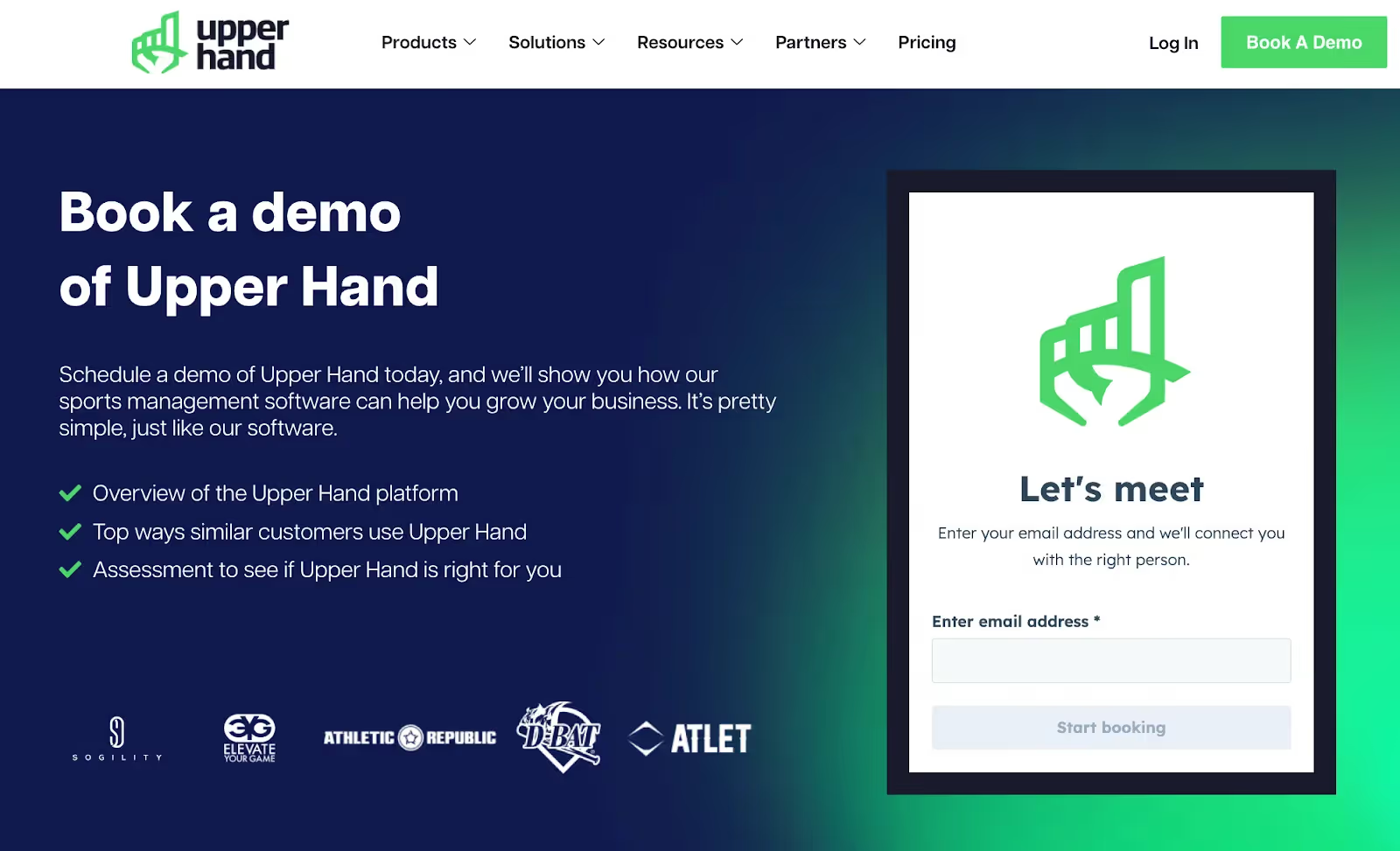
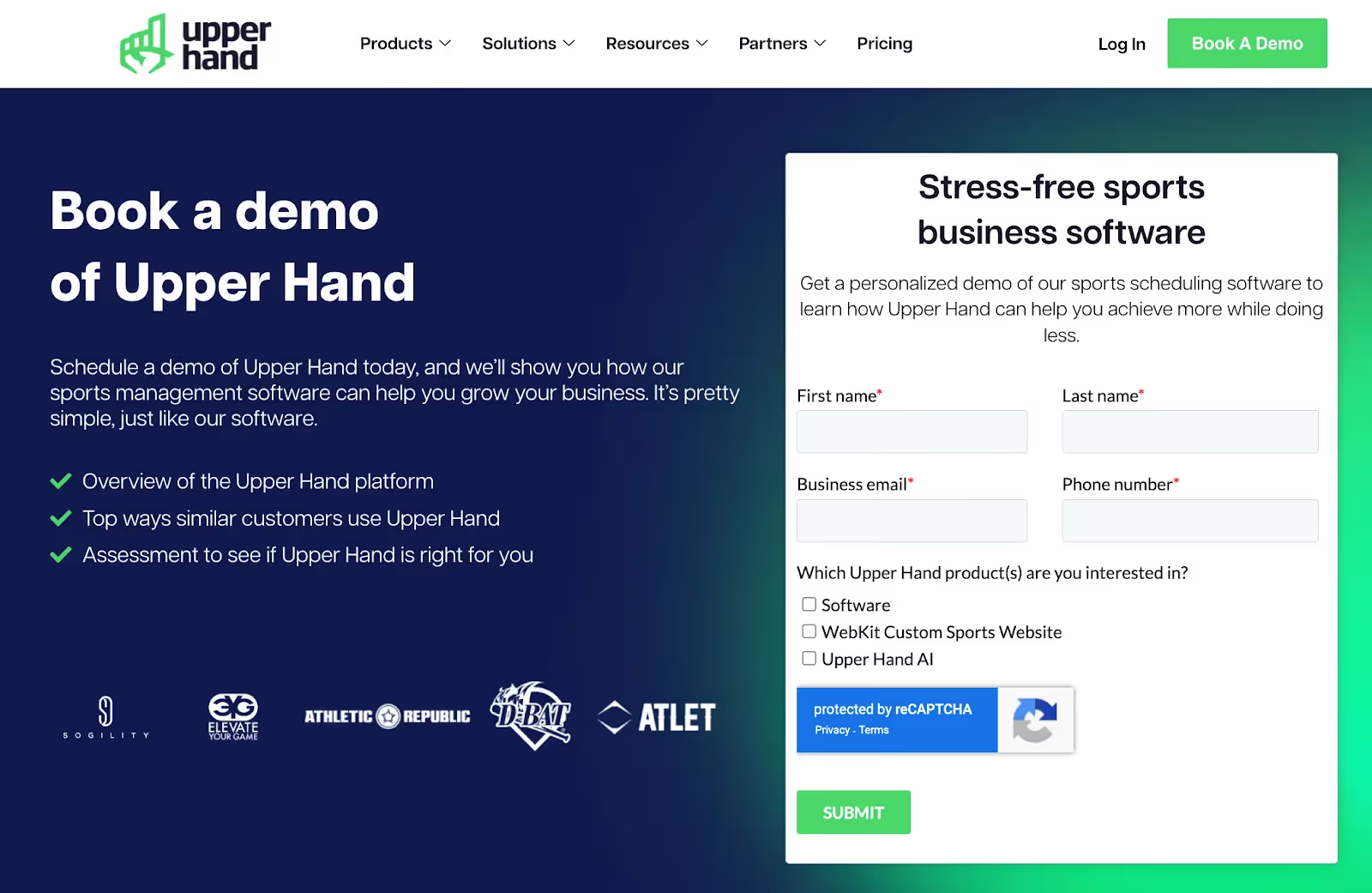
The lesson is more useful than “shorter forms convert better.” We removed steps that added no value and retained a question that supported qualification. Follow-up then needs the same discipline: deliver the report, score, access, or audit on time, preserve offer and qualification data in the CRM, and route the buyer to a proportional next action.
Measure Qualified Progression, Not Just Conversion Volume
Offer performance should show whether the intended buyer consumed the value, revealed fit or intent, and moved toward revenue. CTR, offer conversion rate, and CPL help diagnose messaging, traffic cost, and page friction. They do not show whether the account became an SQL or opportunity.
The offer’s job determines the emphasis. A benchmark may first be judged by ICP consumption and influenced account progression. A trial needs activation and PQL behavior. An audit or pilot should create opportunities large enough to justify fulfillment. This is why a $40 report download and a $600 accepted audit should not be ranked as equivalent B2B lead generation offers.
Separate Sourced and Influenced Pipeline
Sourced pipeline credits the campaign or offer that created the defined entry point. Influenced pipeline includes opportunities that engaged with the offer even when another interaction received source credit. Keep the totals separate, and review both alongside opportunity creation, win rate, CAC, and revenue.
Attribution is the rule set used to assign credit across observable interactions. It cannot reconstruct every internal share, peer conversation, AI-assisted search, or buying-committee discussion. A defensible view combines campaign data, offer events, product behavior, CRM stages, and self-reported attribution. Our analytics and attribution work connects these layers so budget decisions can use downstream evidence.
Feed Revenue Quality Back Into Acquisition
We have seen how quickly campaign decisions change once the platform receives CRM feedback. In our Cloudvisor PMax program, we mapped Form → MQL → SQL → Opportunity → Closed-Won, imported HubSpot events into Google Ads, and gradually moved optimization from general submissions toward qualified stages.
Four weeks after full-funnel optimization, MQL-to-SQL conversion was 130.3% higher than in the implementation week, and Opportunity volume had increased by 50%. Those results came from the broader staged program, including funnel mapping, cleaner definitions, imported signals, and changes to optimization goals. They should not be attributed to CRM integration alone.
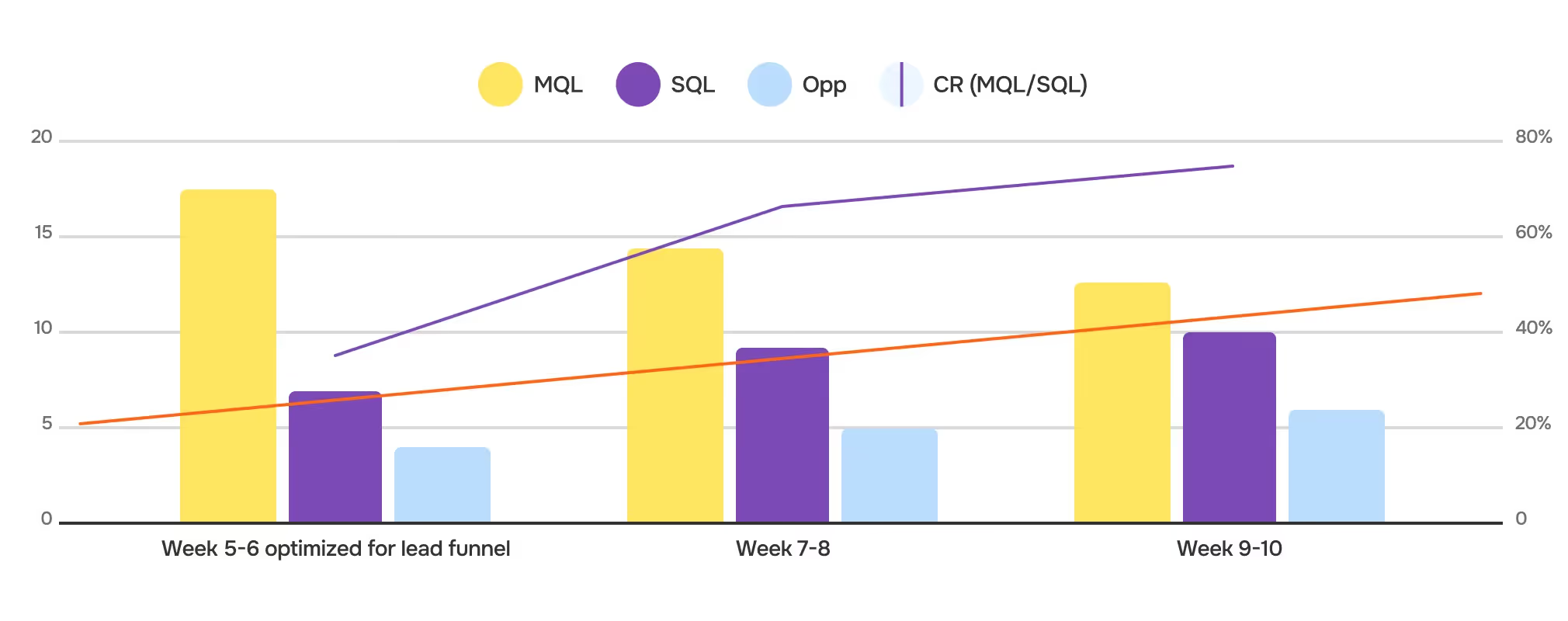
The mechanism is practical: once the system distinguishes a raw submission from an MQL, SQL, and opportunity, marketing can identify which offers produce real progression and give acquisition platforms a stronger signal for budget allocation.

Test One Offer System in 90 Days
A 90-day B2B offer testing plan should validate one audience-stage hypothesis, one primary offer, and one acquisition context. A narrow test makes it easier to tell whether the offer improved progression.
Do not declare a winner from early CPL. For enterprise SaaS, 90 days may not cover enough of the cycle for closed revenue, so continue tracking the original cohorts as opportunities mature.
Common mistakes usually appear before creative production:
• Replacing one universal demo CTA with one universal ebook.
• Building a useful asset with no credible product bridge.
• Calling a sales conversation an assessment without delivering a diagnosis.
• Using the same form friction across cold social, Search, and retargeting.
• Changing the audience, offer, positioning, and page in one test.
• Promoting workshops or audits without delivery capacity.
• Reporting downloads, registrations, or trial starts without progression.
• Giving several CTAs equal visual priority.
Document what the test established: who responded, what they consumed, which signals predicted progression, where buyers stalled, and how much the next stage cost. That record becomes the hypothesis for the next test.
Give Buyers a Better Next Step
A strong B2B SaaS offer strategy increases commitment as buyer readiness and evidence of fit become stronger. Early-stage buyers need context or diagnosis. Evaluators need product proof. High-intent accounts need tailored help with financial, technical, and implementation risk.
The demo remains essential. It becomes more valuable when buyers arrive with a clear problem, relevant product context, and a reason to involve sales. In our work, some of the highest-leverage improvements begin with the value exchange behind the click. Once the offer fits the buyer’s intent, the campaign promise becomes clearer, page friction is easier to justify, and sales receives better context.
Through our B2B SaaS demand generation services, we help teams connect offer strategy, paid media, landing pages, CRO, analytics, and CRM feedback around qualified pipeline. An offer and conversion-path audit can identify which buyer states the current funnel serves, where commitment is mismatched, and which experiment deserves the next 90 days.
FAQs
What Is a B2B SaaS Offer Strategy?

What Can a SaaS Company Promote Instead of a Demo?
When Is a Demo Still the Best CTA?
Which Offers Work Best for LinkedIn Ads and Google Search?
How Should SaaS Teams Measure Offer Performance?