

Paid Media Strategy for B2B SaaS: How to Allocate a $10K Monthly Budget

October 7, 2026

A $10K monthly paid media budget can generate useful pipeline signal for a B2B SaaS company. It can also disappear fast: a few Google campaigns, several LinkedIn audiences, retargeting on two platforms, and one “small” channel test can leave every campaign active but none funded well enough to support a confident decision.
At Aimers, we start by assigning each dollar a specific job. Our recommended B2B SaaS paid media strategy begins with $4,500 for Google Search, $2,500 for LinkedIn Ads, up to $1,000 for retargeting, $1,000 for one fit-based channel test, and $1,000 held as a flex reserve. The model assumes the full $10K is net media spend; agency fees, creative production, landing pages, analytics tools, and internal labor sit outside it.
The harder part begins after launch. Search can post the lowest CPL and still produce weak opportunities. LinkedIn can look expensive while reaching the right accounts and buying roles. This guide turns the split into an operating plan: unit economics, campaign structure, tracking, a 90-day cadence, and rules for moving budget according to SQLs, opportunities, qualified pipeline, and CAC payback. In other words, it shows how to run a paid media strategy for B2B SaaS after the spreadsheet is approved.
The Recommended $10K B2B SaaS Paid Media Budget Split
For a $10K monthly paid media budget, our starting allocation is 45% Google Search, 25% LinkedIn Ads, up to 10% retargeting, 10% for one channel test, and 10% held in reserve.
This paid media budget allocation assumes a confirmed ICP, a functioning website and CRM, a trackable demo or trial event, and an ACV that can support paid acquisition. If $10K is the all-in marketing budget, subtract operating costs before funding the platforms.
At Aimers, we use 45/25/10/10/10 as a planning model, not a universal benchmark or performance guarantee. A B2B SaaS paid media budget should change when its economics or buying motion contradict the baseline, not because a generic channel benchmark says it should. This keeps channel decisions tied to qualified pipeline instead of lead volume alone.
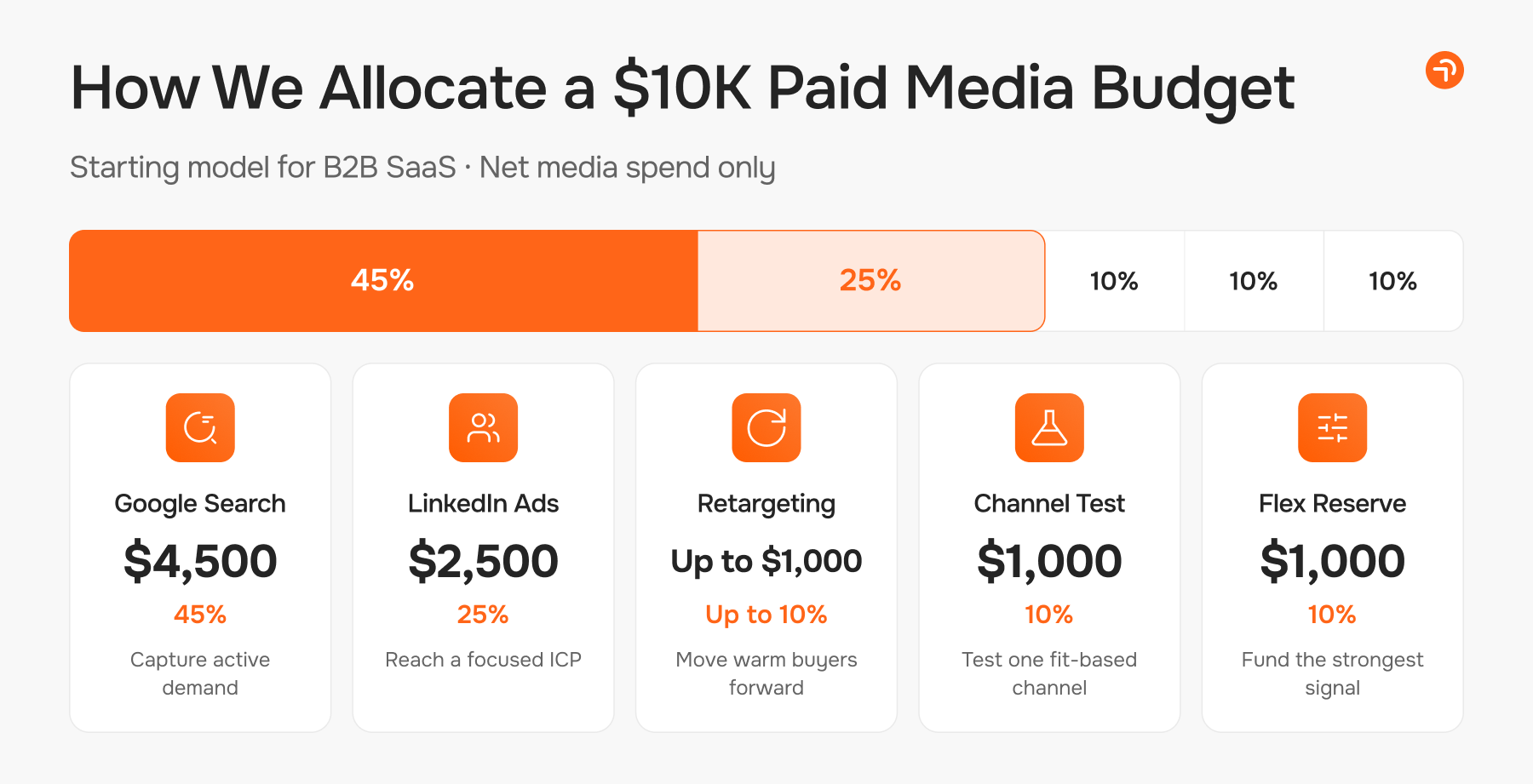
Demand Capture
Demand capture reaches buyers already expressing intent through category, problem, use-case, competitor, or brand searches. Google’s current Search campaign guidance confirms that Search ads reach people while they are actively looking for relevant products and services. Prioritize commercially relevant, high-intent keywords before expanding into broader queries.
Demand Creation
Demand creation puts a relevant problem, use case, or point of view in front of the right accounts before they actively search. LinkedIn’s targeting documentation lists company, job experience, education, demographic, interest, and custom-audience options. Judge this work through account fit, sales acceptance, progression, and later pipeline, not immediate CPL alone.
Retargeting
Retargeting reconnects with people who have already visited the site, engaged with content, or submitted a form. Google describes its data segments as a way to re-engage previous visitors and users. Treat $1,000 as a ceiling: if the audience cannot absorb it without excessive frequency or loose expansion, return the balance to the reserve.
Test Reserve
A test reserve funds one documented hypothesis in a channel that fits the buying motion. Define the audience, message, offer, landing page, expected signal, review date, and stopping rule before launch. The separate flex reserve stays uncommitted until stronger evidence justifies more creative testing, landing page testing, high-intent coverage, or another controlled experiment.
CAC Payback
CAC payback measures how many months it takes to recover customer acquisition cost from gross-margin-adjusted revenue. It connects media efficiency with cash flow. A higher CPL can work when conversion, average contract value, margin, and retention support the payback period; inexpensive leads fail when they never become customers.
With those roles defined, the baseline becomes an operating B2B SaaS paid media strategy. A sound paid media strategy for B2B SaaS gives every funded channel a commercial job, a measurable signal, and a written next decision.
Before You Allocate the Budget: Check the Unit Economics
Before committing the $10K, calculate whether the funnel can support the required cost per SQL and cost per opportunity. A clean B2B SaaS paid media budget cannot rescue an acquisition model that needs more qualified demand than the market, website, or sales team can produce.
Start by separating fully loaded CAC from allowable paid-media CAC. Fully loaded customer acquisition cost includes the sales and marketing resources required to win a customer. Allowable paid-media CAC is the amount left for advertising after agency or internal management, sales, creative, landing pages, and tools. For the broader methodology, use our guide to calculate your SaaS PPC budget.
Benchmarkit’s 2026 B2B SaaS and AI-Native Metrics reports an 80% median software gross margin. Use that figure only as market context; the company’s actual margin belongs in the model.
Worked Example
Assume the following illustrative inputs for the cohort associated with one month of media spend:
The model requires two customers, ten opportunities, and forty SQLs. Gross profit is $16,000 per customer; applying the company’s 50% acquisition policy produces an $8,000 fully loaded CAC ceiling. After $3,000 in non-media costs, allowable paid-media CAC is $5,000. The resulting ceilings are $250 per SQL and $1,000 per opportunity.
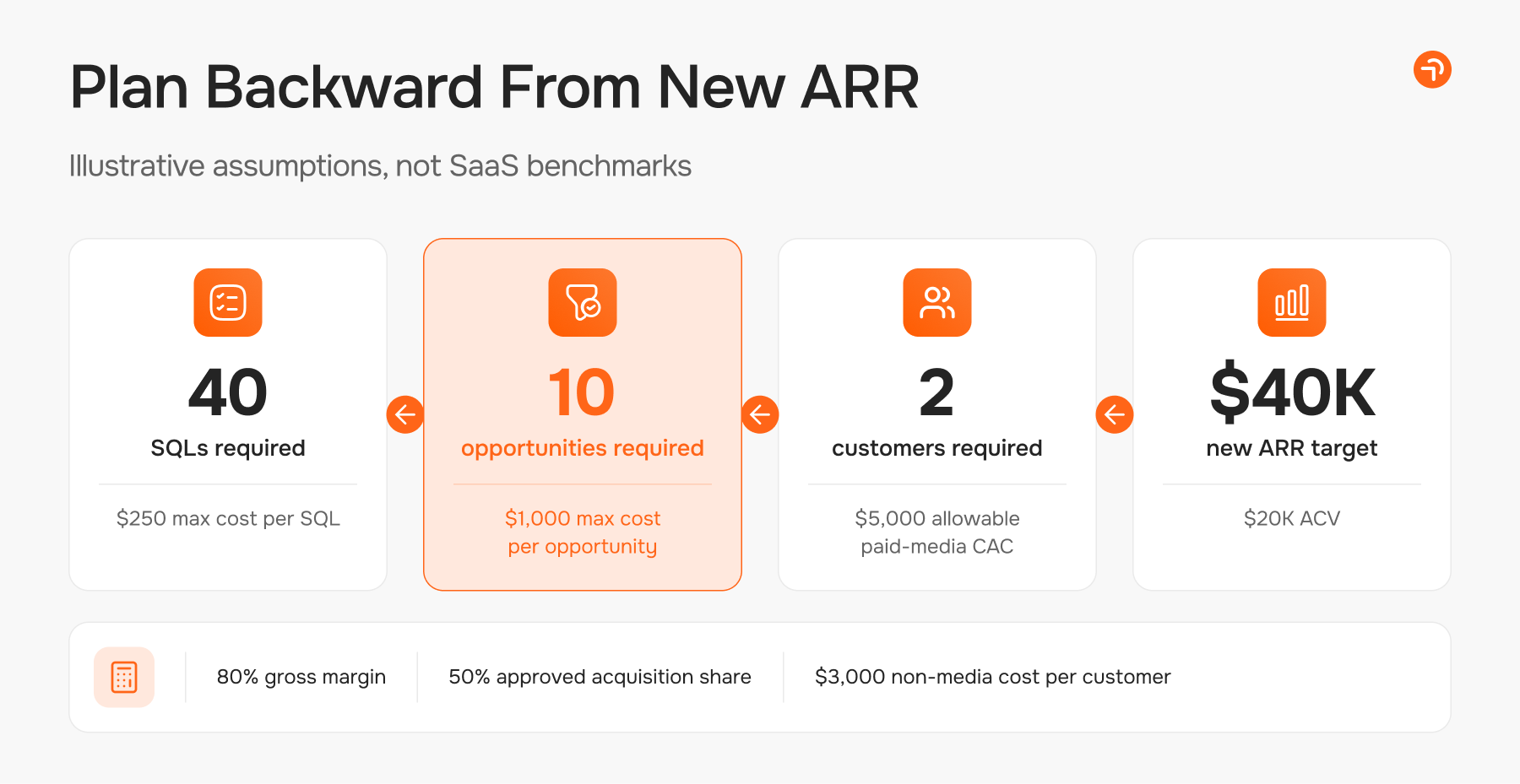
Treat these outputs as planning thresholds. If historical cost per SQL is $700, shifting another 10% from LinkedIn to Google will not close the gap by itself. The company may need higher conversion, stronger retention, better sales progression, a higher ACV, or a different offer.
Run the model with the company’s own stage conversion rates. Use a mature historical cohort where possible, and keep sourced and influenced pipeline separate when calculating pipeline-to-spend. If the math requires forty SQLs but sales can work only fifteen with a credible response time, media is no longer the only constraint. The SaaS PPC budget, routing capacity, and revenue target need to be planned together.
When $10K Is Too Small or Too Risky
A $10K B2B SaaS advertising budget may be premature when:
- Commercially relevant search demand is too limited to spend without weakening intent;
- Expected traffic produces too few qualified events for a useful review;
- The ICP, positioning, website, demo flow, or trial path is not yet validated;
- Sales cannot define an SQL, return rejection reasons, or follow up quickly;
- Allowable paid-media CAC is materially below the cost implied by current conversion rates.
Run a sanity check before launch:
Label every input as historical data, an external benchmark, or an explicit assumption. If the result is only a handful of SQLs, concentrate the paid media budget allocation further or delay expansion.
Where the $10K Should Go
Put the largest share where intent is visible, use the second-largest share to reach a precise ICP, cap retargeting at what the audience can absorb, test one additional channel, and keep the final $1,000 uncommitted. That concentration is the operating core of this paid media strategy for B2B SaaS.
Campaign structure will not protect the budget if every ad sends buyers to the same generic page. Search intent, audience awareness, proof, form length, and CTA should remain consistent through the conversion path. A SaaS landing page design agency can help when message match and conversion friction cannot be solved internally.
Google Search: $4,500 for Demand Capture
Concentrate the Google Ads budget for SaaS on brand defense, high-intent non-brand category terms, use-case or problem searches, and one controlled competitor campaign. Keep those intents separate so brand conversions do not make non-brand acquisition look more efficient than it is. High-intent keywords can use a direct demo or trial path; comparison queries often need competitor proof, implementation detail, or a dedicated page.
Google manages most campaigns through average daily budgets. Google’s current budget guidance says daily spend may reach twice the average daily budget, while the monthly charging limit is generally 30.4 times that average. A $4,500 monthly allocation therefore equals roughly $148 per day across the funded campaigns.
In our broader Google Ads program for ReliableSite, we combined tracking and account restructuring with search-term optimization, Performance Max, creative testing, bidding changes, and budget reallocation. From October to May, the share of purchases from non-branded campaigns grew more than fourfold, while branded campaign spend fell 64%. The mechanism matters more than copying the percentages: separate brand from non-brand, then move money according to incremental acquisition evidence.
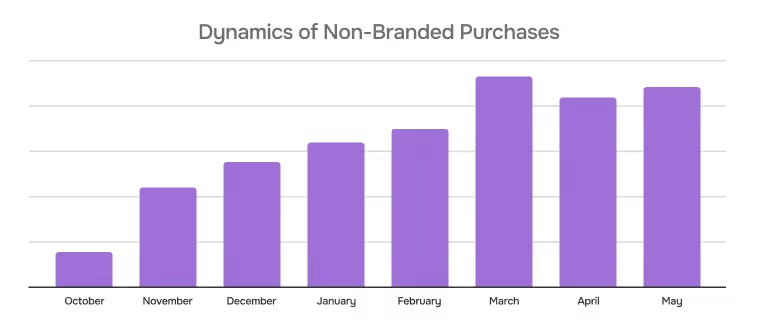
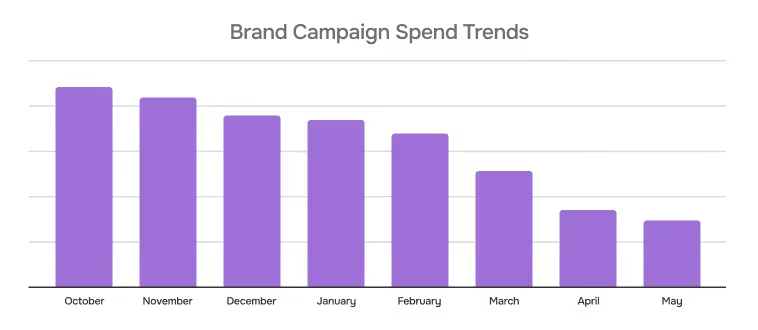
Scale when search terms remain commercial and mature cohorts meet cost-per-SQL and cost-per-opportunity limits. Rebuild when weak queries, mismatched landing pages, or rejected leads continue after the diagnostic window. A SaaS PPC agency is most useful when structure, bidding, tracking, and landing-page economics need to be solved together.
Read the first evidence in layers. Search terms and conversion validity can expose waste within days; SQL quality and opportunity creation require the normal CRM lag. Before moving the B2B SaaS paid media budget, compare brand and non-brand separately, review rejection reasons, and check whether Google Search has room to absorb more spend without broadening into weaker intent.
LinkedIn Ads: $2,500 for Focused Demand Creation
Use the LinkedIn Ads budget for SaaS for one priority ICP, one buying problem, one offer, and two or three creative concepts. Exclude customers, employees, irrelevant company sizes, and accounts sales cannot serve. Match the conversion path to readiness: early audiences may respond to a case study or assessment, while demo offers require stronger existing intent.
LinkedIn’s current pricing documentation explains that cost varies with the objective, bidding strategy, audience competition, and ad relevance. Use our LinkedIn Ads benchmarks for B2B SaaS as diagnostic context, then validate the channel through account fit, sales acceptance, and opportunities.
For Mixpanel, the account contained seven regional groups, more than 60 campaigns, inconsistent UTMs, and limited visibility into Salesforce lead quality. The wider program reorganized the account, standardized tracking, connected Lead Gen Forms to source data, introduced weekly quality reviews, and built remarketing audiences. In the first six months, qualified leads increased 164% while CPL fell 67%, even as total spend decreased.
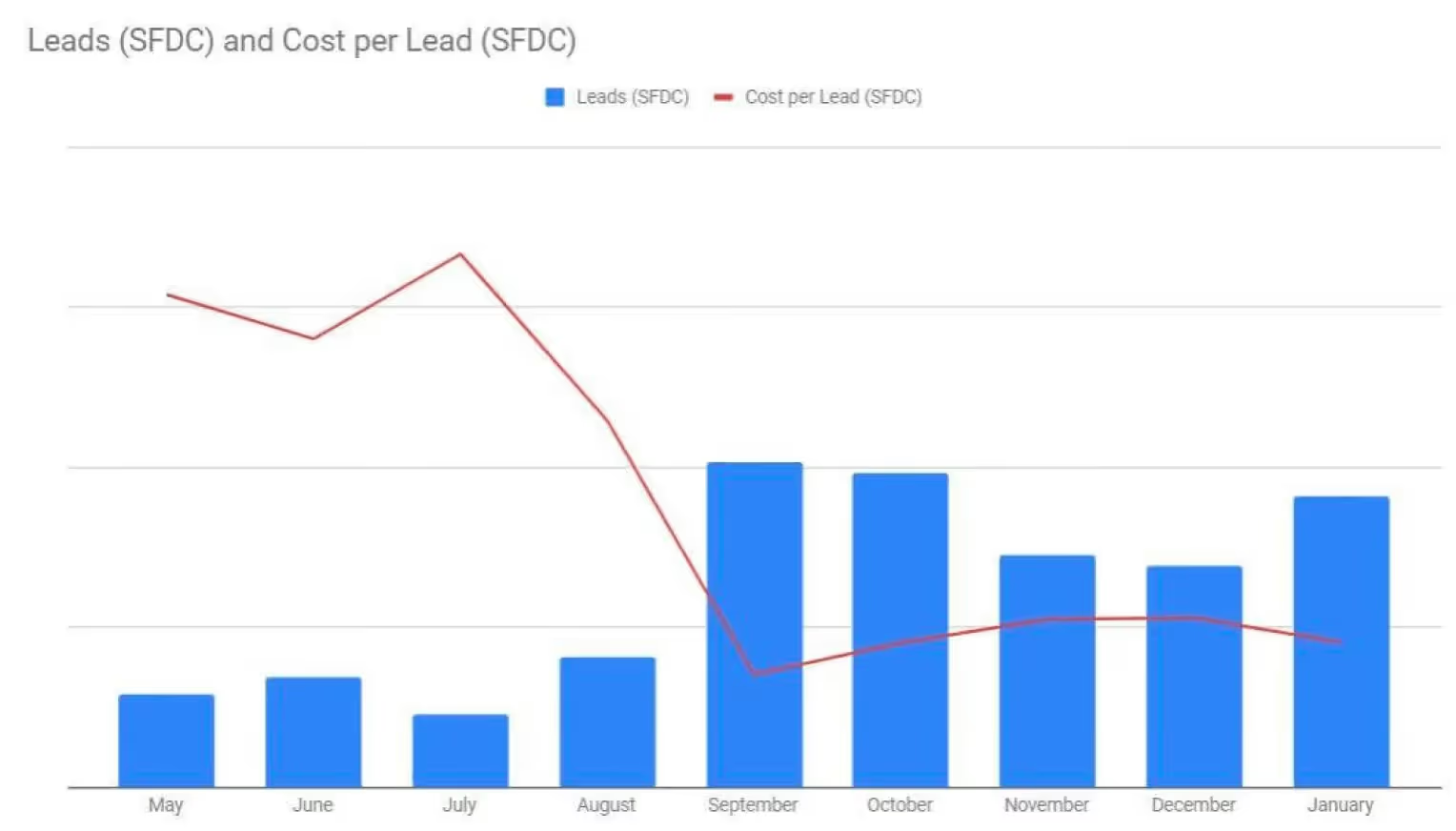
Scale when the audience produces accepted SQLs, buying-group progression, or opportunities that Search is not reaching. Rebuild when efficient form fills fail the ICP or sales-acceptance test. A paid social agency for SaaS should connect audience design, creative testing, and CRM quality instead of optimizing impressions in isolation.
LinkedIn needs enough continuity for repeated exposure and sales feedback. Do not reset the audience, offer, and creative at the same time after one expensive week. First confirm that the intended companies and roles are engaging; then examine qualified conversions and opportunity influence. That sequence lets the B2B SaaS paid media strategy learn without protecting a weak campaign indefinitely.
Retargeting: Up to $1,000 for Warm Demand
Segment retargeting by the behavior that created the audience. Pricing and comparison visitors may need implementation clarity or competitive proof; product visitors may need a relevant case study; content readers usually need a stronger bridge before a demo ask. Exclude customers, recent converters, job seekers, and low-value sessions. Cap the budget when frequency rises without qualified progression.
Use Google, LinkedIn, or Meta according to audience size and the next message the buyer needs. The expected learning is whether warm visitors return, consume stronger proof, and progress at a better rate than comparable non-retargeted traffic. Do not force the full $1,000 into small lists. When delivery becomes repetitive, protect useful coverage and move the unused SaaS PPC budget back to flex.
Fit-Based Channel Test: $1,000 for One Hypothesis
Choose the channel from buyer behavior:
- Microsoft Ads fits when Google already generates qualified search demand and the team wants incremental inventory. Microsoft Advertising supports LinkedIn profile targeting by company, industry, and job function.
- Reddit Ads may fit technical products whose practitioners research the problem in identifiable communities.
- Meta Ads is more plausible for broad SMB or PLG audiences, strong creative, and shorter conversion paths than for a narrow enterprise list.
Define the audience, offer, landing page, maximum diagnostic spend, review date, and stopping rule before launch. Test one commercial question at a time. Scale only when the channel produces credible ICP fit and a downstream quality signal.
The first review should answer a narrow question, such as whether Microsoft Ads can extend qualified Google Search demand or whether Reddit can reach technical evaluators missed elsewhere. Clicks alone do not answer it. Require a valid conversion, account-fit evidence, and sales feedback before a test competes for recurring budget.
Flex Reserve: $1,000 for Evidence
Do not assign the reserve on day one. Use it for an underfunded high-intent search cluster, new creative for a promising LinkedIn audience, landing page testing, or the experiment producing the strongest opportunity signal. If nothing has earned more budget, leaving the reserve unspent is a valid decision.
Three Alternative Allocations by SaaS Motion
Change the B2B SaaS paid media budget when the buying motion clearly favors Search, account-based reach, or faster product activation. Our Google Ads vs LinkedIn Ads for SaaS comparison provides more context on platform fit by intent, ACV, and sales cycle.
Search-Led SaaS
Use this model when category demand and high-intent keywords are already visible. The $6,000 Google Ads budget for SaaS supports category, use-case, competitor, and brand campaigns, while LinkedIn provides a narrower demand creation layer. As an Aimers planning heuristic, the model is often easier to justify below roughly 10,000–15,000 ACV, but search volume and conversion efficiency matter more than the threshold itself.
Enterprise SaaS
Use this model for a limited account universe, a multi-role buying committee, and a long evaluation cycle. The $4,000 LinkedIn Ads budget for SaaS supports account and role coverage; $3,500 in Search captures active research. An ACV above roughly $25,000 makes premium media easier to absorb, but sales capacity, reachable audience size, and account progression still decide whether the allocation works.
PLG or SMB SaaS
Use this model when buyers can trial, activate, or purchase with limited sales involvement. Google retains $4,500 for demand capture; retargeting rises because more visitors and trial users create behavior-based audiences. Test Meta Ads, Reddit Ads, or Microsoft Ads according to research behavior. If activation or retention is weak, repair the product journey before expanding the B2B SaaS advertising budget.
These Aimers planning models should flex with the evidence. Keep the baseline paid media budget allocation when the data does not clearly support a different motion.
The Tracking Setup Required Before Launch
Do not launch until the team can trace a paid conversion through qualification, opportunity creation, and revenue. A useful B2B SaaS paid media strategy needs a feedback loop that connects media with the CRM:
Google’s enhanced conversions for leads documentation explains that the setup supplements offline conversion imports with hashed first-party lead data to improve measurement and bidding. Return meaningful stages such as qualified leads, opportunities, or customers, rather than treating every CRM status as an equal conversion.

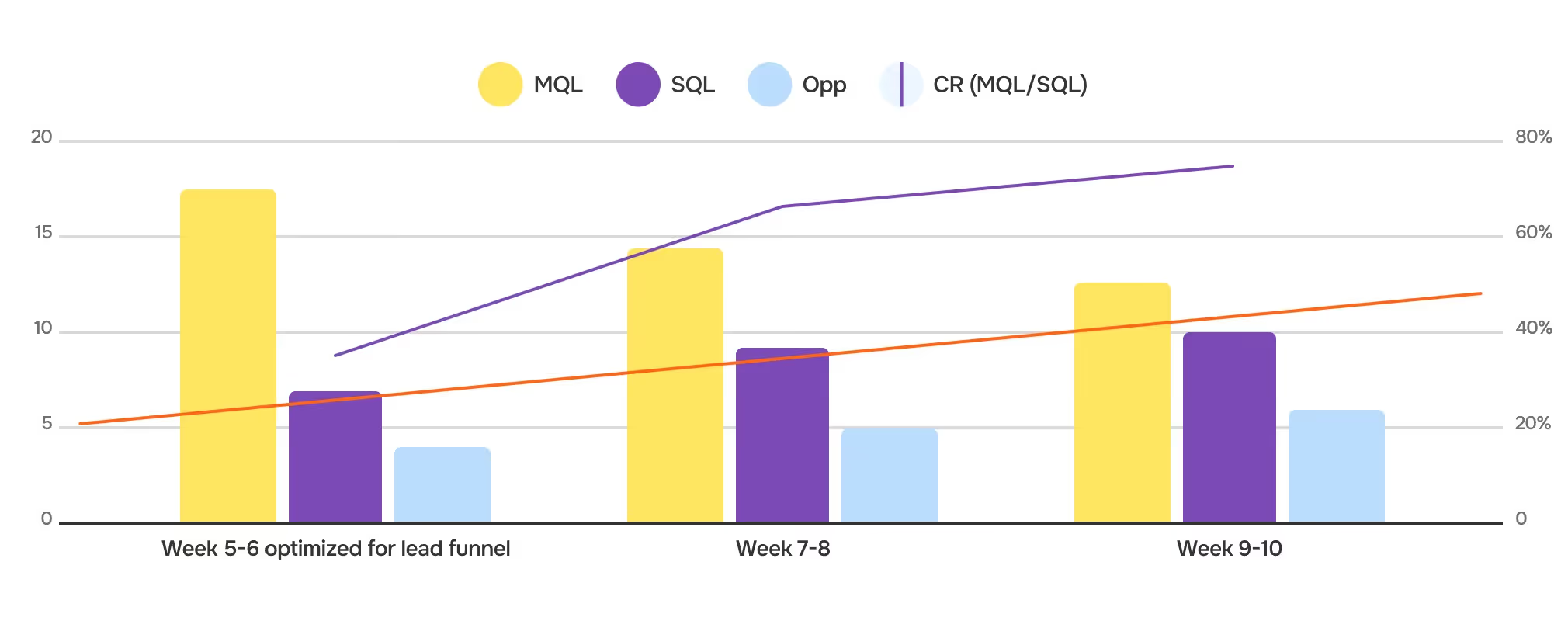
Our work with Cloudvisor shows the feedback loop in practice. The broader program mapped Form → MQL → SQL → Opportunity → Closed-Won, integrated HubSpot outcomes with Google Ads, refined qualification, and moved optimization toward higher-value stages. Four weeks after full-funnel implementation, MQL-to-SQL conversion was 130.3% higher than in the implementation week, while Opportunity volume increased 50%.
Before launch, submit each form, confirm each event fires once, check that UTMs and click IDs reach the CRM, move a test record through the lifecycle, and verify that selected outcomes return to the platform. If analytics and CRM reports cannot tell a consistent business story, assign an owner or involve a Google Analytics agency for SaaS before adding spend. Stable CRM integration and offline conversion imports are prerequisites for revenue-led optimization.
A 90-Day Operating Plan for the $10K Budget
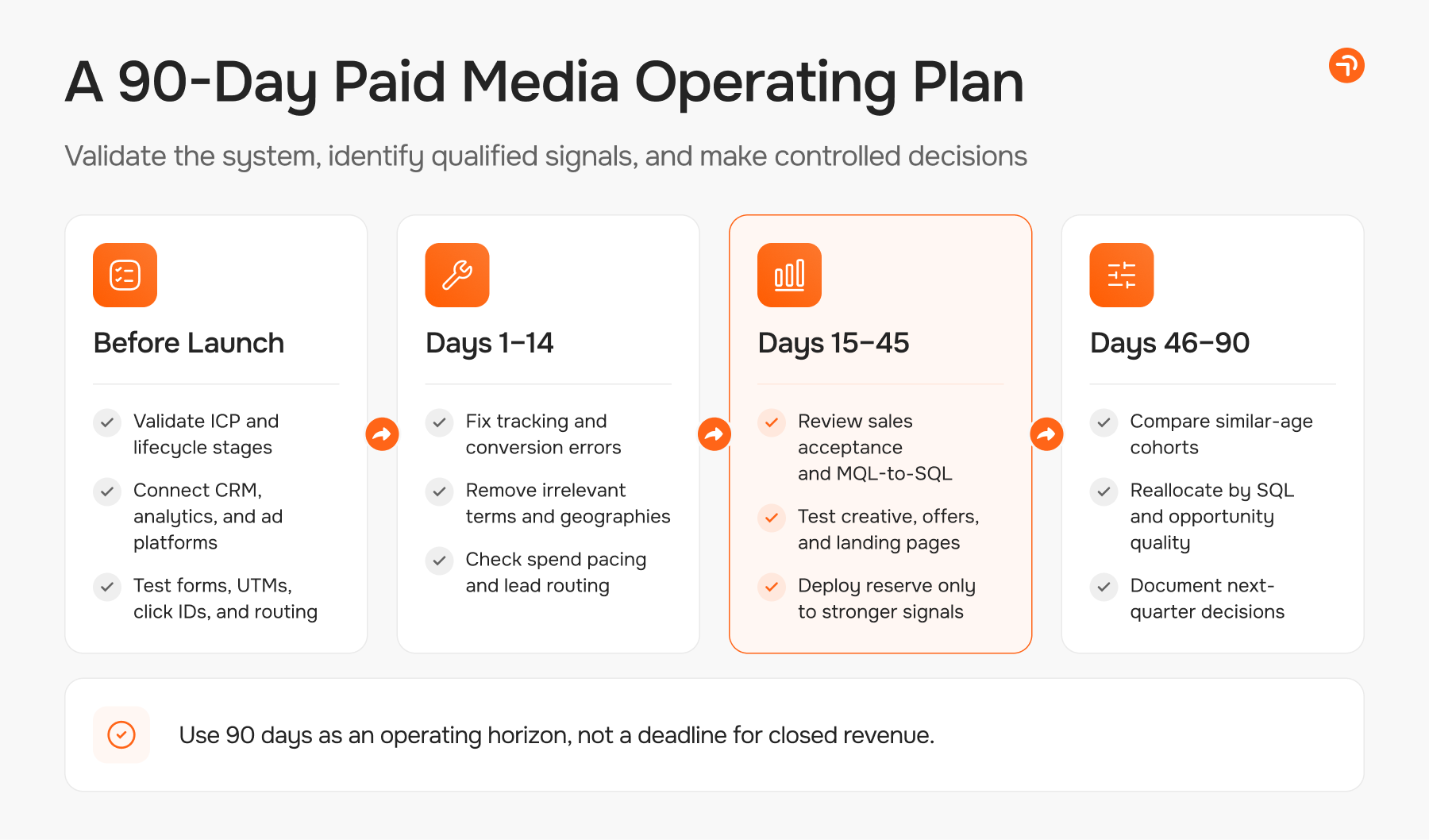
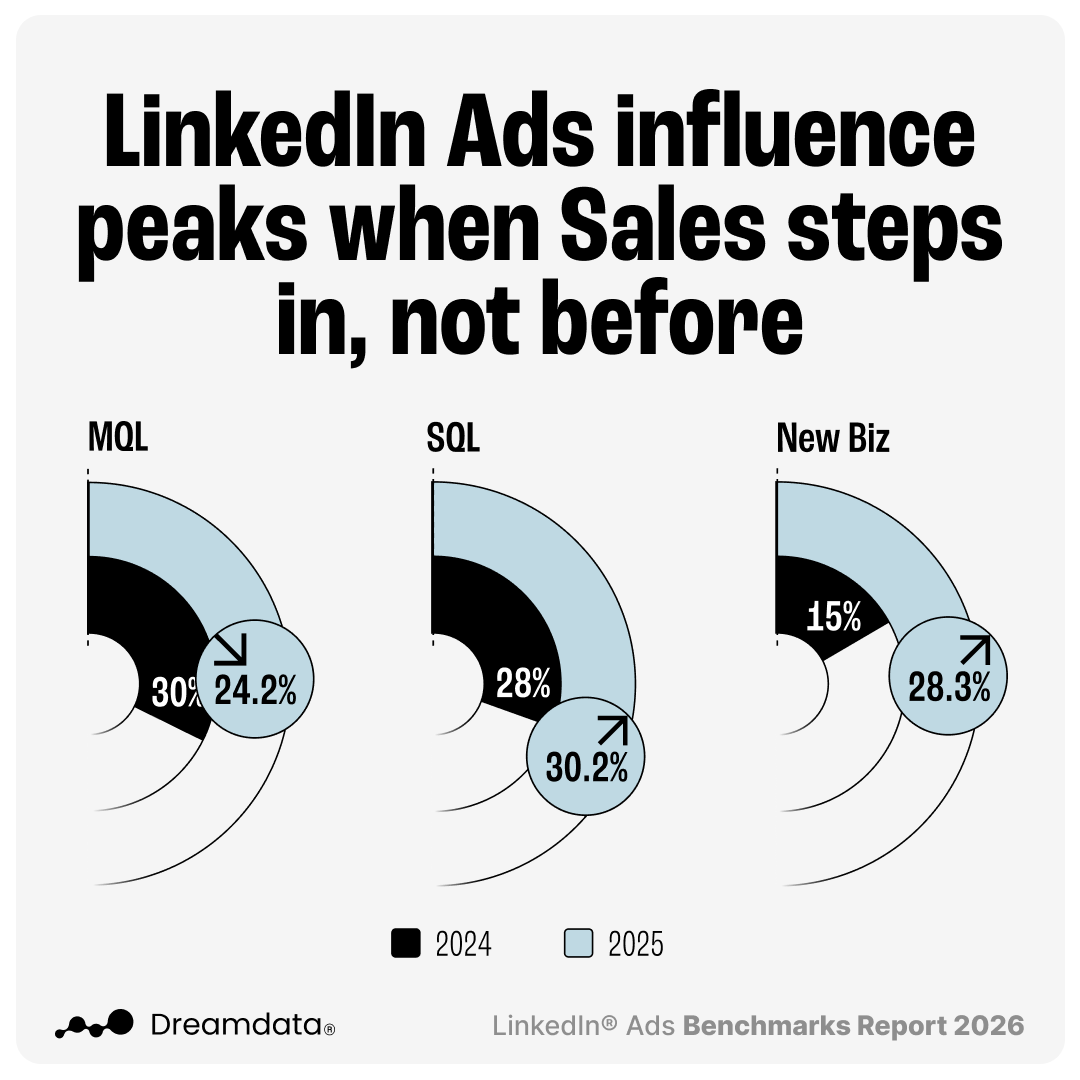
Use 90 days to validate the system, identify qualified signals, and make controlled decisions. It is an operating horizon, not a deadline for closed revenue. Dreamdata’s 2026 LinkedIn Ads analysis, built from more than 66 million sessions and 3.5 million customer journeys, found an average 281 days from first LinkedIn ad impression to revenue. That is a LinkedIn-specific interval within Dreamdata’s customer data, not a universal SaaS sales-cycle benchmark.
%20(1).png)
Before Launch: Make the Account Measurable
Confirm ICP, unit economics, lifecycle definitions, CRM integration, primary events, exclusions, and channel-specific landing paths. Test the chain through SQL and Opportunity. Do not launch if paid leads cannot be connected to qualification and pipeline.
Days 1–14: Fix What Is Clearly Broken
Review search terms, geography, audience fit, event firing, page behavior, routing, and budget pacing. Stop irrelevant queries, spam, duplicate conversions, and invalid locations. A small sample should delay channel verdicts, not obvious repairs.
Days 15–45: Look for Qualified Signal
Compare sales acceptance, MQL-to-SQL progression, rejection reasons, landing-page behavior, and account engagement alongside CPL. Run focused creative testing, landing page testing, audience refinement, and offer changes. Deploy the test or flex budget only when the receiving campaign has a stronger qualified signal.
Days 46–90: Reallocate and Set the Next Plan
Compare similar-age cohorts using cost per SQL, cost per opportunity, early qualified pipeline, and sales capacity. Return downstream outcomes through offline conversion imports, scale gradually where economics hold, and rebuild sources that produce activity without progression.
By day 90, the B2B SaaS paid media strategy should have validated tracking, clearer ICP signals, early cost ranges, documented rejection reasons, and a defensible next-quarter paid media budget allocation. Preserve cohort start dates so demand creation is not judged before the buying committee has had time to respond.
The deliverable is a decision record, not a victory slide: what the team learned, which assumptions failed, where the next dollar should go, and what still needs more time. That record turns a one-quarter test into a repeatable paid media strategy for B2B SaaS.
How to Measure and Reallocate Without Chasing Noise
Reallocate only when the data can distinguish delivery, conversion, qualification, and revenue performance. With a $10K monthly paid media budget, one expensive week or one additional SQL can move the averages sharply. Diagnosis should come before a large budget shift. The same discipline applies whether the next decision changes one campaign or the full B2B SaaS paid media budget.
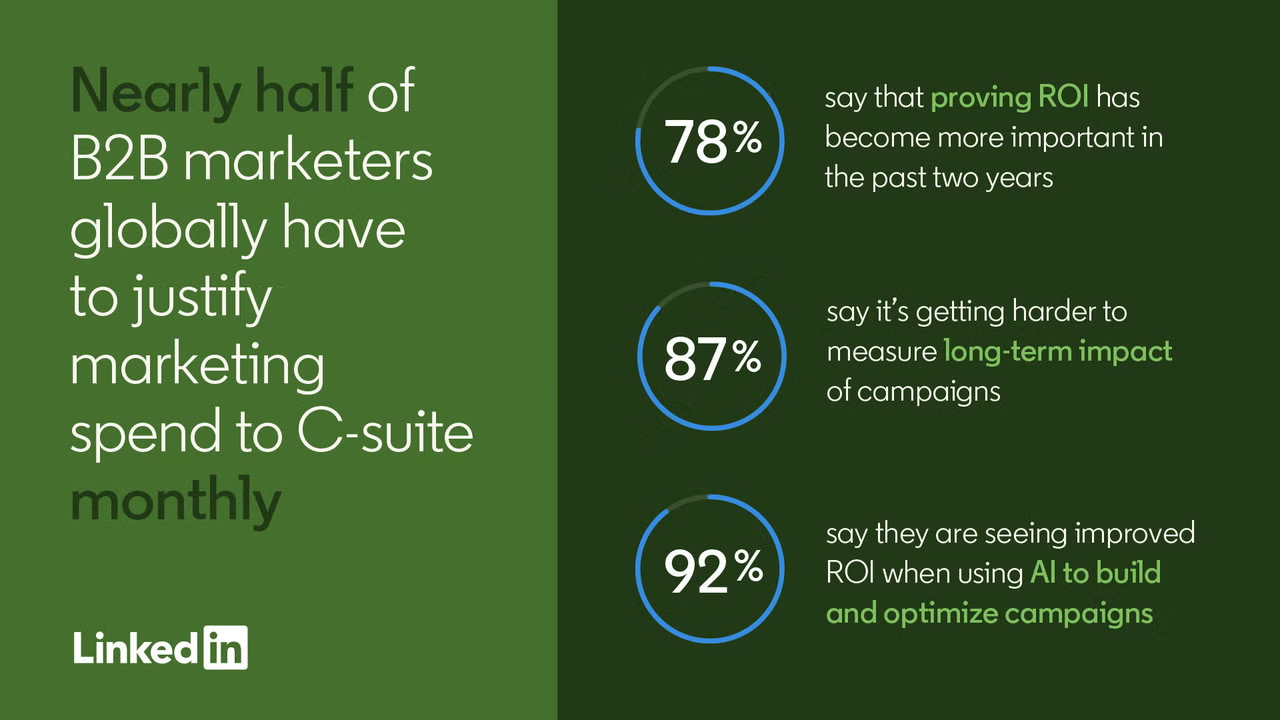
The pressure is real: in LinkedIn-commissioned YouGov research across 1,014 senior B2B marketers, 87% said measuring long-term campaign impact was getting harder. A layered reporting cadence keeps qualified pipeline visible and helps teams make current-quarter decisions without pretending mature revenue appears immediately.
Platform metrics and CPL are diagnostic. They show whether the ad earned attention and the page captured a response; they do not show whether the company bought. Our analysis of the state of SaaS PPC in 2026 explains the wider efficiency pressure. In a simple illustration, a $500 lead that creates an opportunity can be more efficient than a $150 lead that sales rejects.
Keep Sourced and Influenced Pipeline Separate
Attribution is the rule set used to assign credit for an opportunity or customer. Sourced pipeline covers opportunities that originated from paid media under the agreed CRM rule. Influenced pipeline covers opportunities that had a meaningful paid interaction but originated elsewhere. Report both, but do not add them together or present all influenced pipeline as paid-media revenue.
UTMs, CRM lifecycle data, sales notes, platform reporting, and self-reported attribution provide different pieces of the journey. Review sites, communities, AI tools, peer recommendations, and private conversations will still leave gaps. Attribution supports consistent decisions; it is not a perfect replay of buyer research.
Turn the Signals Into Budget Decisions
Use the target cost per SQL derived from unit economics as the baseline. The ranges below are Aimers operating guardrails, not industry benchmarks.
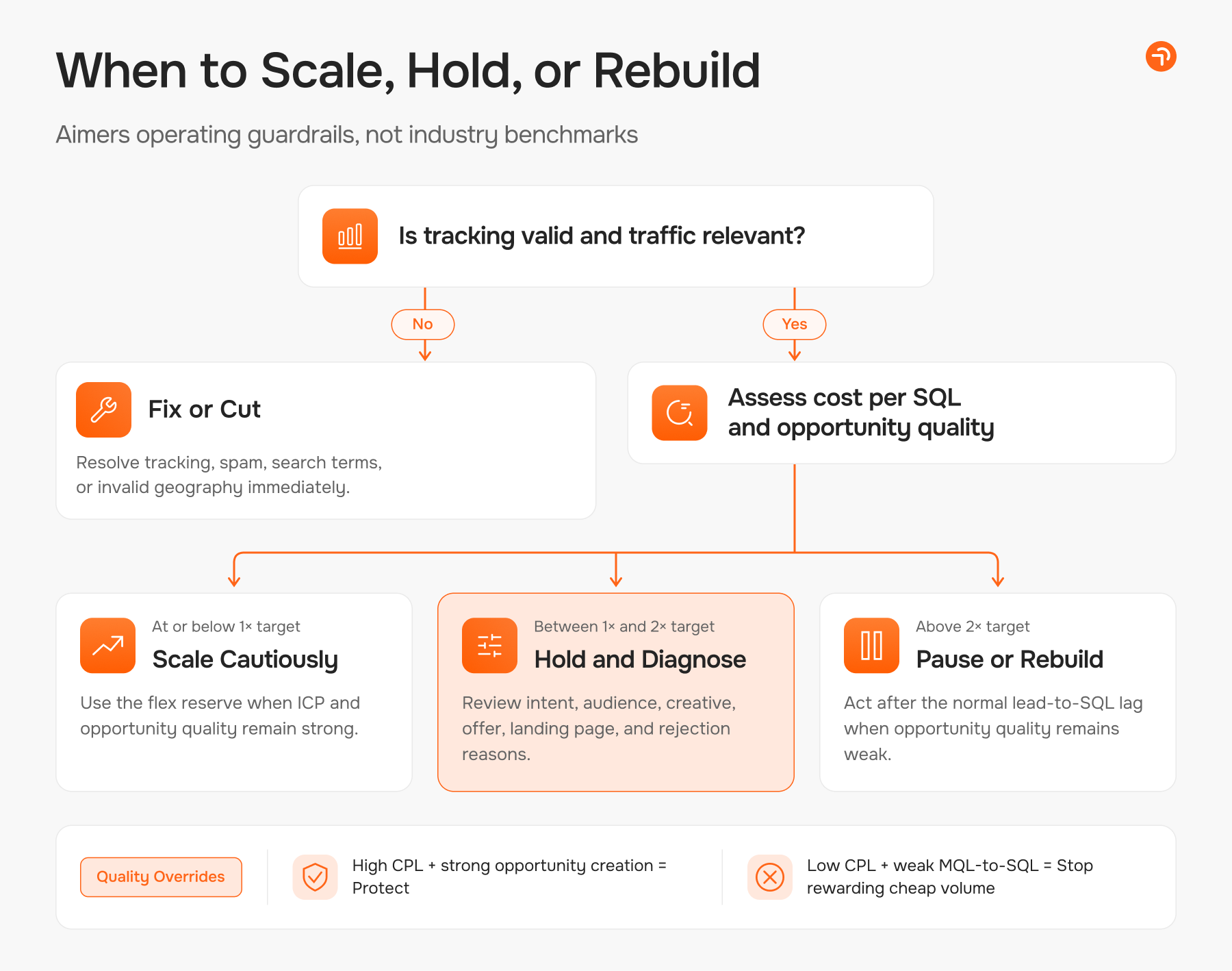
Scale above $10K only when mature cohorts meet cost-per-SQL and cost-per-opportunity limits, additional qualified demand exists, sales can absorb it, and CAC payback remains acceptable. A “Limited by budget” label only says a campaign can enter more auctions; it does not prove the marginal traffic will be profitable.
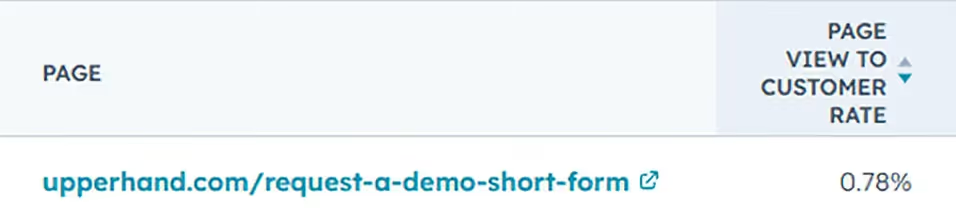
When traffic fits the ICP but the form, demo flow, trial, or follow-up underperforms, hold media spend and repair the path. A focused SaaS conversion rate optimization program can improve the economics without buying more clicks. For Upper Hand, a 50/50 test replaced a multi-step demo flow with a five-field form plus a qualifying question. Over three to four weeks, the page-view-to-customer rate rose from 0.17% to 0.78%, a 4.6× lift, while lead quality remained strong.

Pause expansion when the current funnel has no credible path to target CAC, quality is falling, tracking is unreliable, or sales cannot process more demand. Keep defensible brand, high-intent non-brand, or retargeting coverage if the economics support it. Before adding the next $1,000, name the constraint it should remove and the metric that will confirm the change.
Review the SaaS PPC budget as a portfolio, but make changes at the level where the evidence exists. A weak audience does not automatically invalidate LinkedIn, and one efficient brand campaign does not validate the whole Google account. Protect proven segments, isolate the failure, and move spend only after the receiving campaign has both economic headroom and capacity.
What Not to Fund With a $10K Monthly Paid Media Budget
A $10K B2B SaaS advertising budget cannot support every reasonable idea at once. Exclude initiatives that fragment the audience, conversion data, or sales feedback before they create a decision-quality signal:
- Cold programmatic display without an account-based use case: broad reach and weak intent consume learning budget.
- Too many geographies: language, CPC, proof, competition, and sales coverage split the evidence.
- Multiple small LinkedIn audiences: too many titles, industries, company sizes, and offers leave every cell underfunded.
- Broad awareness video without a downstream plan: reach and completion rates need a defined audience, next step, and account signal.
- Premature Performance Max expansion: automation needs clean goals, CRM stages, and reliable downstream feedback.
- A new channel every month: constant resets prevent cohorts from maturing and make sales feedback harder to interpret.
These are sequencing decisions, not permanent channel verdicts. The B2B SaaS advertising budget should first fund visible intent, deliberate ICP reach, conversion support, and one useful experiment.
Build a $10K Paid Media System You Can Defend
A defensible B2B SaaS paid media strategy connects every dollar to buyer intent, funnel progression, and revenue economics. The split provides a starting point; the operating system comes from CRM feedback, qualified pipeline, explicit thresholds, and the discipline to leave money unspent when no campaign has earned it.
If your team cannot show which campaigns create SQLs, opportunities, and sustainable customer acquisition cost, our PPC audit services can review allocation, campaign structure, targeting, search terms, landing-page leaks, analytics, and CRM data. The output should make the next decisions clear: what to protect, repair, test, and stop.
That clarity turns a $10K monthly paid media budget from a collection of percentages into a repeatable B2B SaaS paid media strategy.
FAQs
Yes, it can support focused acquisition and useful learning when the company has a validated ICP, a measurable conversion path, reliable CRM stages, and unit economics that support paid acquisition. It may be insufficient when qualified events are rare, CPCs are unusually high, or the team spreads the B2B SaaS paid media budget across too many markets and channels.

Our baseline B2B SaaS paid media strategy assigns $4,500 to Search and $2,500 to LinkedIn Ads. The remaining $3,000 covers up to $1,000 for retargeting, $1,000 for one fit-based test, and $1,000 in reserve. Adjust the Google Ads budget for SaaS and LinkedIn Ads budget for SaaS according to demand, ACV, sales cycle, and pipeline quality.
No. This model treats $10,000 as net media spend. Agency or internal labor, creative production, landing pages, analytics tools, and other operating costs sit outside it. If $10K is the all-in amount, subtract those costs first and build the paid media budget allocation around what remains.
Use cost per SQL, cost per opportunity, sourced and influenced pipeline, win rate, paid-media CAC, CAC payback, ACV, and closed revenue from mature cohorts. CTR, CPC, landing-page conversion rate, and CPL remain diagnostic metrics; they should not overrule stronger downstream evidence.
Use 90 days as an operating horizon, not a promise of closed revenue. Validate tracking and delivery in days 1–14, assess qualified signals through days 15–45, and consolidate or rebuild in days 46–90. Continue monitoring long-cycle cohorts until enough opportunity and revenue data has matured.
October 7, 2026
October 6, 2026

.avif)

