

YouTube Ads Best Practices for SaaS & B2B in 2026

March 18, 2026

The high-cost and complex setup required to produce results can scare off product teams considering video ads on YouTube. At the same time, YouTube is the second largest advertising platform after Google, with revenue of $36.1 billion in 2024 and a monthly audience of 2.7 billion users. However, it's important to note that more than 70% of impressions are generated through algorithm recommendations. In other words, the platform shapes demand rather than working with it.
At Aimers, we primarily work with the SaaS and B2B sectors. In this article, we will discuss which YouTube advertising best practices bring the best results and where to implement them in your marketing strategy.
YouTube Ad Formats: Functional Characteristics and Use Cases for SaaS
YouTube offers several advertising formats with unique characteristics. In the table below, we have listed their characteristics and features in the context of B2B SaaS.
Using the wrong format can waste your budget and hinder your strategy's performance metrics. For teams figuring out how to use YouTube for advertising, format selection is the first structural decision. In this article, we'll provide tips on selecting the most effective format for your product. For more recommendations, check out our other article, which discusses the best practices for video marketing in detail.
You can also check out examples of the best video ads for SaaS, as well as LinkedIn video ad examples.
Audience Targeting for B2B SaaS on YouTube
A workable YouTube advertising strategy starts with targeting discipline, not with creative volume. YouTube has a wide audience and a relatively high cost per contact in the B2B segment. When targeting a professional audience, CPM ranges from $5-10 and above, which makes Google Ads cost an important benchmark when comparing YouTube against other paid channels.
The goal of targeting is not to reach as many people as possible, but to narrow the audience down to those who are actually in the process of researching solutions in your category, so as not to waste your budget on everyone else.
However, YouTube does not offer direct targeting by job title or company, as LinkedIn does. The most useful YouTube advertising tips in B2B SaaS therefore focus on combining intent and behavioral signals. Therefore, targeting accuracy is achieved through a combination of behavioral signals.
Custom Intent: Targeting Users with Active Search Intent
Custom Intent allows you to reach users based on their recent Google search queries:
- Competitor names
- Category queries
- Non-branded keywords
In fact, you can set up impressions for an audience that is already looking for a solution in your category but does not yet know about your product. Therefore, it is not necessary to spend large amounts of money on clicks for the most popular queries. Custom Intent on YouTube allows you to pay tens of times less per view while targeting the same audience. For teams looking to improve Google Ads efficiency across channels, this is one of the clearest ways to extend search intent into video. It is the most accurate and cost-effective tool for cold B2B audiences on YouTube.
In addition, it would be useful to use placement targeting for specific YouTube channels that your target audience regularly watches. These could be channels with popular industry conferences or simply channels of opinion leaders. This allows you to run ads for your product on those channels that already have a relevant audience.
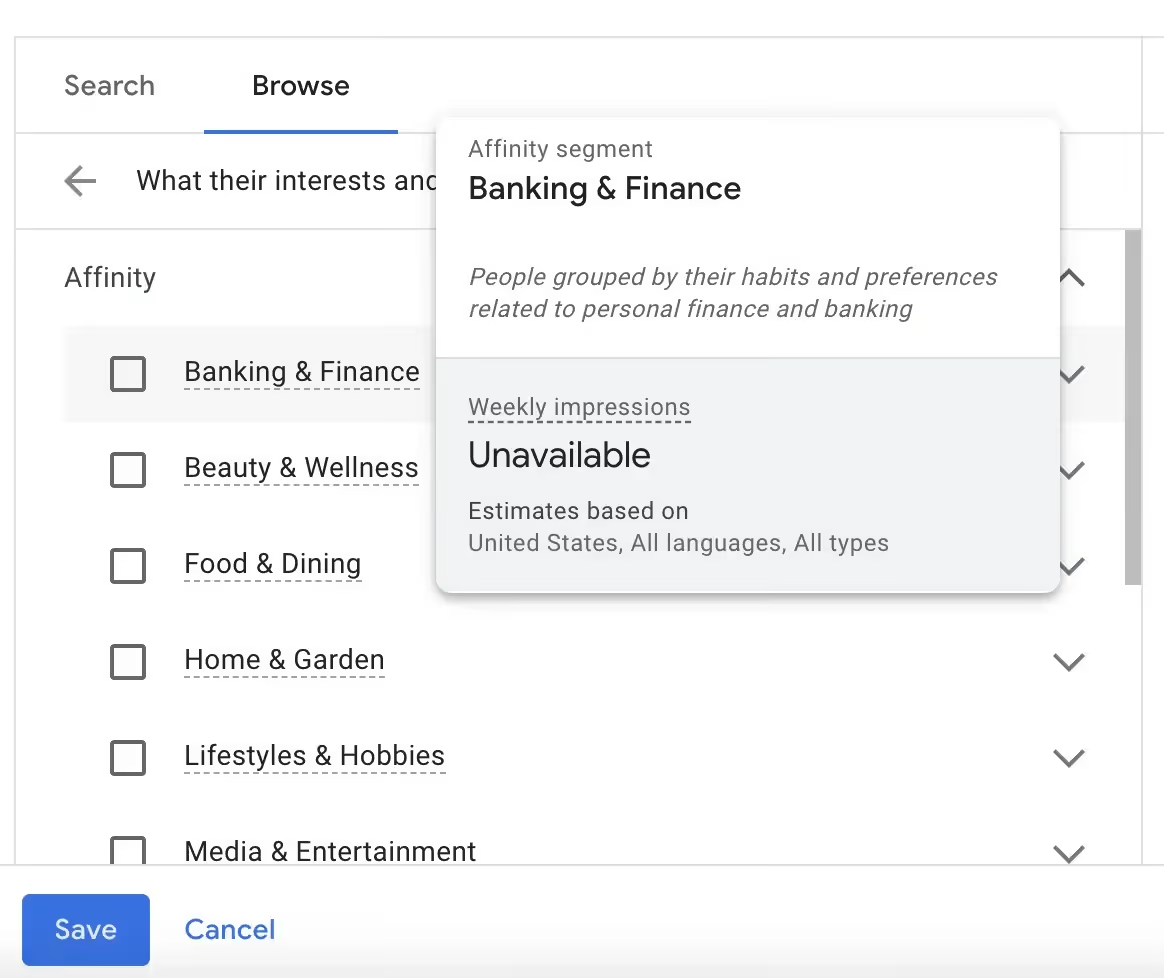
But avoid Affinity Audiences and Google's automatic recommendations. They optimize reach, not relevance. In a B2B context, this means wasting your budget on non-targeted audiences.
Remarketing: Targeting a Warm Audience
In B2B SaaS, any serious YouTube ads strategy needs a dedicated remarketing layer rather than a single broad audience. Cold targeting builds an audience. Remarketing converts it. This is important for B2B SaaS because the purchase decision cycle is longer in this sector. Most users do not convert on first contact.
Remarketing on YouTube is based on three types of audiences, each of which reflects a different level of familiarity with the product:
- Website visitors by page. A user who has opened a pricing page is at a different point in the decision-making process than someone who has read a blog article. Segmentation by URL allows you to show different ads depending on which section of the site was visited: pages with prices, demo requests, or documentation are signals of high intent that justify a direct conversion CTA.
- Audiences by video viewing depth. Google Ads allows you to create audiences based on what percentage of the video the user has watched (25%, 50%, 75%, or 95%). Those who watched to the end can be shown the next step in the funnel: demo, case study, conversion offer. Those who watched 25% are still in the stage of getting acquainted with the product, and pressure to convert is premature.
- Customer Match. Uploading your CRM database to Google Ads allows you to work with contacts who are already familiar with the product: leads who did not convert, webinar participants, trial users. This is also where a PPC audit services team can spot weak audience logic and missed retargeting opportunities faster than an internal review. This is the warmest segment within YouTube campaigns – an audience that does not need to be told what the product is, but needs to be given a specific reason to take the next step.
Incorrectly configured targeting can consume a large portion of your budget. For instance, the Coefficient team, which offers a B2B SaaS tool for working with data in Google Sheets, spent up to 90% of their budget on "Optimized Targeting," a setting that enables Google to expand the audience beyond the specified segments. Consequently, the campaigns reached users who had never interacted with the brand. During the entire time this setting was enabled, only two install conversions were received at a cost of over $7,000.
After restructuring the strategy by disabling "Optimized Targeting," creating over 350 custom retargeting audiences for high-intent segments, and launching Demand Gen campaigns on YouTube, Gmail, and Discovery, the results changed dramatically:
- 1,500+ sign-ups
- 166% increase in conversion rate
- Two record-breaking quarters in a row
Campaign Structure by Funnel Stage
One of the core best practices YouTube ads in B2B SaaS is to separate campaigns by funnel stage from the start. Another way to spend most of your budget on YouTube Ads alone is to launch a single campaign for the entire audience at once without dividing it into funnel stages. The cold audience receives a conversion offer they are not ready to accept. Meanwhile, the warm audience sees the same awareness video they have already watched. As a result, you will have a high CPL and confusing attribution.
In B2B SaaS, structuring campaigns by funnel stage is not optional, but rather a basic requirement for effective channel use.
TOFU – Awareness and Funnel Entry
The goal at this stage is to reach an audience that is relevant but not yet familiar with the product, and direct them into the sales funnel. For many brands, this is where video marketing for SaaS starts making a measurable contribution to branded demand. Formats: Bumper ads and skippable in-stream ads for broad reach and display and demand generation for a presence on multiple platforms simultaneously. The success metrics for TOFU are qualified reach and completed views, not conversions.
One important effect of TOFU campaigns that is difficult to measure directly is that they generate branded demand, which manifests as branded searches. In our case study with Demio, a webinar SaaS platform, TOFU campaigns on YouTube, display, and demand generation, combined with SEO and social media activity, led to a 74% increase in estimated impressions for branded search queries.

MOFU – Consideration and Product Education
At this stage, Google video ads best practices are less about reach and more about message clarity and product education. The audience is already aware of the product's existence or is actively looking for a solution in the category. The task is to explain the value proposition, demonstrate functionality, and provide sufficient context for the next step. Formats: Skippable In-Stream and In-Feed Ads. CTAs at this stage are low friction: “Watch a demo,” “See how it works,” “Read the case study.”
BOFU – Conversion Campaigns for Warm Audiences
At this stage, you should focus on an audience that has already interacted with the brand, such as visiting the website, watching videos, or opening emails. The format is Demand Gen with a conversion offer. The CTA is direct: "Book a demo" or "Start free trial." This is where social proof comes in handy: customer logos, short testimonials, and specific results. In practice, this is also where a Conversion Rate Optimization agency can help align landing pages and offer framing with warm audience intent.
In the Demio case study mentioned above, we created bottom-of-funnel (BOFU) campaigns for two segments: users who searched for brand-related terms and users who had previously visited the website and were looking for solutions in the same category again. For the first segment, we used brand search campaigns to protect traffic from competitors actively bidding on the Demio name. For the second segment, we used Search Remarketing with increased bids. Display remarketing on YouTube and other platforms bolstered the brand's presence and brought back users who had not yet converted.

As a result, with advertising costs increasing by 60%, the number of customers grew by 110% and the cost of attracting a customer decreased by 24%.
Why Funnel Stage Isolation Matters
Among the most consistent YouTube ads best practices for SaaS is keeping TOFU, MOFU, and BOFU campaigns structurally separate. The funnel structure solves the problem of message relevance. It also allows you to correctly evaluate the effectiveness of each stage according to relevant metrics. With this structure, you can manage the frequency of impressions without overlapping audiences and scale what works without diluting optimization signals. YouTube campaigns are most effective as part of a comprehensive media mix, with Google Search and LinkedIn, rather than in isolation. This is one reason many SaaS brands prefer working with a SaaS digital marketing agency that can manage channel interplay instead of optimizing each platform separately.
Video Creative Requirements for B2B SaaS
In B2B SaaS, YouTube creatives determine whether the platform builds attention or wastes impressions. Google claims creative quality accounts for 70-80% of a YouTube campaign's effectiveness. We see no reason not to believe them. In a skippable environment, this means you have exactly five seconds before the "Skip" button appears to convince viewers to stay.
The First 5 Seconds: Hook, Brand, Retention
Most YouTube video ads best practices start with the same principle: the first five seconds decide whether the viewer stays. Ads in which the brand appears before the “Skip” button show a 40% higher view-through rate compared to those where the brand appears at the end. The principle is easy to spot in many best Google Ads examples, where brand recognition happens early without interrupting the hook.
An unexpected sound, movement, or visual transition at the four-second mark can reduce the skip rate by 15–25%.
For B2B SaaS, the hook must be ICP-specific. Strong creative advertising ideas video execution starts with role-specific pain points rather than generic brand messaging. Addressing a specific role and its tasks is more effective than making a general brand statement. The audience must recognize themselves within the first few seconds; otherwise, they will have no reason to continue watching.
Audio, Captions, and Accessibility
Unlike Facebook, YouTube viewers often watch videos with the sound on, especially on connected TVs (CTVs). However, approximately 85% of mobile YouTube views occur without sound. The optimal approach includes the following:
- Subtitles for all speech
- Text overlays for key messages
- An audio track that tells a complete story for viewing with sound
- Carefully selected music that increases ad recall by 18%, compared to videos with mismatched or generic sound
YouTube Shorts: Separate Creative Logic
Shorts require a different production approach, rather than adapting existing content. In the Shorts feed, viewers decide whether to watch or scroll in less than two seconds, compared to five seconds for standard in-stream formats. A video that starts with a title card, logo, or slow intro will be mentally rejected, even if it cannot be skipped. Technically, the video will play, but the viewer will have already switched their attention elsewhere.
The 9:16 format is a must for Shorts. Many digital marketing video ads examples that perform well in vertical feeds follow this same pattern: immediate motion, fast context, and zero wasted intro time. A native style without corporate polish, featuring fast editing and text overlays, consistently outperforms repurposed landscape content. According to available data, native creative content for Shorts has a completion rate three times higher than repurposed horizontal content.
Campaign Optimization and Scaling
YouTube campaigns do not convert directly, and CPL does not appear in the report. This makes you want to shift the budget back to Search. But this is the wrong approach to evaluating the effectiveness of YouTube Ads. YouTube influences the pipeline through Search, brand demand, and decision-making speed, and this contribution is only visible if you know where and how to measure it.
How to Read Performance Signals on YouTube
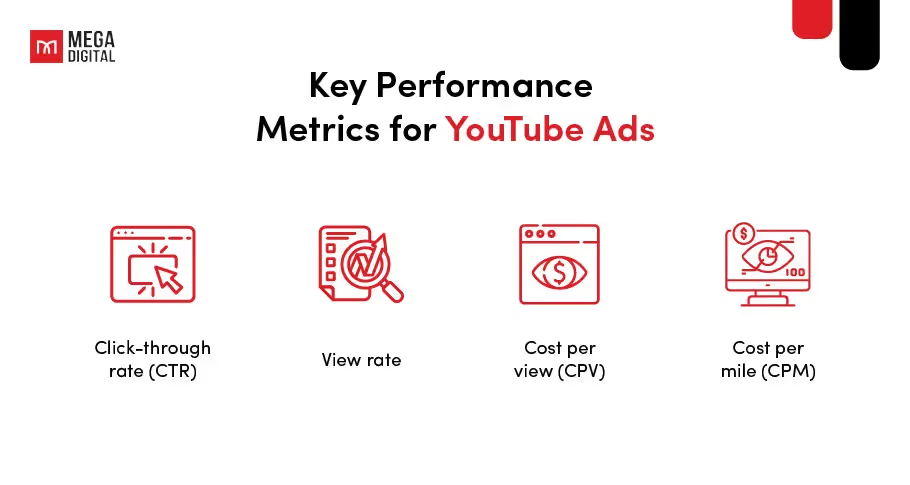
YouTube does not provide direct attribution based on the last-click model–most of the channel's impact on the pipeline is visible indirectly: through branded search, decision-making speed, and reduced CPL in other channels. Therefore, campaign evaluation is based not on a single conversion metric, but on a system of signals, each of which indicates a specific level of the problem.
View Rate (VTR)
The percentage of views in which the user watched the video for 30 seconds or until the end (whichever comes first). For skippable formats, this is the main indicator of relevance: the viewer actively chooses whether to stay or leave.
The average value across the platform is 31.9%. In the Business & Finance and Science & Technology categories, which are closest to the B2B SaaS audience, the indicator is higher at 35.4%.
A VTR above 35% means that the creative and audience segment match – you can scale up. A VTR below 20% signals one of two things: either the first 5 seconds do not hold the viewer's attention, or the audience is irrelevant. Before changing the video, it is worth checking the placements and segments: often the problem is not with the creative.
CTR (Click-Through Rate)
The percentage of views that resulted in a click on the ad. The average CTR on YouTube is 0.65%. For B2B, it is 0.37%. The gap is explained not by the quality of the advertising, but by the nature of the channel: B2B buyers rarely click on ads at first touch, especially at the awareness stage.
A low CTR with a high VTR is not a failure. This is normal for TOFU campaigns: the audience watches, remembers, but is not ready to take action here and now. The problem begins when the CTR is low and BOFU campaigns have a warm audience – this is a sign of a weak CTA or a mismatch between the offer and the funnel stage.
CPV (Cost per View)
The cost of one counted view. The average CPV across the platform is $0.026. For B2B, it is $0.037. An increase in CPV without changes in the audience or bids is one of the first signs of creative fatigue: the algorithm continues to play the video, but the audience responds less favorably, and the cost of each view increases.
It is important to look at CPV in terms of dynamics rather than as an absolute value. If CPV has increased by 20-30% over 2-3 weeks with stable settings, it is time to rotate the creative or expand the audience segment.
CPM (Cost per Mille)
The cost of 1,000 impressions. The average value across the platform is $3.53, and for B2B it is $3.70. In niches with high competition for the B2B audience, such as healthcare, CPM reaches $7.10.
CPM reflects the cost of accessing an audience segment, not the quality of interaction with the ad. A high CPM with a narrow audience is normal if VTR and downstream metrics justify the costs. The problem arises when CPM increases and reach narrows: this is a sign of auction pressure or overly strict targeting restrictions.
Optimization order
Metrics are not equal in diagnostic value. It is worth optimizing your campaign in the following order: first the audience (VTR and CPM will indicate whether the impressions are going there), then the creative (VTR and CTR will show whether the video is engaging and motivating to action), and lastly the bids (CPV and CPM will indicate whether it makes sense to pay more for the current audience).
YouTube's Indirect Impact on Search Performance
The most underrated role of YouTube in the B2B SaaS media mix is its impact on the effectiveness of search campaigns. Although the channel does not convert directly, it builds awareness and trust, which manifest as brand searches and improved search metrics.
This has been documented in real-world cases. For example, an enterprise B2B SaaS company with several product lines launched YouTube campaigns to explain the value proposition of two solutions with low conversion rates in search. For the first solution, the click-through rate (CTR) in search increased, the cost per click (CPC) decreased, and the cost per lead (CPL) fell by 30%. Despite an increase in CPC due to competitive pressure, the conversion rate for the second solution more than doubled, and the CPL decreased by 25%.
The second case is a local B2B business. The YouTube campaign did not generate any direct leads for five months. When the campaign was stopped, the CPL of branded search campaigns increased by 47%. After restarting the YouTube campaign and adding Demand Gen, the CPL returned to its previous level and then decreased by 47% relative to the initial value.
Based on this, we can identify the following pattern: YouTube indirectly influences the pipeline, and this contribution only becomes apparent when the channel is turned off. When evaluating the effectiveness of YouTube campaigns for B2B SaaS, it is necessary to consider not only direct conversions from videos but also search metric dynamics during periods of channel activity and inactivity.
Creative Testing and Scaling Logic
The operational cycle for working with YouTube Creatives for B2B SaaS is based on several principles, and the same logic is used by many high-performing video marketing agencies when they scale creative systems beyond one-off tests.
The more video options, the better. Minor variations of a single video help reduce creative fatigue and maintain audience engagement. Using three, four, five, or more videos simultaneously is standard practice for campaigns that produce consistent results. Once a frequency of three or more impressions is reached for a single segment, rotation becomes mandatory. An increase in CPV without changes in targeting or the competitive environment is usually a consequence of creative fatigue rather than a problem with bids.
Successful campaigns are scaled by expanding audience segments, not just by increasing the budget for a single group. At the same time, YouTube costs can be significantly lower than commonly believed. In two documented cases, for example, YouTube expenses accounted for less than 5% of the clients' total advertising budgets and had a measurable positive effect on Search metrics.
FAQs
It happens, but that's not the channel's main role. In B2B SaaS, YouTube more often generates demand than leads to immediate leads. A user may see an ad, understand the value of the product, and then later perform a brand search or return through retargeting. When set up correctly, the channel stimulates growth in brand queries, improves CTR, and reduces CPL in search campaigns.

The cost depends on the audience and competition in the niche. The average CPV on the platform is about $0.026, and for B2B segments it is usually around $0.037. CPM is most often in the $3–7 range, but for narrow professional audiences it can be higher.
A combination of several audience signals is most effective. Custom Intent audiences based on search queries, placement targeting on industry channels, and retargeting website or video users are commonly used. This approach allows you to get closer to the audience's ICP even without direct targeting by job title or company.
The average view rate on the platform is approximately 31–32%. In categories close to B2B SaaS, such as Business or Technology, the rate is usually higher and can reach around 35%. If the VTR exceeds 35%, this usually means that the creative and the audience are well matched. A value below 20% often indicates a problem with targeting or the first few seconds of the video.
For the B2B SaaS sector, a 15-30 second video is usually optimal. This allows you to quickly explain the value of the product and hold the audience's attention before the “Skip” button appears. Longer videos can be used for educational content, but short ads tend to have higher view rates.





.png)