LinkedIn Thought Leader Ads for B2B SaaS: Examples and a Practical Launch Plan
November 18, 2026


Your next LinkedIn ad might already be on a customer’s profile. They’ve explained what changed after using your product, and your sales team wants more prospects to read it. Before you sponsor it, though, you’ll need a clearer plan than “the post did well.”
LinkedIn Thought Leader Ads let you sponsor an eligible public post with its author’s approval. Start with one audience and one campaign job, test three to five credible posts, then retarget engaged viewers and track the result in your CRM.
Before paying for more reach, we plan the follow-up: who speaks, what engaged readers see next, and how the result reaches the CRM.
Key Takeaways
- Authors must approve sponsorship of their posts.
- Standard image/video/document TLA lacks a separate CTA. Some accounts have newer options.
- Choose credible voices. Look for firsthand experience that buyers recognize, such as a workflow teardown or an implementation story.
What Are LinkedIn Thought Leader Ads?
LinkedIn Thought Leader Ads (TLA) are Sponsored Content ads that promote eligible public posts from individual LinkedIn members with each author’s permission. The member’s post supplies the creative; advertisers control campaign targeting, budget, placement, and reporting in LinkedIn Campaign Manager.
Page Sponsored Content uses a company identity. Member boosting lets individuals promote their own posts.Employee advocacy is organic sharing by staff; it becomes TLA when the company requests sponsorship and the author approves. A creator partnership adds commercial terms, but sponsorship follows the same approval process. Sponsored posts carry advertiser labeling.
How Thought Leader Ads Fit the B2B SaaS Funnel
TLA works best for awareness and consideration, before a direct-response ask. As a LinkedIn Ads agency for B2B SaaS, we plan the next offer alongside the post. Use TLA when buyers need education or credible proof.
Do not use TLA as a standalone demo campaign for cold audiences.
This LinkedIn Ads for SaaS sequence shows how to run Thought Leader Ads for an ideal customer profile (ICP):
Reserve budget for the next-step campaign, so engaged readers have an offer waiting.
LinkedIn Thought Leader Ads Requirements and Limitations
Platform rules for LinkedIn TLA setup verified on November 3, 2026.
Article-specific options: LinkedIn’s article guide lists Lead generation for standalone articles, not newsletters. Confirm availability.
Gradual rollout: Some accounts can add headlines, CTA buttons, destination links, and Lead Gen Forms to the sponsored version. LinkedIn’s marketing specifications still exclude documents and added headlines/CTAs, while current Help permits them. We follow Help here. Confirm availability in Campaign Manager.
4 LinkedIn Thought Leader Ads Examples for B2B SaaS
These official LinkedIn cases show TLA in a product launch, an event, a customer-video test, and a full-funnel program. For more formats, see our LinkedIn Ads examples for B2B SaaS.
LinkedIn-reported campaign results, not forecasts. Customer stories reviewed November 3, 2026.
1. Rippling: Customer Voices for an AI Launch
Rippling needed to reach C-suite leaders and functional heads for its AI launch. It mobilized more than 300 customers, amplified selected posts, and added creator video. LinkedIn reports 35% of TLA clicks from C-suite members and 5.8× ROI across the coordinated campaign, which used Conversions API (CAPI).
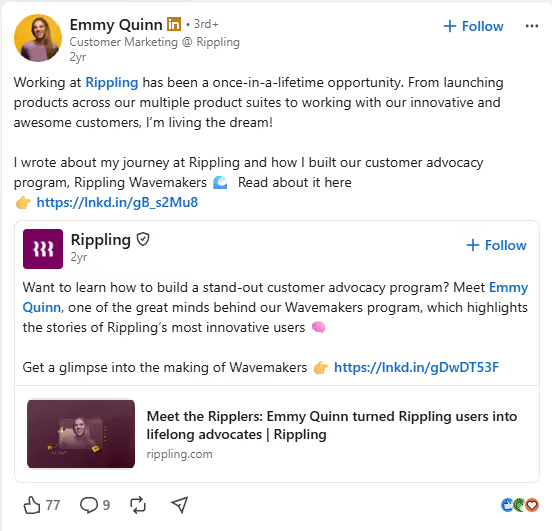
Customers could describe the product through changes to their own work. For executives assessing AI claims, that made the story more concrete. We’d adapt this by asking a customer to explain one workflow change after implementation, then promoting it to buyers facing the same problem.
2. Snowflake: External Voices Followed by Technical Expertise
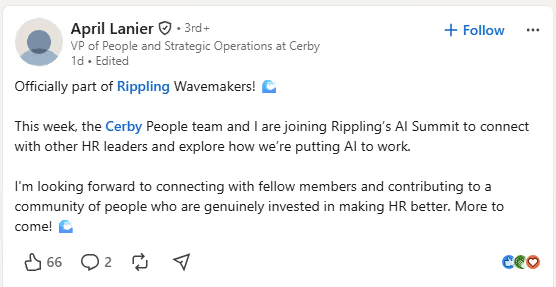
For its 2024 events, Snowflake promoted speaker and attendee posts to a niche audience of developers, data scientists, engineers, and other data professionals. LinkedIn reports 5.6% CTR, 2.7× its Single Image Ads. Retargeting with developer advocate Dash Desai’s Dev Day post delivered 21.2% CTR and 64 sign-ups, contributing to registrations from 40 target accounts.
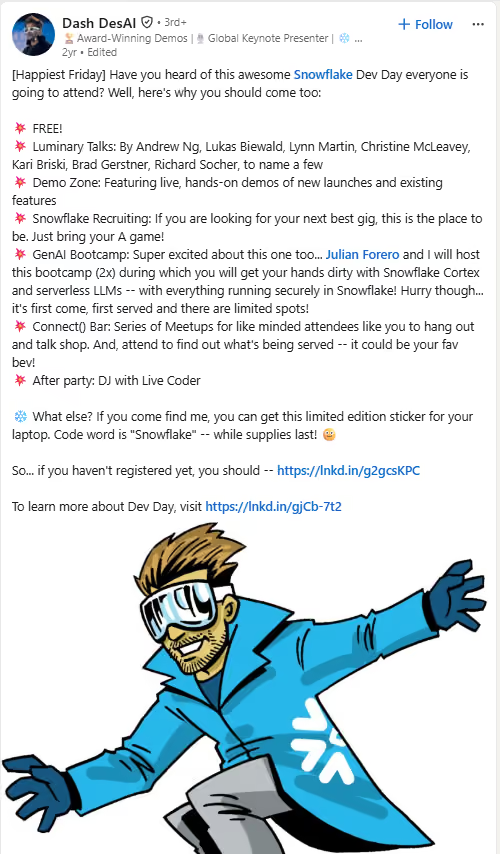
Retargeting gave engaged technical buyers a concrete reason to attend. A SaaS webinar could follow this sequence with an engineer answering implementation questions. The published case doesn’t say whether objectives or click definitions matched, so treat the comparison as campaign-specific.
3. Smokeball: Reuse the Testimonial, Test the Distribution
Legaltech company Smokeball needed stronger brand recognition among prospective customers. It cut a three-minute customer story into 30-second videos featuring Empire Legal for customer-led posts promoted through Matched Audiences. Against a video campaign using the same footage, LinkedIn reports 2× the view rate and 8.7× the completion rate, plus 50% lower cost per view.
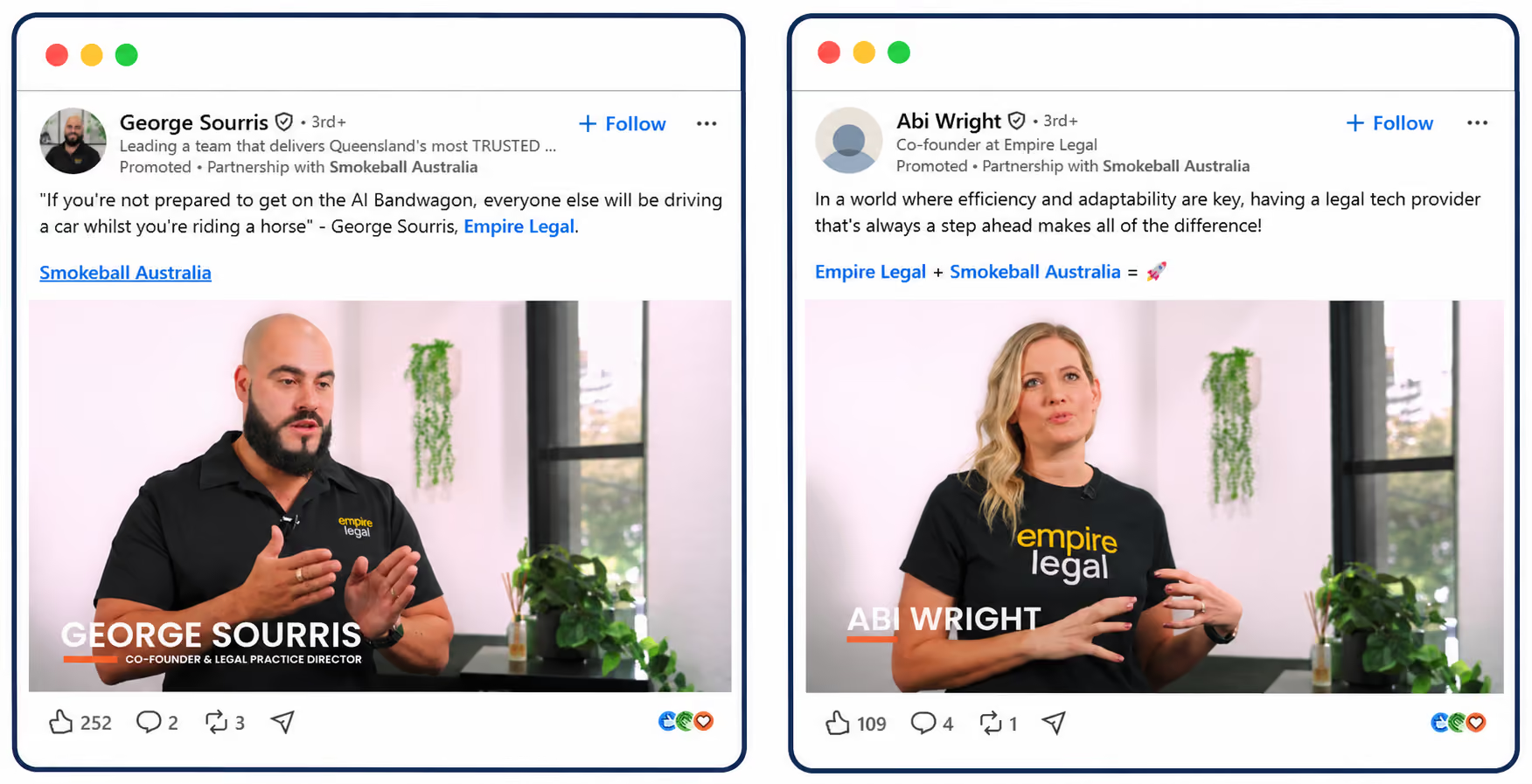
The customer voice gave legal-software buyers a peer’s account of using the product in daily work. Before commissioning another testimonial, test an existing story through TLA. That reuses the footage while changing how buyers encounter the customer’s experience.
4. Holded: Education Alongside Demand Capture
SMB software provider Holded had put 90% of marketing spend into direct-response conversions. Its LinkedIn program combined Video Ads, TLA, educational content, and CAPI to reach SMBs earlier. LinkedIn reports a 22% subscription lift and 37% lower cost per conversion for the combined program.
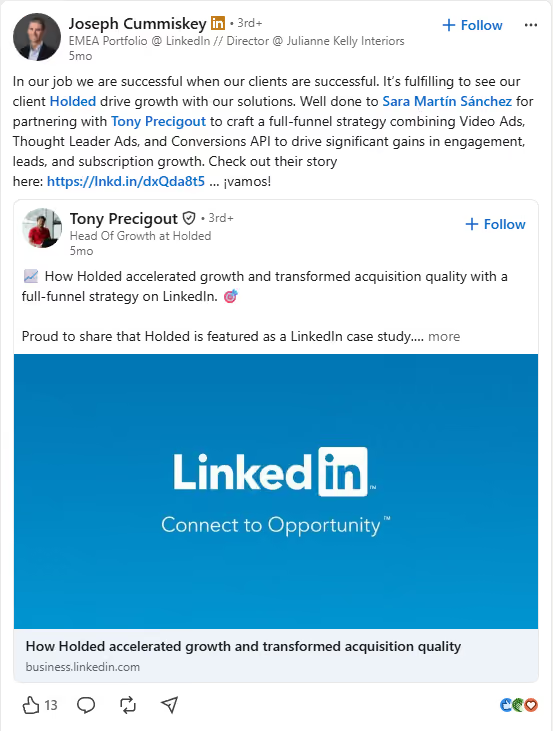
The published summary does not name TLA authors or isolate the format’s contribution. The practical lesson is the campaign mix: pair education with demand capture, such as retargeting and direct-response campaigns. Then evaluate acquisition over the full sales cycle in your CRM, from first touch through subscription.
How to Launch LinkedIn Thought Leader Ads
Use the first month to validate one campaign job, and settle the next offer before requesting posts.
- Define the job. Choose awareness, launch support, or event registrations. Agree with sales on one primary KPI and two supporting signals.
- Choose credible voices. Look for firsthand experience, such as a workflow teardown or implementation story. Assign approvals and comment responses.
- Select posts worth promoting. Compare six to ten candidates for relevance, proof, and buyer comments. Start with three to five posts from at least two voices if budget allows.
- Prepare measurement. RevOps should test website events, CRM campaign IDs, the Insight Tag, and LinkedIn CAPI or offline imports. Check link parameters.
- Secure sponsorship. Request author approval and confirm disclosure and usage terms. Use Creator Marketplace for eligible 3rd-degree+ connections, and prepare approved backups.
- Build the ad set. Match objective and format. In Campaign Manager, use Browse existing content → Content Library → LinkedIn members → Posts, or an approved Marketplace request. Preview sponsorship labels.
- Target and exclude. Match ICP roles, industries, company sizes, and accounts. Exclude unsuitable accounts and staff, then review LinkedIn Audience Network.
- Budget the test. Divide target impressions by 1,000, multiply by forecast CPM, and add our suggested 15–25% reserve. Our LinkedIn Ads cost and budget planning explains auction costs.
- Launch a controlled test. Keep major settings constant and vary one element, following how to A/B test LinkedIn Ads. If tracking or delivery breaks, pause affected ads while you resolve it.
- Activate the next offer. Run your LinkedIn retargeting strategy in a separate campaign with supported engagement or website audiences. Targeting requires at least 300 matched members. Match the offer to intent.
A Practical 30-Day Launch Calendar
Treat month-one findings as preliminary. Evaluate pipeline over your sales cycle.
How to Measure LinkedIn Thought Leader Ads
Measure attention, next steps, and pipeline separately. Campaign Manager shows paid results. Authors see combined organic and paid impressions/reach, excluding LinkedIn Audience Network.
CTR uses clicks that LinkedIn’s billing rules count, divided by impressions. Those can include follows or profile visits. Track landing-page clicks for website traffic.
Report by author, post, audience, format, and objective. Our LinkedIn Ads benchmarks for B2B SaaS provide context for compatible comparisons.
With marketing analytics and CRM attribution, define which touch originated an opportunity (sourced pipeline) and which other touches influenced it (influenced pipeline). Set a lookback window, the period before conversion in which a touch can count. Exposure alone does not prove causation.
Scale when buyer engagement and follow-up conversions improve affordably. Hold spend steady while evidence is thin. Refresh posts when frequency rises and response weakens. If the wrong roles keep engaging, revise targeting before adding spend.
Common Mistakes and How to Fix Them
Check audience fit and tracking when engagement stalls before pipeline.
Build a LinkedIn Thought Leader Ads Test That Supports Pipeline
Aimers can review your audience, authors, posts, setup, and measurement, then connect the test to retargeting and CRM reporting. Companies spending at least $5,000 monthly on ads can request a free PPC audit.
FAQs
Employees, founders, customers, subject-matter experts, and creators can be featured when the post is public, the profile shows the author’s full last name, and the author approves sponsorship. LinkedIn also asks authors to disclose their relationship with the advertiser. At the time of this review, authors in Digital Markets Act (DMA) countries are excluded from sponsorship.

LinkedIn’s current Help Center lists public text, single-image, video, document, article/newsletter, and eligible LinkedIn Live Event posts. Brand Awareness and Engagement are available across these formats, while Video Views applies to video. LinkedIn’s separate marketing specifications page still lists documents as unsupported, so confirm document eligibility in Campaign Manager before launch.
For single-image, video, and document Thought Leader Ads, LinkedIn’s Help Center says advertisers cannot add a CTA button; Event Thought Leader Ads include one. A URL needs to be part of the author’s organic post before sponsorship, rather than added later in Campaign Manager. Plan the post copy and destination before requesting approval because the advertiser cannot edit the original post.
Start with the delivery the test requires, not a fixed “TLA budget.” Divide target impressions by 1,000, multiply by the CPM forecast in Campaign Manager, and add a 15–25% reserve for auction volatility. If that total is too high, reduce the number of posts or simplify the test rather than underfunding every variant, and reserve budget for the next-step retargeting campaign.
Yes, the author can revoke approval after launch. LinkedIn says every ad using that post will stop immediately and be canceled in the ad account. The ad set can continue delivering only if other approved ads remain, so secure at least one approved backup before launch.