
12 Best CRM Platforms for B2B SaaS Companies in 2026

Every CRM vendor will tell you their platform is built for SaaS. Then you open it and find a pipeline designed for someone selling office furniture in 2009. Trial conversions, expansion MRR, churn signals. None of it fits without months of custom config.
At Aimers, we work with B2B SaaS companies from seed stage to mature platforms, managing over $30M in ad spend across 100+ clients. The wrong CRM for B2B does not just slow things down. It distorts your data and trains your team to think about the sales cycle in ways that do not match reality.
The average B2B SaaS deal does not move in a straight line. Champions go quiet, procurement appears out of nowhere, IT needs a security review two weeks before close. A CRM tool that flattens all of that into five linear stages is actively working against your B2B SaaS teams.
Incomplete CRM records spread damage downstream: broken audience segments, lead scoring that reflects activity over intent, attribution pointing at the wrong source. The CRM is not just where sales happens; it is the data foundation the rest of your SaaS business sits on.
What to Look for in a SaaS CRM Before You Commit
When choosing the right CRM, context matters more than capability rankings. The right CRM for a five-person SaaS startup bears no resemblance to the right CRM for a 200-person company with a full RevOps function. Feature counts and G2 scores do not settle that question. Your sales process does.
Core CRM Features That Actually Move the Needle for SaaS Teams
Pipeline visibility, automation depth, lead scoring, and reporting that surfaces something actionable. Those are the CRM features worth evaluating. Not the AI email summarizer. Whether you can see stage conversion rates by rep, spot where deals stall, and act on it without leaving the CRM platform.
Our team says it often enough it has become a refrain: marketing rarely fails because of low traffic. The leak is further down: in how leads get qualified, handed off, and followed up. A SaaS CRM that surfaces those gaps pays for itself. One that hides them behind activity metrics is quietly expensive. Read free version pricing carefully; the ceiling arrives at the worst moment.
Integration Depth and Why Your CRM Platform Can't Live in a Silo
If the CRM platform cannot talk natively to your ad platforms, marketing automation, product analytics, and support tooling, and you will spend a lot of time in Zapier, and Zapier will let you down. Native intergrations separate a CRM that runs your go-to-market from a shared spreadsheet with a nicer UI. Even the best ad campaign hits a wall when the data feeding it is broken.
The 12 Best CRM Platforms for B2B SaaS Companies in 2026
These are the top CRMs we actually see working across our client base, evaluated on CRM features, pricing, integration depth, and real-world usability across different growth stages and go-to-market models.
1. HubSpot CRM – Best All-in-One CRM for Scaling SaaS Businesses
.avif)
HubSpot CRM is where most mid-stage SaaS companies end up, and usually for good reason. The free version is capable. Paid tiers are expensive, more than the surface price once you count contacts and add-ons, and the unified view across marketing, sales, and service is hard to replicate with separate point solutions. We connect HubSpot to paid acquisition stacks for clients regularly; proper configuration changes how teams allocate budget.
Best for: Mid-stage SaaS companies that want sales and marketing teams operating from shared data.
2. Salesforce – Best B2B CRM Software for Enterprise-Level SaaS Operations
.avif)
Salesforce is the one everyone complains about and nobody stops using.Complex, expensive, real investment to configure, but for enterprise B2B SaaS with actual RevOps teams and multi-product pipelines, the depth is hard to match. The fully loaded cost surprises finance teams. With the right resources and pipeline complexity, the ROI argument holds.
Best for: Enterprise B2B SaaS with dedicated sales operations and complex, multi-stage pipelines.
3. Pipedrive – Best CRM for B2B Sales Teams That Live in the Pipeline
.avif)
Pipedrive CRM figured out something most CRM providers get wrong: if sales reps do not use it, nothing else matters. Clean visual pipeline, activity-based model, no pretense of being everything. Not the best for marketing automation; pair it with ActiveCampaign for that, but for sales-led SaaS companies where pipeline hygiene and rep adoption are the real problem, it solves it well.
Best for: Sales-led SaaS startups and scaleups where pipeline clarity comes first.
4. Zoho CRM – Best Budget-Friendly CRM for SaaS Startups
.avif)
Zoho CRM is underrated, mostly because Zoho does not market aggressively. Competitive pricing, real CRM features, and the broader ecosystem (Analytics, Campaigns, Desk) lets SaaS startups that want a coherent stack build one without HubSpot costs. The UI takes patience and onborading is not polished. But zoho CRM comes through for bootstrapped teams that need CRM software capabilities without enterprise pricing.
Best for: Early-stage SaaS startup teams that need CRM depth on a real budget.
5. Close – Best Sales CRM for High-Velocity B2B SaaS Teams
.avif)
Close is built for outbound-heavy B2B SaaS teams: high call volumes, tight follow-up cadences, SDR sequences. The built-in calling and SMS are strong, and the follow-up automation is not the watered-down version added as an afterthought. It is not trying to be a comprehensive CRM solution. That focus is the point.
Best for: B2B SaaS companies running high-volume outbound with a structured inside sales function.
6. Freshsales – Best SaaS CRM for Startups That Want Smart Automation
.avif)
Freshsales has grown into a legitmate CRM for SaaS companies: AI-powered lead scoring, workflow automation, clean interface. The Freshdesk integration is the underrated piece: it removes the manual handoff work between sales and customer success that usually falls through cracks. Reporting has limits at the complex analytical end, but for the stage it targets, it fits.
Best for: SaaS startups that want CRM automation without a multi-week implementation.
7. Attio – Best New SaaS CRM for Modern B2B Go-to-Market Teams
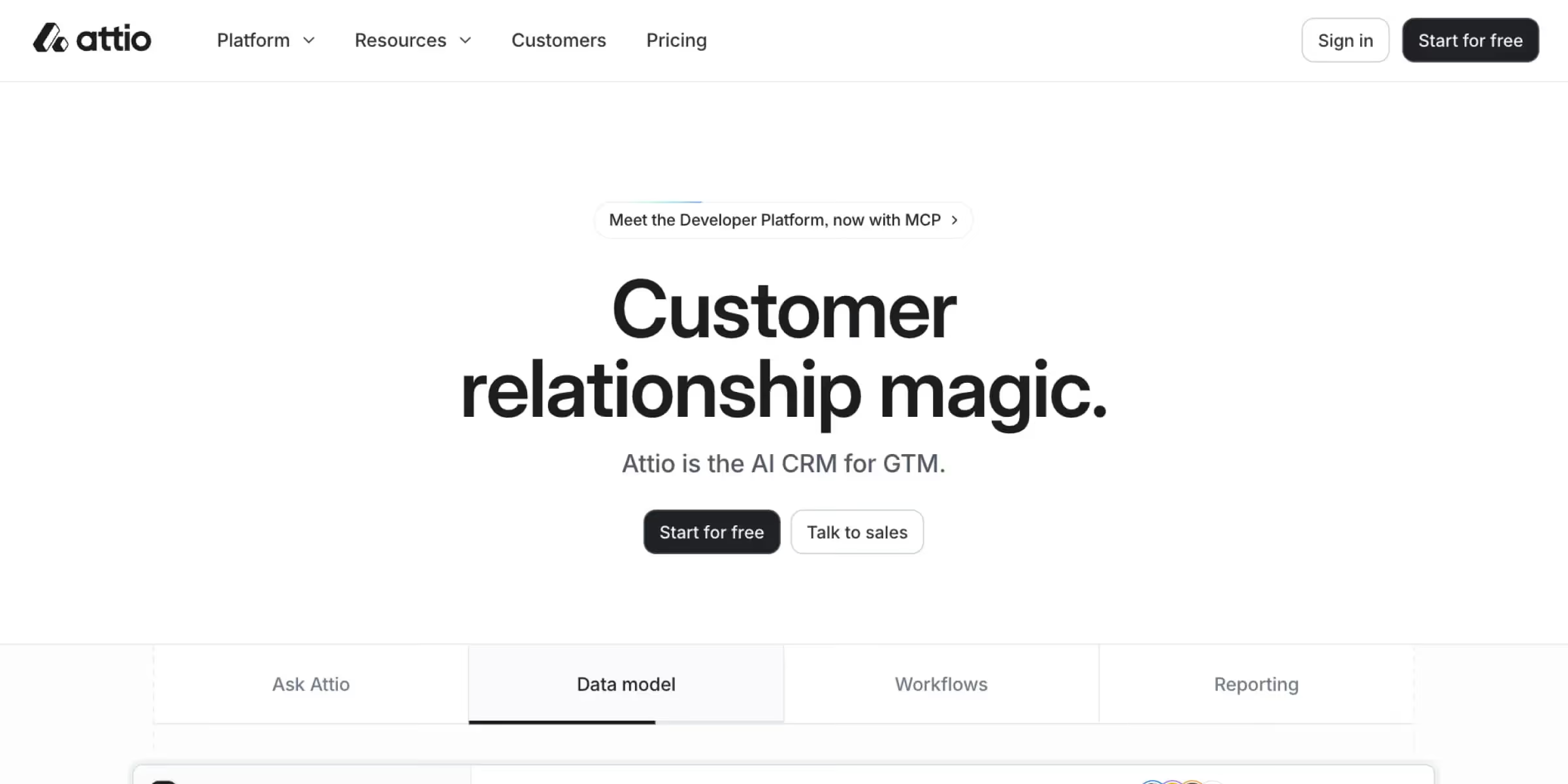
Attio is a new SaaS CRM worth paying attention to. Data-model-first, built around how modern SaaS teams think about relationships rather than just deal stages. PLG companies gravitate toward it because ingesting product usage signals alongside sales data is native to the platform, not a bolt-on. The integration ecosystem is thinner than established CRMs, a real constraint in 2026, but the product direction is right.
Best for: PLG SaaS teams and growth-stage B2B SaaS companies that want a modern, flexible CRM platform.
8. Copper – Best CRM for B2B SaaS Companies Running on Google Workspace
.avif)
Copper lives inside Gmail. For SaaS teams where Google Workspace is the actual daily environment, it removes the adoption friction that kills most CRM rollouts. Contacts and deals captured automatically, no context-switching, no end-of-day logging nobody does. Outside a Google-first stack, the value drops considerably. It knows what it is.
Best for: Google Workspace-first SaaS teams that want CRM without pulling reps out of their inbox.
9. monday CRM – Best Flexible CRM Solution for Cross-Functional SaaS Teams
.avif)
If you are already in monday.com, adding the CRM is low-effort. The configurability is strength and trap at once. No clear structure going in means a mess nobody maintains. Where it earns its spot: when the CRM needs to cover sales, partnerships, and account management without three separate tools.
Best for: SaaS orgs that need CRM workflows across multiple functions, not just sales.
10. ActiveCampaign – Best CRM for B2B SaaS Marketing and Sales Alignment
.avif)
ActiveCampaign is for SaaS companies where the path from first touch to paying customer is long and relationship-driven. The automation builder is the best we have used. Lead scoring and segmentation strong enough that sales and marketing teams work from the same data. No more lead quality arguments.
Best for: SaaS companies with email-driven lifecycle B2B marketing and longer sales cycles.
11. Streak – Best Free CRM Option for Early-Stage SaaS Startups
.avif)
Streak is a Gmail plugin that turns your inbox into a basic sales pipeline. Lowest-friction CRM option on this list, by some distance. It will not scale, was not designed to.But it forces early thinking about your sales process, which pays off when you move to a real CRM.
Best for: SaaS founders managing sales personally in the zero-to-one stage.
12. Insightly – Best CRM for B2B SaaS Companies That Need Project Visibility Post-Sale
.avif)
Insightly addresses a gap most CRMs ignore: what happens after the contract is signed. For B2B SaaS companies where implementation and onboarding are long and tied directly to renewal. The built-in project management layer means sales context does not evaporate when a deal closes. Early churn in SaaS often comes from a broken handoff, not the product itself.
Best for: B2B SaaS companies with complex post-sale onboarding and customer success workflows.
How to Choose the Best CRM for Your SaaS Business in 2026
There is no universal answer when it comes to choosing the best CRM for your SaaS. If you’re comparing options, reviewing curated lists like Best CRM for SaaS
can help you benchmark platforms before deciding. The right CRM is the one your team will actually use, that connects to your stack without engineering involvement every time something updates, and that produces data you can act on.
Matching CRM Capabilities to Your Stage of Growth
Early stage: simplicity and setup speed. You need to close deals and understand your sales process, not configure a system built for 200 reps. Growth stage: structure, automation, and reporting that holds up when you add headcount. Over-buying on CRM software is as common a mistake as under-buying. A compelling enterprise demo has a way of making the $80K/year option look reasonable right up until the implementation hits month six.
When we tightened the link between ad targeting and pipeline qualification for Cloudvisor, their pipeline quality grew by 130% and opportunities increased by 50%. The ads barely changed. A properly configured CRM made the difference.
Red Flags to Watch for When Evaluating CRM Providers
Pricing that looks fine until you count seats. Native integrations that turn out to be one-way syncs. Reporting flexible in demos but rigid in real accounts. Support excellent through the trial, unreachable after.Stress-test integrations with your actual tools. Ask what happens when something breaks. Talk to a reference the CRM provider did not suggest.
Ready to Build a B2B SaaS Growth Stack That Actually Performs
The CRM is one piece. Getting paid acquisition, conversion strategy, and pipeline working as a single system, not three loosely connected parts, is where the growth compounds. At Aimers, we work with B2B SaaS and tech companies on performance marketing that produces real numbers: paid search, paid social, CRO, and the analytics layer that ties it together. Google Premier Partner. $30M+ in annual ad spend managed across 100+ clients.
If you are wondering where your ad budget is silently leaking, book a short strategy call with us. We will tell you what we actually see.
FAQs
What is the best CRM for a small B2B SaaS team just getting started?

How is a SaaS CRM actually different from a standard one?
Is HubSpot really worth the cost for B2B SaaS companies?
How do you know when it is time to switch CRMs?
Can a CRM actually move the needle on conversion rates and revenue?