
B2B Demand Generation for SaaS: Strategies and Best Practices

B2B SaaS demand generation is harder than it used to be because buyers are more informed, buying committees are larger, and most of the journey happens before a sales conversation. A campaign can create leads and still fail if those leads do not match the ICP, understand the product, or move into qualified pipeline.
That is why B2B demand generation best practices now start with account clarity, intent signals, strong positioning, helpful content, and pipeline-driven measurement. The goal is not simply to create attention. The goal is to turn the right attention into product interest, sales conversations, adoption, retention, and revenue.
This guide explains how to build a B2B SaaS demand generation strategy that works across the full funnel, from ICP definition to ABM, channels, content, and measurement.
Why B2B SaaS Demand Generation Is Harder Than It Used to Be
In early SaaS growth, a company could often rely on paid search, a few landing pages, gated content, and sales follow-up. That still works in some categories, but it is rarely enough. Buyers now compare tools across search, communities, review sites, AI answers, LinkedIn, peer conversations, podcasts, and vendor websites before they fill out a form.
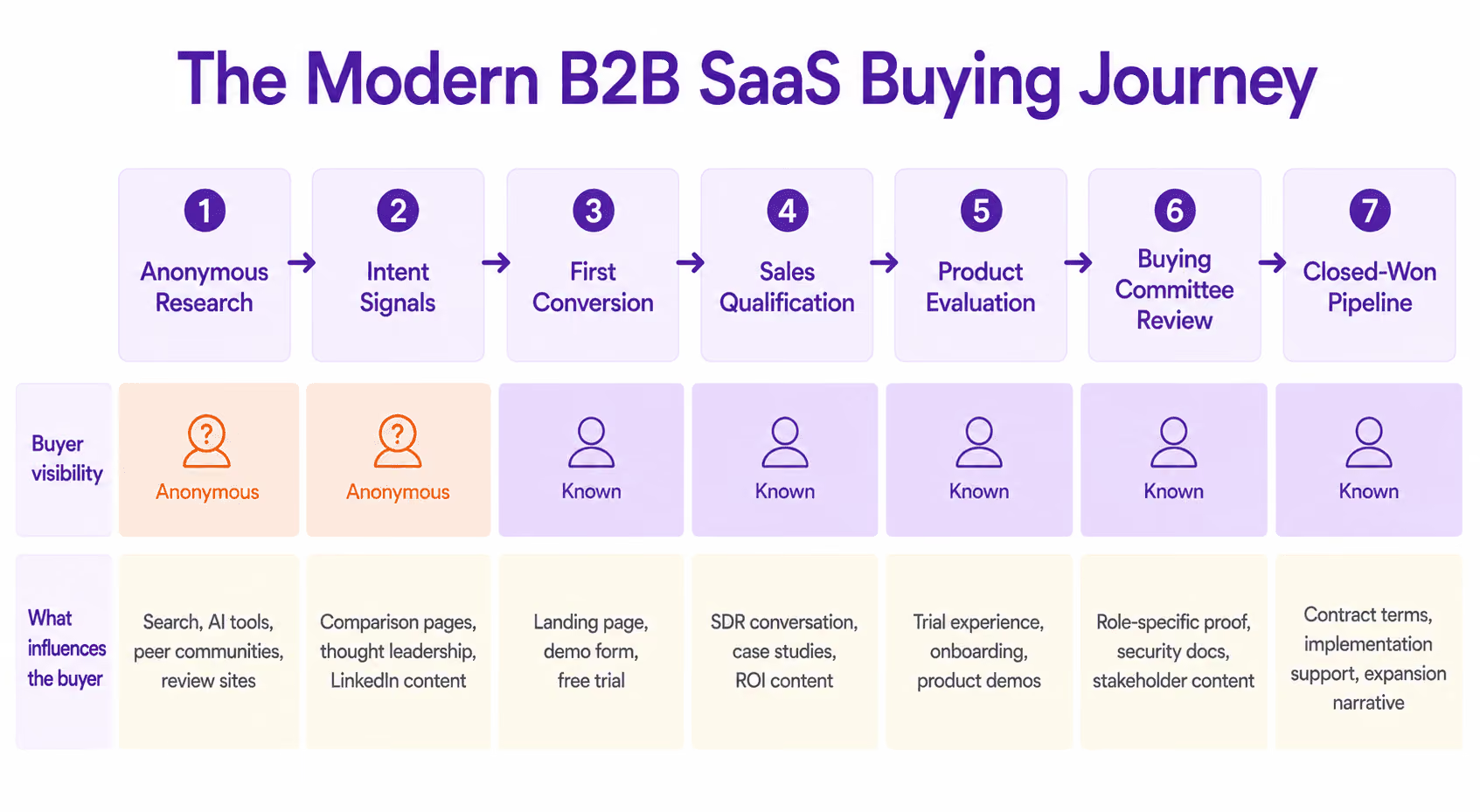
The buying process has also become less linear. Gartner reports that 75% of B2B buyers prefer a rep-free sales experience, yet self-service digital purchases are more likely to result in purchase regret. Buyers are also 1.8 times more likely to complete a high-quality deal when supplier-provided digital tools work together with sales reps rather than independently.
At the same time, buying decisions involve more stakeholders than before. Product, finance, IT, procurement, and executive teams often evaluate the same purchase from different perspectives, making consensus just as important as individual interest.
For SaaS teams, this changes what demand generation has to do. A campaign can create attention, but it also needs to help the buying committee understand value, reduce risk, and move toward consensus. One keyword, one ad, or one ebook is rarely enough to persuade an entire account.
We've covered this broader foundation in our guide to building a marketing strategy, where we explain why demand generation cannot sit outside positioning, messaging, product value, pricing, and sales motion. If those fundamentals are weak, channel execution only amplifies confusion.
How to Define and Activate Your ICP With Intent Data
The first B2B demand generation best practices are not about channels. They are about knowing which accounts are worth reaching. A SaaS demand generation strategy should begin with the best customers you already have, not the largest audience you can target.
Building a Precise ICP From First-Party and CRM Data
Start with first-party data: won deals, lost deals, product usage, churn reasons, customer interviews, onboarding notes, support themes, CRM fields, and expansion history. The strongest ICP is not only a firmographic profile. It explains which companies feel the problem most urgently and can realize value fastest.
Use these inputs to define:
- Company size, industry, region, funding stage, and tech stack
- Pain intensity and business trigger
- Current workaround or competing product
- Buying committee roles
- Sales cycle length and average contract value
- Activation, adoption, retention, and expansion patterns
This matters because demand quality depends on customer fit. If your best customers are mid-market cybersecurity teams with urgent compliance needs, a broad campaign for "security software" may produce leads but weak pipeline. If your best customers are product-led teams looking for faster onboarding, the offer, landing page, and follow-up should reflect that use case.
Layering Intent Signals to Identify In-Market Accounts
Intent data helps prioritize accounts showing signs of active research. 6sense describes its platform as combining first-party data, CRM, web, product, and third-party signals with buyer data and technographics. That kind of signal layer can help marketing and sales distinguish accounts that merely match the ICP from accounts that may be in-market now.
Intent should not replace judgment. It should sharpen it. A good demand generation strategy for SaaS combines fit and timing:
For teams investing in paid channels, Aimers' analytics services can help connect ad, website, CRM, and pipeline data so intent signals are not trapped in separate dashboards.
Account-Based Marketing for SaaS: Targeting the Full Buying Committee
ABM works best when the target account list is narrow enough to justify personalization and large enough to support the pipeline goal. It is not a replacement for broad-reach demand gen. It is a focused layer inside the larger SaaS demand generation strategy.
When to Run ABM Alongside Broad-Reach Demand Gen
Run ABM when your ACV, sales cycle, or buying committee makes one-to-one or one-to-few engagement worthwhile. For example, an enterprise product sold to finance, security, and operations leaders needs different messaging for each stakeholder. A self-serve product with low ACV may not need heavy ABM, but it still benefits from segment-specific campaigns.
Broad-reach demand gen creates market awareness and captures category demand. ABM focuses resources on named accounts with higher revenue potential. The two should work together:
- Use broad campaigns to build awareness and learn which messaging resonates
- Use ABM to reach high-fit accounts with personalized value stories
- Use retargeting to stay visible during evaluation
- Use sales feedback to refine content and offers
- Use pipeline data to decide which account clusters deserve more budget
Engaging Multiple Stakeholders Across a Single Account
Buying committees do not all care about the same outcome. A VP of Marketing may care about pipeline growth. A CFO may care about CAC payback. A product leader may care about adoption. A RevOps leader may care about attribution and CRM quality.
That is why SaaS messaging should translate product capabilities into role-specific business value. The same product may need several narratives:
- Executive narrative: growth, efficiency, and strategic risk
- Practitioner narrative: workflow speed, adoption, and daily usability
- Technical narrative: integrations, data quality, security, and governance
- Finance narrative: payback, retention, and expansion potential
Effective account-based programs do not send every stakeholder the same asset. They map messaging to role, stage, and account intent.
ABM Messaging by Buying Committee Role
Content and Channel Strategy That Builds SaaS Pipeline
Content is still central to demand generation, but its job has changed. It is no longer just a gated PDF machine built to collect emails. In B2B SaaS, content has to help buyers understand the problem, compare options, reduce internal risk, and build enough confidence to move toward a sales conversation.
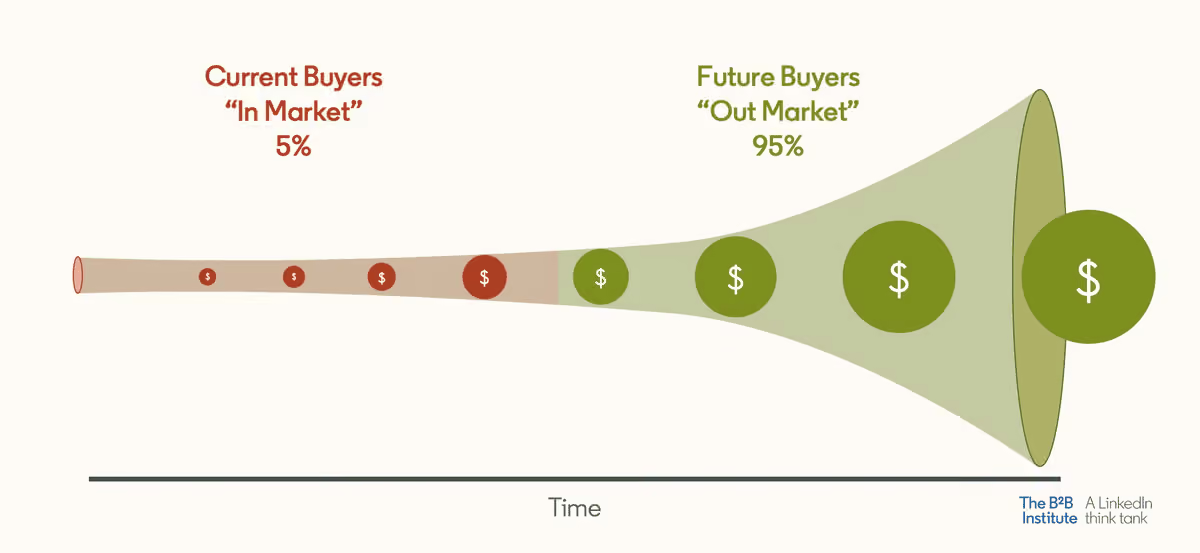
That matters because most buyers are not ready to buy today. Research from the LinkedIn B2B Institute and Ehrenberg-Bass Institute popularized the 95-5 rule: at any given time, only a small share of potential B2B buyers are actively in-market, while most are future buyers. For SaaS teams, the practical takeaway is simple: demand generation should balance demand capture with demand creation. It should convert existing intent while also building memory, trust, and category understanding before buyers enter an active buying cycle.
Ungated Content, Thought Leadership, and AI Search Visibility
Ungated content helps buyers learn without forcing a premature conversion. That does not mean every asset should be free forever. It means the most useful educational content should be accessible enough to build trust before the buyer is ready to talk.
Strong SaaS content should answer the questions buyers ask before they contact sales:
- What problem is this category solving?
- What are the available approaches?
- How does this product compare with alternatives?
- What will implementation require?
- Which integrations, security requirements, or workflows matter?
- What proof shows that the solution works for companies like ours?
Thought leadership, category education, comparison pages, use-case content, customer stories, and implementation-focused assets should not sit in separate content silos. They should work together to help buyers move from problem awareness to confident evaluation.
AI search adds another layer. If buyers ask AI tools to shortlist products, explain categories, or compare vendors, your content needs to be clear enough for both humans and machines. That requires consistent positioning, specific messaging, credible sources, structured pages, and third-party validation.
We've covered the earlier stage of this process in our article on early-stage marketing tactics, where we explain why practical channel experiments can help SaaS teams learn what resonates. As the company grows, those experiments need to become a coordinated content and channel system.
Which Channels Drive Pipeline for B2B SaaS in 2026
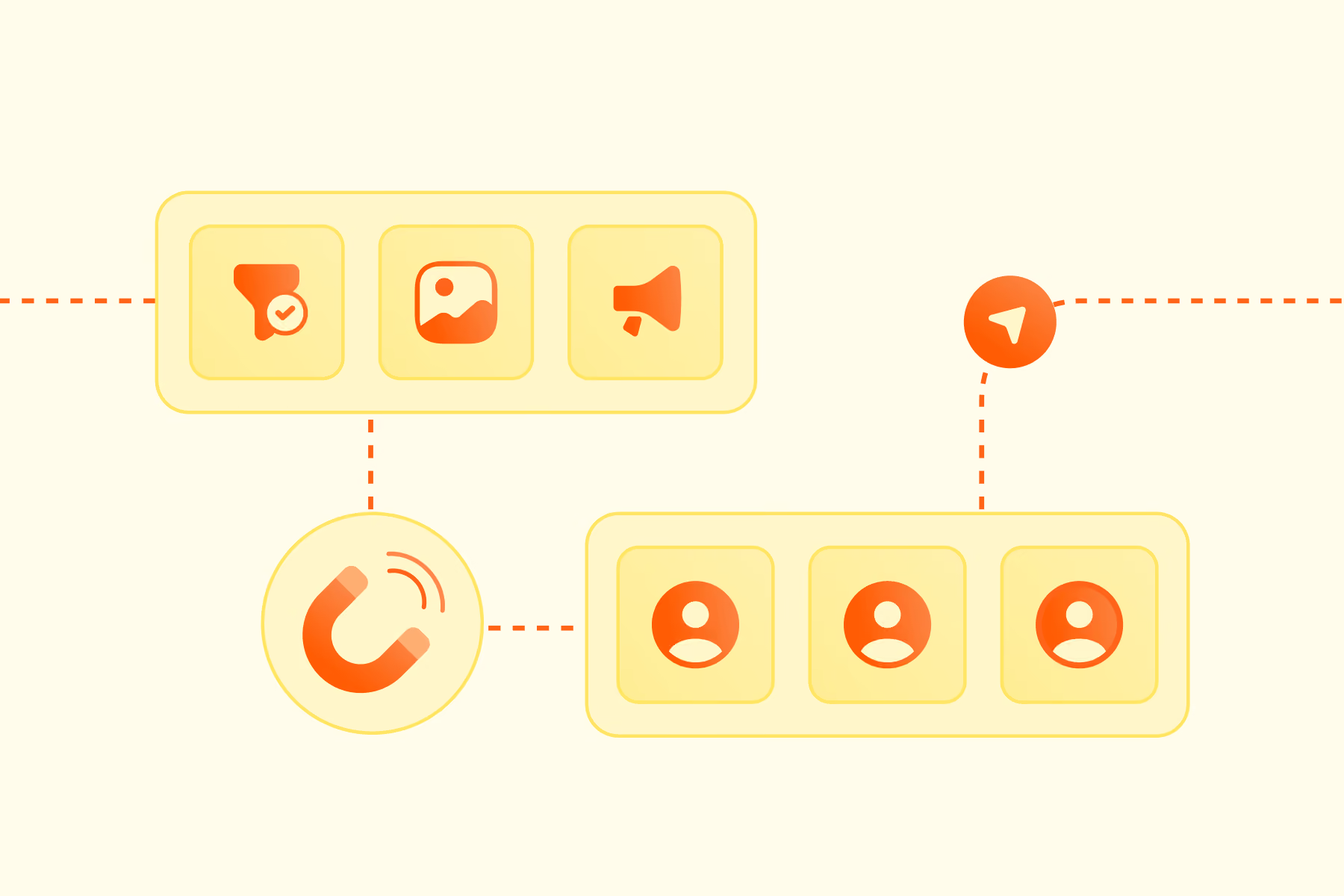
There is no universal channel mix. The right mix depends on ACV, category maturity, sales motion, competition, and buyer behavior. Still, most SaaS demand generation plans need a blend of three channel roles:
- Demand capture channels that reach buyers already looking for a solution;
- Demand creation channels that educate future buyers and build category memory;
- Conversion channels that move known accounts and engaged prospects toward pipeline.
Paid search often captures existing demand. LinkedIn Ads, thought leadership, webinars, and events help create or shape demand. Review pages, comparison content, retargeting, landing pages, outbound, and lifecycle email help convert and progress demand. The strongest channel mix is not the one with the most channels. It is the one where each channel has a clear job.
For paid acquisition, the key is not simply running more campaigns. SaaS-specific paid programs need to connect targeting, messaging, landing pages, qualification, and pipeline feedback. We've covered this in more detail in our SaaS PPC work and paid social programs, where channel execution is tied to conversion quality instead of isolated lead volume.
Moving From MQLs to Pipeline-Driven Measurement
MQL volume can be useful, but it should not be the main success metric for B2B SaaS demand generation. A high-MQL campaign that produces low-fit leads, slow sales cycles, and no qualified pipeline is not working. A lower-volume campaign that creates better-fit opportunities, stronger sales acceptance, and higher product engagement may be far more valuable.
Pipeline Velocity, CAC Payback, and Marketing-Sourced ARR
A strong SaaS demand generation strategy should measure quality, speed, and commercial value. Benchmarks can be useful, but they only matter when compared against the same segment, ACV, sales motion, and funnel stage. The real goal is to understand which programs create qualified pipeline and which only create activity.
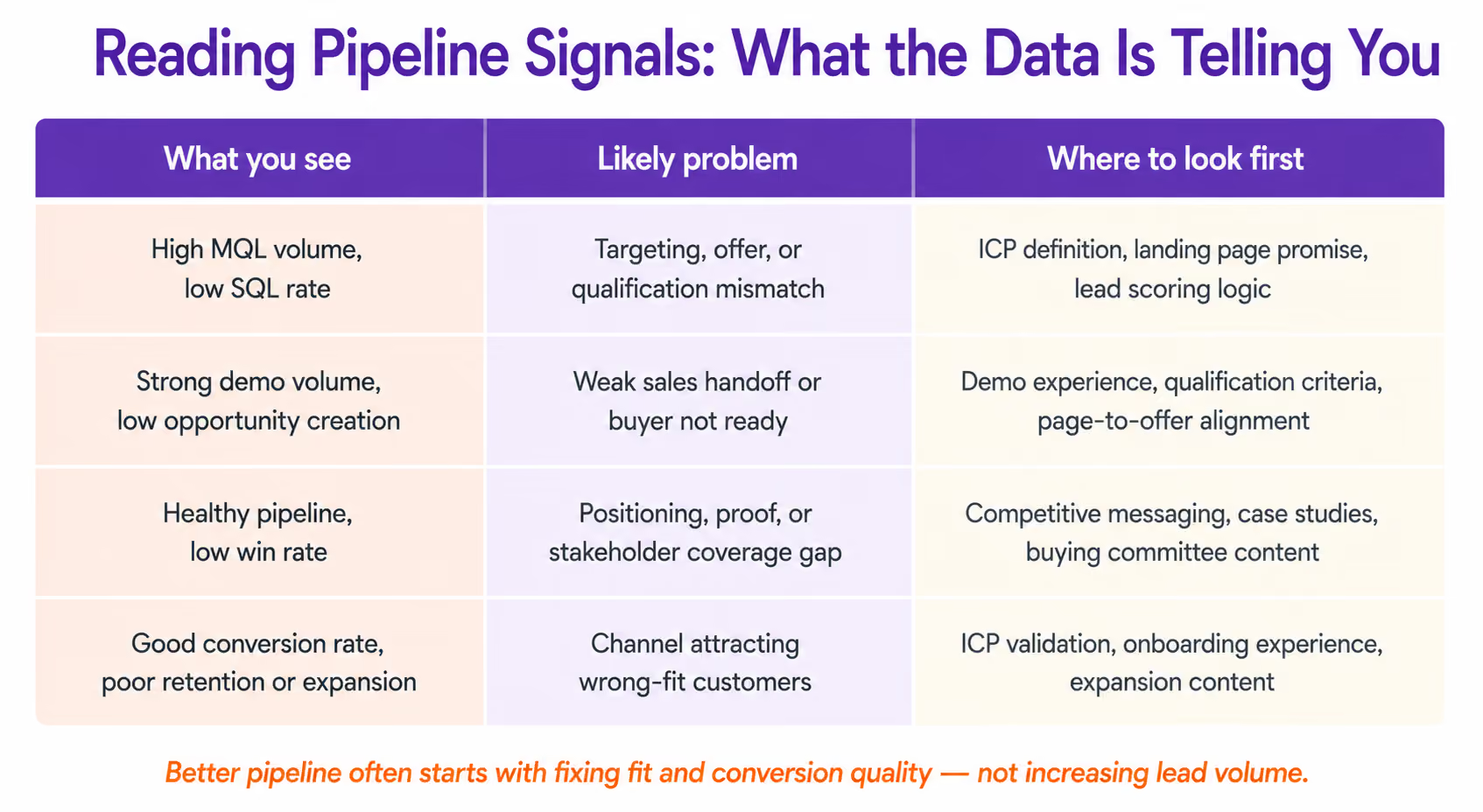
The most useful demand generation metrics rarely work in isolation. They become meaningful when teams read them together:
- High MQL volume with low SQL rate usually points to a targeting, offer, or qualification problem
- Strong demo volume with low opportunity creation may signal a weak sales handoff or a mismatch between page promise and buyer readiness
- Healthy pipeline with low win rate often points to positioning, proof, stakeholder coverage, or sales enablement gaps
- Good conversion rates with poor retention or expansion can mean the channel is attracting customers who convert but do not fit the long-term ICP
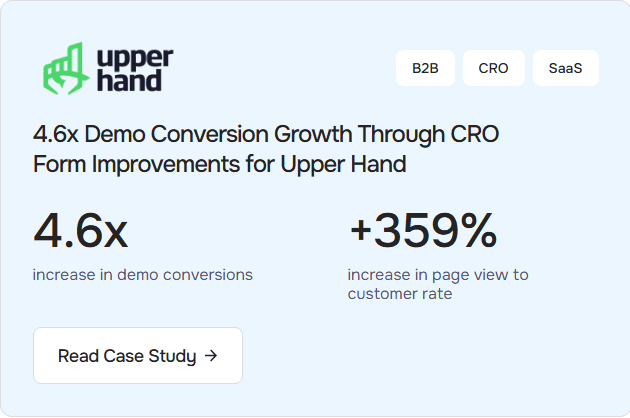
A good example is our work with Upper Hand, where improving targeting, landing page experience, and qualification logic reduced unqualified leads by 57%. The case reinforces a core demand generation principle: better pipeline often comes from improving fit and conversion quality, not simply increasing lead volume.
For SaaS teams that drive paid traffic to campaign pages, landing page design can support the conversion layer between channel spend and qualified pipeline.
Attribution When Most of the Buyer Journey Is Anonymous
Attribution is difficult because buyers do not move in a neat linear path. They may see LinkedIn content, ask peers, read a comparison page, visit pricing, attend a webinar, and only then request a demo. Some of those touches are visible. Many are not.
Instead of arguing over perfect attribution, use a practical model:
- Track source, campaign, landing page, and account data in the CRM
- Separate sourced pipeline from influenced pipeline
- Review performance by segment, ACV, and sales cycle stage
- Ask sales which conversations were meaningfully warmed by marketing
- Use self-reported attribution in demo forms as a directional signal
- Compare cohort quality, not just conversion rate
This is where B2B demand generation best practices become cross-functional. Marketing cannot measure pipeline alone. Sales, RevOps, product, and finance need shared definitions of qualified leads, opportunities, source, influence, ARR, and payback.
Building a Scalable Demand Generation Program for SaaS Growth
Scaling demand generation does not mean adding every channel at once. It means removing the biggest bottleneck first, then building a system that can learn, repeat, and improve.
A practical SaaS demand generation strategy can follow this sequence:
- Clarify ICP, positioning, messaging, and the core product value
- Audit current pipeline by source, segment, win rate, deal size, and retention
- Choose one or two demand capture channels that match existing buyer intent
- Build supporting content for objections, use cases, comparison queries, and buying committee roles
- Add ABM for high-fit accounts with stronger revenue potential
- Connect campaign data to CRM and product usage data
- Review pipeline quality with sales every month
- Scale spend only when lead quality, conversion rate, and sales acceptance are clear
The important thing is sequencing, because different problems require different fixes. If positioning is weak, fix positioning before scaling paid media. If the product is hard to understand, improve demos, use-case pages, and onboarding content. If sales rejects leads, refine qualification and offer strategy. If pipeline is created but does not close, review messaging, stakeholder coverage, and proof.
The strongest programs are not built by one team in isolation. Marketing creates demand, sales converts it, product proves value, customer success supports adoption, and RevOps keeps the data honest. Scaling works when each team can see where demand is gaining momentum and where it is breaking down.
Turning Demand Into Predictable Growth
High-performing SaaS demand generation is not built around lead volume alone. It is built around a system that helps the right buyers discover the product, understand its value, and move toward a confident purchase decision.
For SaaS teams, the practical takeaway is simple:
- Start with customer fit, not lead volume
- Balance demand capture with demand creation
- Build content for buyer questions, not just keyword coverage
- Measure pipeline quality, revenue efficiency, and customer fit instead of MQLs alone
- Use performance data to improve messaging, channels, and conversion paths over time
Companies that consistently outperform in SaaS demand generation are rarely the ones running the most campaigns. They are the ones building a system where positioning, content, channels, sales, product, and measurement reinforce one another.
If your team is generating activity but not enough qualified pipeline, we're happy to help. At Aimers, we work with SaaS and technology companies to connect demand generation, paid acquisition, landing pages, analytics, and conversion optimization into one measurable growth system.
FAQs
What is B2B demand generation for SaaS?

What are the most important B2B demand generation best practices?
How is demand generation different from lead generation?
What channels work best for B2B SaaS demand generation?
How should SaaS teams measure demand generation?