
Why Lower CPA Can Mean Worse SaaS Leads and How to Fix It
November 25, 2026


Your Google Ads report can look green while your sales team says the leads are junk. A falling SaaS CPA and rising conversions often hide a drop in lead quality, with fewer qualified leads, lower SQL rates, and deals that are harder to close.
CPA is only a reliable metric when the conversion behind it predicts revenue. The fix is Google Ads offline conversion tracking: import sales outcomes from your CRM, such as qualified leads, opportunities, and closed deals, and optimize toward them instead of cheap form fills.
By combining stronger SaaS marketing analytics with an offline conversion import, you show Google Ads what a valuable customer looks like and make value based bidding possible.
In this article, we explain why lower CPA can mean worse revenue, how offline conversion tracking works, and which metrics matter beyond CPA.
How Can a Lower CPA Mean Worse Revenue?
A lower CPA does not automatically mean better performance, because Google Ads optimizes toward the conversion signal it is given, not toward revenue. If that signal is a form submission, the system will find more of them at the lowest cost, including from users who rarely become qualified opportunities or customers.
That is why lead quality matters more than lead volume:
The problem is rarely the bidding strategy but the conversion event behind it, especially when cheap leads eat away your profit instead of contributing to pipeline or revenue. To avoid optimizing for the wrong outcome, SaaS advertisers need to connect ad data with CRM and sales results, not judge performance on CPA alone.
When Optimizing for the Wrong Conversion Hides Real Value
Case: When a Cheaper Lead Wasn’t the Most Valuable One
The Setup: Google Ads was optimizing for an upper-funnel action, a click or form submission on the first page. That gave the system plenty of data to learn from, but no view of what happened to users later in the funnel.
The Change: The Google Ads management team started sending a deeper conversion event back to Google Ads: a purchase recorded in the partner system, together with its monetary value. For selected campaigns, it became an additional optimization signal.
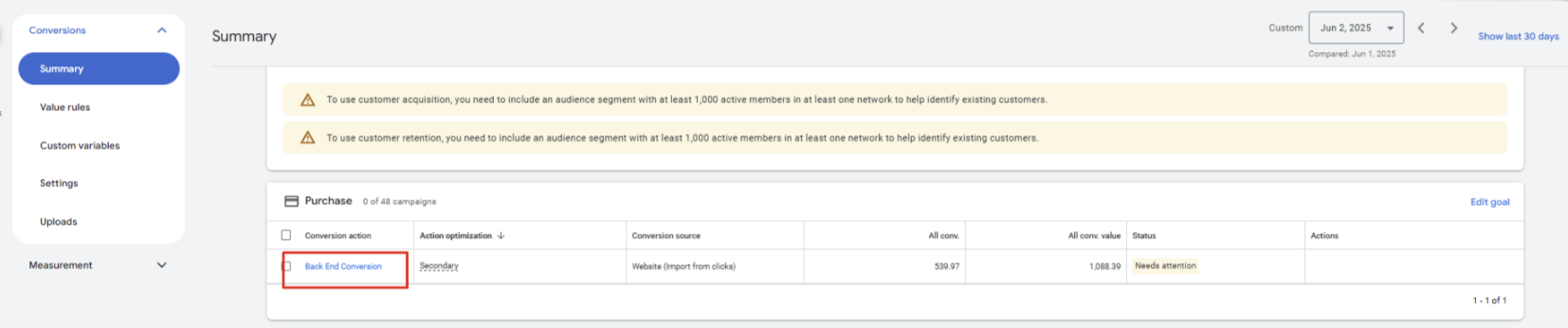
The Test: Traffic was judged not only by CPA, but also by EPC, the revenue generated per click in the partner system. Over seven days, backend traffic earned more per click in both accounts:

This was not a controlled experiment, so we cannot say that the diffrence was caused only by changing the conversion signal. Campaign settings, traffic mix, and partner conditions also varied.
But the comparison revealed something CPA alone could not show: a segment with a higher acquisition cost could still generate more value further down the funnel.
That is why later scaling decisions took into account not only lead cost, but also the value that traffic created after the initial conversion.
Similar issues can appear when lower-cost conversions increase volume without improving quality, as we saw when reducing unqualified leads in another account.
How Do You Set Up Offline Conversion Tracking in Google Ads?
Google Ads offline conversion tracking connects an ad click with what happens later in the sales process. Instead of stopping at a form submission, you can send qualified leads, opportunities, closed deals, or revenue back to Google Ads and use those outcomes to evaluate, and eventually optimize, campaigns.
A typical setup looks like this:
1. Capture the ad interaction.
Make sure the website can associate a lead with its Google Ads interaction. Depending on the setup, this may include the GCLID and first-party data such as an email address or phone number collected through the lead form.
2. Pass the data to your CRM.
When the lead submits a form, the relevant attribution data should be stored alongside the contact or deal record. This allows the original Google Ads interaction to stay connected to the lead as it moves through the funnel.
3. Define the CRM stages that matter.
Not every status needs to become a Google Ads conversion. Focus on stages that represent meaningful progress, such as MQL, SQL, sales opportunity, or closed customer.
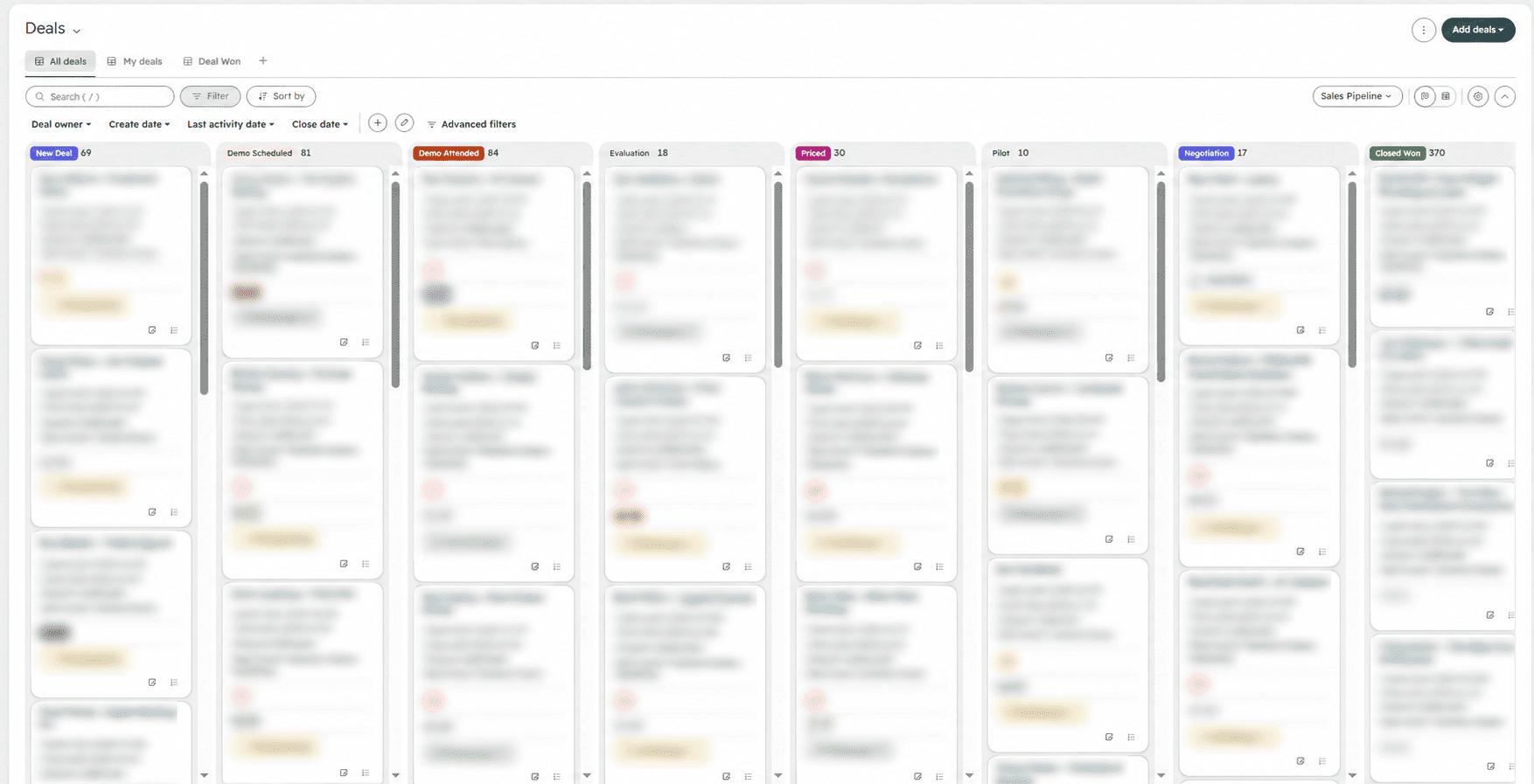
4. Create corresponding conversion actions in Google Ads.
Set up offline conversion actions for the stages you want to measure. For SaaS lead generation accounts, qualified lead or converted lead goals can provide stronger signals than the initial form submission when there is enough consistent volume.
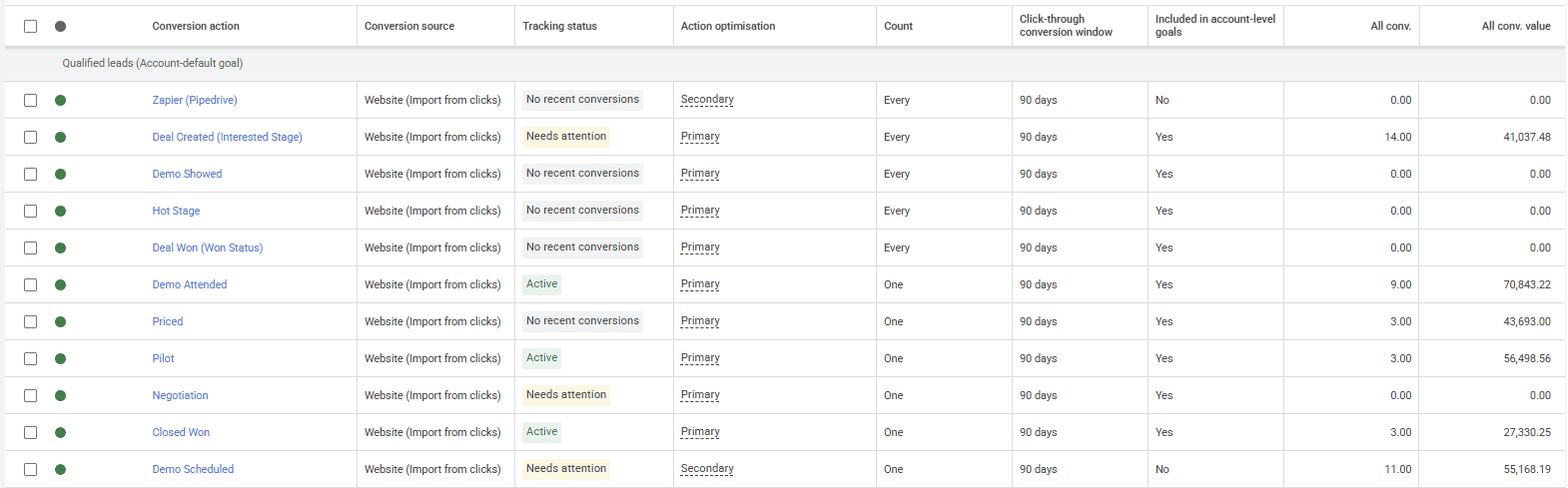
5. Send offline outcomes back to Google Ads.
Use Google Ads Data Manager or another supported integration to import CRM outcomes. An offline conversion import should include enough information to match the sales event back to the original ad interaction.
6. Assign conversion values where possible.
If different outcomes have different business value, reflect that in the data. An SQL can be worth more than an MQL, while a closed deal can carry actual revenue. This creates the foundation for value based bidding instead of treating every conversion equally.
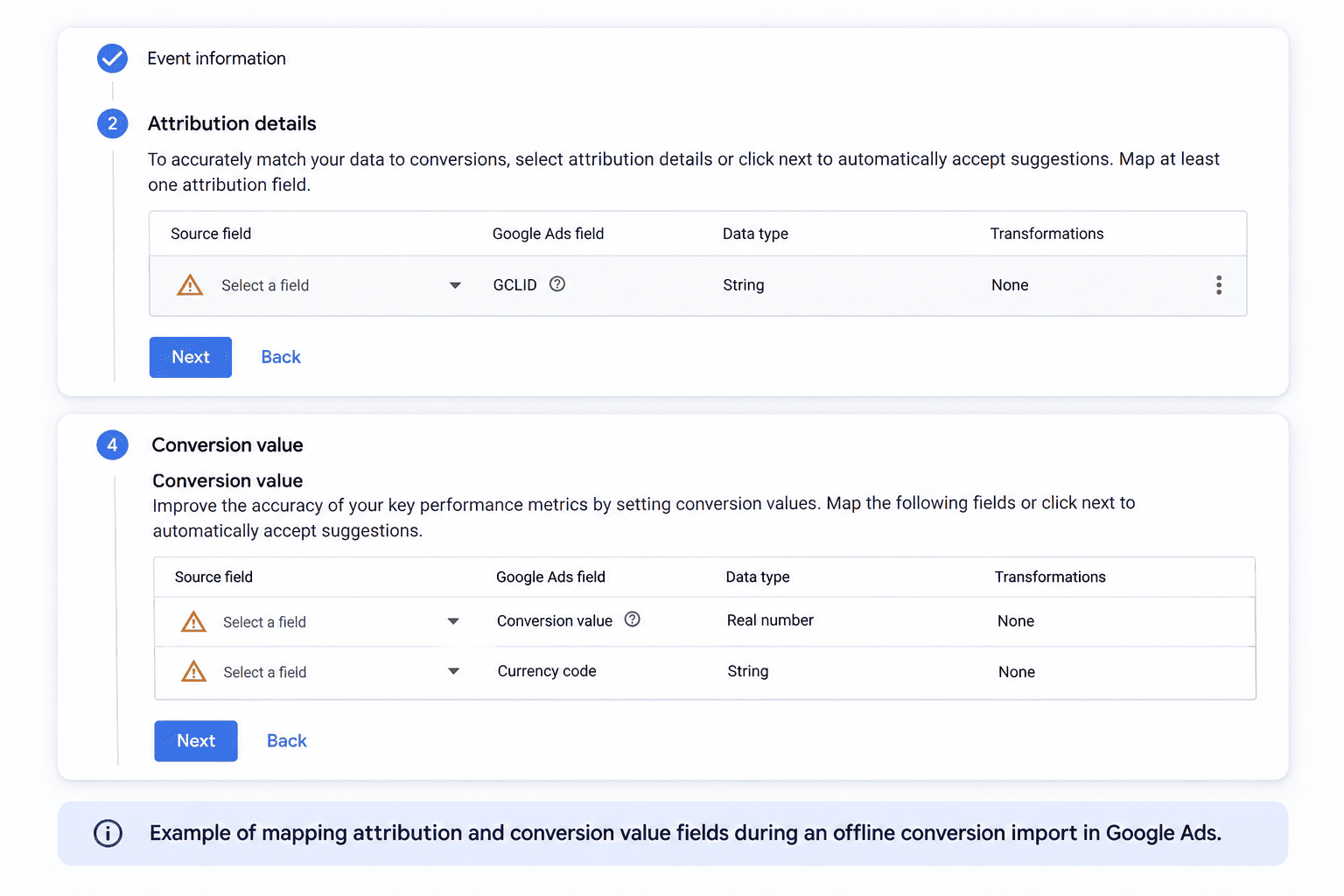
7. Validate the data before changing bidding.
Check whether imported conversions are appearing consistently, whether stages are mapped correctly, and whether the numbers in Google Ads broadly match the CRM. Do not switch optimization toward a deeper-funnel event simply because the integration has been turned on.
8. Close the loop with sales regularly.
Offline tracking is not a one-time technical setup. Review lead quality, qualification rates, rejected leads, pipeline, and revenue with the sales team. If the definition of a qualified lead changes, the signals sent back to Google Ads should change with it.
The goal of offline conversion tracking is not simply to add more conversion actions. It is to teach Google Ads which leads actually create business value, so campaign optimization can move beyond form volume and CPA alone.
What Is the Conversion Hierarchy We Use?
Not every conversion should have the same weight in Google Ads. A form submission, an MQL, a qualified lead, and a closed deal all represent very different levels of business value. In general, the closer a conversion is to revenue, the more useful it is for optimization.
However, deeper-funnel conversions usually happen less frequently. If an account does not generate enough MQLs, SQLs, or opportunities for Smart Bidding to learn from, optimizing only toward those events can limit the amount of usable conversion data.
In that case, we may temporarily use a higher-volume action, such as a form submission or demo request, as the primary conversion. The key is to keep monitoring lead quality in the CRM and move bidding toward a deeper-funnel event once there is enough consistent data.
The goal is not simply to optimize for the deepest possible conversion. It is to find the best balance between signal quality and conversion volume. A smaller number of high-quality conversions is valuable, but Smart Bidding still needs enough consistent data to identify patterns and optimize effectively.
What Did We Change in the Campaigns?
Once we identify that a campaign is optimizing toward a weak conversion signal, the first step is to review which actions are being used for bidding as part of a broader Google Ads optimization checklist.
If the account has enough volume from deeper-funnel events such as MQLs, SQLs, opportunities, or closed deals, we can make those actions primary and use them as the main optimization signal. Form submissions, demo requests, or trial signups can then remain secondary for reporting and funnel analysis.
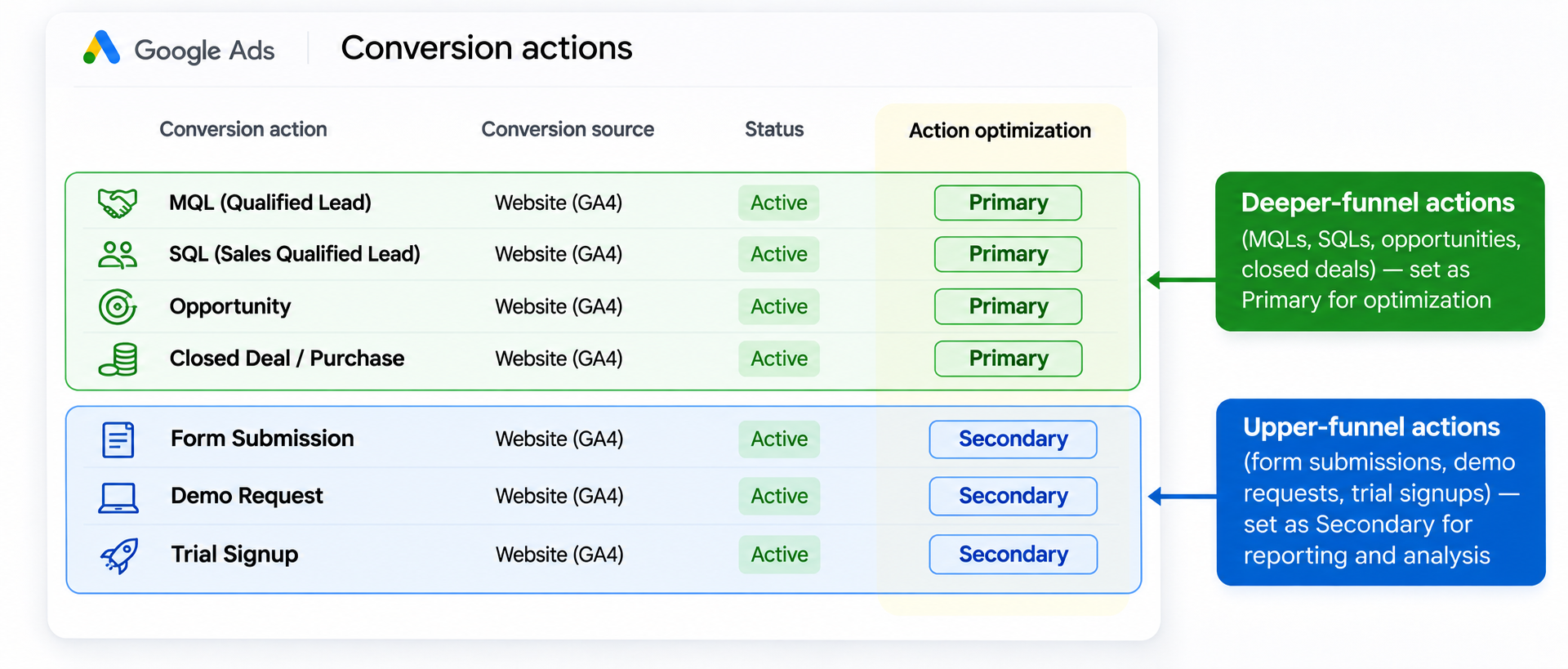
When deeper-funnel volume is still too low, we may keep a higher-volume action, such as a form submission, as the primary conversion temporarily. In that case, lead quality needs to be monitored closely in the CRM so we can see whether cheaper conversions are actually turning into qualified pipeline.
We also review bidding strategy, campaign-level goals, and conversion values. Where revenue or pipeline value is available, value-based bidding can become a better fit than optimizing for conversion volume alone.
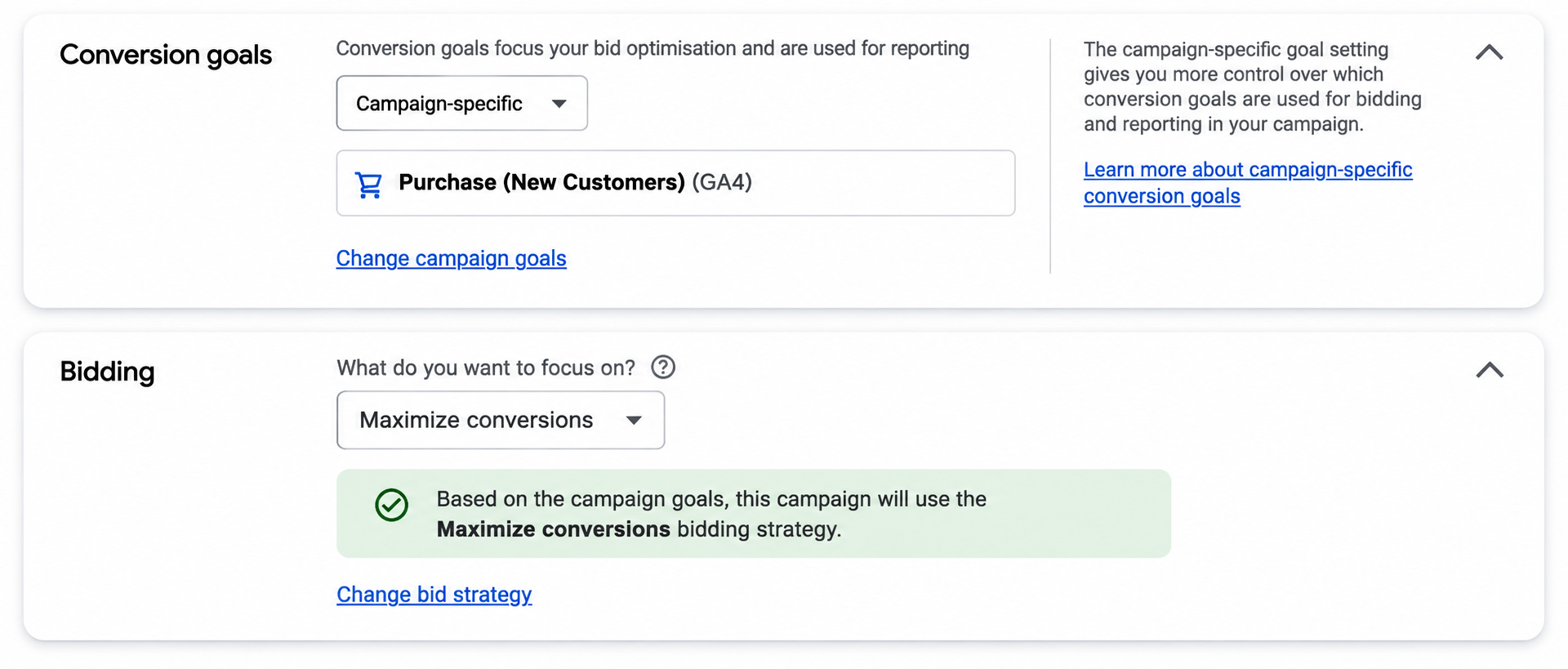
The goal is not to make the campaign chase the deepest conversion at any cost. It is to give Google Ads the strongest reliable signal available while maintaining enough data for Smart Bidding to learn.
Which Metrics Should You Report Instead of CPA Alone?
CPA is still useful, but it should not be the only metric used to judge campaign performance. To understand whether paid traffic is actually contributing to business growth and SaaS marketing performance, we also look at:
- MQL rate – how many leads meet marketing qualification criteria.
- SQL rate – how many leads are accepted as sales-qualified.
- Cost per qualified lead – what it costs to generate a lead that sales actually wants.
- Opportunity rate – how often leads turn into a real pipeline.
- Revenue per lead – how much revenue each lead generates on average.
- Pipeline value – the total potential revenue influenced by paid campaigns.
- CAC or ROAS – to connect ad spend with actual customer value and revenue.
Focusing on lead quality pays off: in our B2B lead quality case for ZappySys, lead score grew by 58% while CPA fell by 10%.
Key Takeaways
- A lower CPA does not always mean better business results if the conversion behind it does not predict revenue.
- Google Ads should optimize toward the strongest reliable signal available, not simply the easiest conversion to generate.
- Deeper-funnel events such as MQLs, SQLs, opportunities, or closed deals are more valuable for bidding when there is enough conversion volume.
- If deeper-funnel volume is too low, higher-volume actions such as form submissions can still be used temporarily.
- Offline conversion tracking helps connect ad performance with CRM and sales outcomes, making lead quality, pipeline, and revenue part of the optimization process.
At Aimers, we connect Google Ads, analytics, and CRM data so your campaigns chase qualified pipeline, not cheap form fills. Not sure which leads turn into revenue? Book a free call and we will review your setup together.
FAQs
Optimize for the deepest conversion that is closely connected to revenue and still provides enough consistent volume for Smart Bidding. This could be an MQL, SQL, opportunity, or closed deal. If deeper-funnel volume is too low, a higher-volume action such as a form submission can be used temporarily.

There is no single number that works for every account. The key is consistency. If deeper-funnel conversions happen too rarely, Smart Bidding may not have enough data to identify patterns. In that case, use a higher-volume conversion until enough qualified conversion data is available.
Yes. CRM outcomes such as qualified leads, opportunities, and closed deals can be imported into Google Ads as offline conversions. This gives Smart Bidding stronger signals about which clicks are actually producing valuable business outcomes.
CPL measures the cost of generating a lead, while CPA measures the cost of a defined conversion action. Depending on the setup, that action could be a lead, signup, purchase, or another event. Neither metric alone tells you whether the lead became a customer.
Switch when deeper-funnel events happen frequently and consistently enough to become a reliable bidding signal. Until then, keep monitoring lead quality in the CRM and use form submissions as a temporary optimization signal.