
20 Facebook Ad Mistakes To Avoid At All Costs

We're going to be straight with you.
Most of the Facebook ad accounts we audit shouldn't be running at the budgets they're running. Not because the companies behind them are bad at marketing, it's usually the opposite. The founders and marketers we work with are sharp, data-driven people. But somewhere between launching campaigns and checking dashboards, things go sideways in ways that aren't obvious until you know exactly what to look for.
We've been running paid social for B2B SaaS companies as a Paid social advertising agency for years. Hundreds of audits. Millions in managed spend. And the same Facebook ads mistakes continue to surface, account after account. Specific numbers change. The underlying problems seldom do. This guide covers the most common mistakes in Facebook advertising we see, and exactly how to fix them.
So How Do You Even Know Your Facebook Ads Are Wasting Money
Budget waste in Facebook campaigns rarely looks dramatic. The ads are running, you're getting some leads, the dashboard shows spend going out and numbers coming in. Everything looks like it's working.
Until your sales team tells you the leads are garbage.
Until your cost per qualified opportunity climbs for the third month straight. Until you stare at your pipeline and realize almost none of it traces back to paid social. These are the clearest signals you have Facebook marketing mistakes running in your account:
- Cost per lead keeps rising with zero improvement in lead quality
- The sales team has quietly stopped mentioning Facebook
- Clicks arrive, but almost nothing converts downstream
- You duplicated a winning campaign and it immediately fell flat
Two or more of those sound familiar? You almost certainly have at least one of the common Facebook Ad mistakes below. Probably more.
Tracking and Conversion Mistakes
1. Running campaigns before conversion tracking is properly set up
We still see this constantly, and it genuinely surprises us every time. An account has been live for weeks, sometimes months, spending real budget, with conversion tracking either missing or misconfigured in ways that make the data worthless. Without reliable conversion data, Meta's algorithm can't work toward outcomes that actually matter. You're paying the platform to guess, and it's not cheap.
Set up your conversion events in Meta Ads Manager, verify them against real user flows, confirm they're firing, then spend. As Meta's own Business Help Center explains, properly configured conversion events are the direct input driving every automated optimization decision the platform makes.
2. Counting page visits as conversions
A visit to your pricing page isn't a lead. When you tell Meta that a page visit counts as a conversion, you're training the algorithm to find people who visit pages, not people who become customers. This is one of the most common Facebook ads conversion mistakes that corrupts your data so gradually you barely notice, until you realize your conversion rate looks great and your pipeline looks empty.
3. Ignoring Pixel health
The Meta Pixel can break silently. A site update goes live, a developer reorganizes some code, and suddenly the Pixel isn't firing, or it's firing twice on certain events. No alert. The Ads Manager keeps showing data that looks plausible, and you keep making decisions based on numbers that stopped reflecting reality weeks ago. Install the Meta Pixel Helper browser extension. Check it regularly, especially after site changes. It takes five minutes and has saved our clients from some genuinely expensive blind spots.

4. Skipping the Conversions API
The Pixel lives in the browser, and browsers are increasingly unreliable. Ad blockers, iOS privacy restrictions, cookie limitations all chip away at it. Running only Pixel-based tracking in 2026 means you're already missing a meaningful slice of your conversion data, and you probably don't know which slice.
The Conversions API sends event data directly from your server to Meta, bypassing browser-level gaps. Tools like stape.io make the setup straightforward without custom development. There's very little reason not to have this running. Here's a quick comparison of how these two tracking methods actually differ in practice:
Most accounts run one or the other. The ones that run both consistently report cleaner data and fewer attribution gaps.
5. Never checking whether Meta's numbers match your CRM
Meta will tell you how many conversions your campaigns produced. Your CRM will tell you how many of those actually became pipeline. Those two numbers are rarely identical, and the gap between them is often where the real story lives. Optimizing toward leads your sales team will never qualify means getting better and better at generating the wrong thing. It's like tuning a car engine while ignoring that the wheels are pointed sideways. Reconciling Meta data with CRM data regularly is one of the most practical ways to understand why Facebook ads fail to produce real revenue, even when platform metrics look fine.
According to Social Media Examiner's annual social media marketing report, only a fraction of B2B marketers feel confident about accurately measuring ROI from paid social. Attribution gaps between ad platforms and CRM systems are one of the top reasons cited. Worth reading if you're trying to build a cleaner measurement setup.
Targeting Mistakes
6. Treating Facebook like it's Google
This one makes us a little crazy, honestly. On Google, someone searches "project management software for agencies," they want a solution, right now. Intent is sitting right there on the surface. On Facebook, that same person is watching a video about their college friend's kitchen renovation. They did not ask to hear from you. Serving them a "Start your free trial today" ad isn't a bad creative decision so much as a wrong-platform decision.
Our breakdown of Google Ads vs. Facebook Ads goes deeper on this, but the short version is Facebook creates demand, Google captures it. Stop mixing them up. The table below shows where the two platforms genuinely differ for B2B SaaS, because the gap is bigger than most people realize:
Both platforms have a place in a B2B SaaS account. The mistake is treating them as interchangeable.
7. Building audiences too narrow to learn from
Precision targeting feels responsible. It often isn't. These Facebook ad targeting mistakes are costly, Meta's algorithm needs volume, and audiences under 200K give the system very little room to find patterns, test delivery, or improve. You end up with technically tight targeting and practically useless delivery. Start broader than feels comfortable, use strong creative to self-select your real audience, then build tighter retargeting pools from engagement data.
8. Forgetting to exclude existing customers
Showing acquisition ads to people already paying you wastes money and irritates the people most likely to refer you. Build exclusion audiences from your customer list, your lead list, recent converters. Update them regularly. This takes twenty minutes to set up and most accounts skip it entirely.
9. Switching off Advantage+ automation without testing it
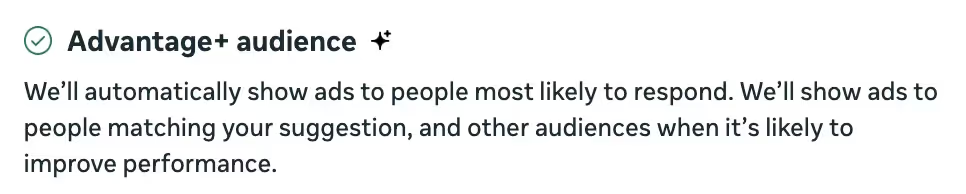
Numerous advertisers have disabled Meta's audience automation tools because it feels like losing control, and that instinct isn't fundamentally wrong. But Advantage+ audience targeting regularly finds users that manual targeting would've excluded, often at lower CPL. The right move isn't to blindly enable everything; it's to test it deliberately, with proper exclusions in place, and see what the data actually says. Turning it off by default, without ever testing, is leaving real performance on the table.
10. Ignoring lookalike audiences entirely
A customer list of 500 or more contacts and no lookalike audiences built from it, that's one of the highest-signal targeting inputs available, sitting completely unused. Lookalikes built from closed-won customers or high-LTV accounts consistently outperform broad interest targeting in the B2B SaaS accounts we manage. Start there.
Creative Mistakes
11. Writing copy that sounds like every other ad
"Transform your workflow." "Built for modern teams." We've seen variations of these lines so many times they've become invisible. Vague copy that tries to appeal to everyone connects with no one, and on a feed where people are moving fast, invisibility is useless.
The ads that actually stop people are weirdly specific. They name a real pain point, they describe a moment the reader has lived, the one where they're manually exporting data for the third time that week and quietly considering a career change. HubSpot's research on Facebook advertising effectiveness consistently shows that persona-specific messaging outperforms broad brand copy. Our collection of Facebook Ad examples shows what that looks like in practice.
12. Trying to fit the whole product into one ad
Your product does a lot of things. That's great. It's also the fastest way to write an ad that says nothing, like walking into a sales call and reading the entire product roadmap out loud. Pick one problem, one audience, one outcome. We've run the same product's ads to sales leaders, marketing directors, and finance teams simultaneously, with completely different creative for each, and watched all three outperform the comprehensive overview version. Every time.
13. Calling cosmetic changes "tests"
Changing a CTA button from blue to green is not a test. The Facebook ads creative mistakes we see most often here aren't laziness, they're overcaution. Teams don't want to risk a big change, so they make tiny ones and call it testing. Real testing compares a pain-point-led hook against a results-led hook, a video demo against a customer testimonial, a free guide against a direct demo request. Those tests generate data worth acting on. Minor visual variations rarely do.
Search Engine Journal published a solid piece on why Facebook ad creative testing fails for most advertisers, and a lot of it comes back to exactly this: testing cosmetic differences instead of meaningfully distinct concepts. Worth a read before you plan your next round of creative experiments.
14. Designing for desktop
Most of your Facebook traffic is on a phone. An ad built for desktop Feed looks wrong in Reels; a static image formatted for landscape feels improper in Stories. Not adapting creative to the environments where it'll actually appear costs you performance on placements Meta may be actively pushing delivery toward. Design for mobile first. Hook people in the first two seconds. These aren't suggestions in 2026.
15. Letting creative run into the ground
Frequency climbs, CTR softly declines, CPL drifts upward, until you look at the numbers and realize the campaign you were happy with three months ago has become a quiet budget drain. Watch frequency and performance together. When frequency rises and results weaken at the same time, refresh the creative. Our guide on how to optimize Facebook ads walks through the signals to watch before the drop gets serious.
Budget and Campaign Structure Mistakes
16. Mismatching bid strategy to campaign goal
If your priority is lead quality, optimizing for volume will produce plenty of leads your sales team won't thank you for. If your priority is scale, tight cost controls will strangle delivery before the algorithm finds efficient conversions. The Ads Manager keeps reporting numbers regardless of whether your bid strategy aligns with your actual objective, which is exactly why Facebook ads budget mistakes like this quietly compound for months without triggering any obvious alarm. Think through what each campaign actually needs before you tell Meta how to advertise. The default settings are rarely right for B2B SaaS.

17. Spreading the budget thin across too many ad sets
Too many small ad sets means none of them accumulate enough data to learn from. It's like trying to heat ten rooms with one small radiator. Delivery becomes inconsistent, the algorithm never gets enough signal, and you end up paying more for less. Fewer campaigns, stronger budgets per ad set, cleaner structure. Our guide to Facebook ads pricing in 2026 covers what consolidated spend should realistically produce at each funnel stage.
18. Editing constantly
We understand the impulse, honestly. You check the dashboard, numbers look soft, and the instinct is to do something. The problem is that every significant change resets the learning phase and the campaign never stabilizes. Facebook ads campaign mistakes like this are sneaky, patience in paid social is a competitive advantage, even when it doesn't feel like one staring at a soft CPL on a Monday morning.
Optimization and Reporting Mistakes
19. Skipping retargeting, then blaming the platform
Skipping retargeting means spending real money building awareness with cold audiences and never capitalizing on the intent signals that awareness creates. Measuring only same-day conversions means you never see Facebook's contribution to deals that closed weeks later through other channels. You end up cutting campaigns that are, quietly, working, then telling people Facebook doesn't work for B2B. These are the Facebook ads mistakes that waste money most silently, no dramatic failure, just slow, invisible bleed.
Segment retargeting audiences by behavior. Serve different messages to pricing page visitors, trial dropoffs, and demo no-shows. Track assisted conversions. Our breakdown of Facebook retargeting Ads covers the specific approaches that actually move the needle.
20. Running Facebook like it exists in a vacuum
Facebook and Google aren't competitors for your budget. Facebook builds brand familiarity that makes Google Ads perform better; Google captures intent that Facebook already helped create. In our client accounts, prospects who encountered a brand on Facebook before finding it on Google converted 40% faster than those who arrived cold through search, and that kind of speed difference has real implications for CAC payback and cash flow.
WordStream's Facebook Ads benchmarks consistently show that B2B companies running coordinated multi-channel strategies outperform those treating each platform in isolation. Understanding how Google Ads vs. Facebook Ads and Bing Ads vs. Facebook Ads fit together is how you stop arguing about channel allocation and start building something that actually works end to end.
Neil Patel's breakdown of multi-channel paid advertising for B2B is also worth bookmarking here, particularly his take on how brand touchpoints across different platforms compound over time in ways that single-channel attribution almost always misses.
The Pattern Here
The common thread isn't incompetence. It's a mismatch between how Facebook actually works and how most B2B marketers approach it, and that's understandable, because most teams learned their paid acquisition instincts on Google, where the rules are genuinely different.
Understanding how to successfully advertise on Facebook means accepting that it rewards patience, creative quality, proper funnel architecture, and measurement that reflects how B2B buyers actually buy. Most campaigns get built for speed and last-click credit. That gap is where the waste lives, and where Facebook ads optimization mistakes do the most damage quietly.
.avif)
None of these Facebook advertising mistakes are permanent. For a framework on what strong campaign structure looks like, our guide to Facebook ads best practices in 2026 is a good place to start. For a closer look at how to generate leads from Facebook in ways that feed real pipeline, we've covered that too. Most accounts we audit have three to five of these Facebook ad mistakes to avoid running simultaneously. Finding them is faster than you'd expect.
Seeing your account in a few of these? Our team at Aimers is a dedicated Facebook ads agency that audits B2B SaaS ad accounts regularly and can show you exactly where things are leaking. Get in touch, and we'll take a look together.
FAQs
Why do Facebook ads consistently fail for B2B SaaS companies?

How long should a Facebook campaign run before you judge its performance?
What are the most common Facebook ads mistakes that waste money?
How can you tell if your Facebook ad creative is causing poor performance?
Should B2B SaaS companies run Facebook ads alongside Google Ads, or pick one?