
Facebook Ads Cost for SaaS 2026: CPC, CPL & Benchmarks

When analyzing Facebook ads cost for SaaS in 2026, it is important to understand that the final number depends on competition for the target audience, the optimization goal selected in Meta Ads, the complexity of the target action, and the size of the available market. These factors influence cost per click (CPC), cost per lead (CPL), and the actual monthly budget that a SaaS company must allocate to achieve its key performance indicators (KPIs).
At Aimers, we operate as a SaaS digital marketing agency and regularly analyze SaaS performance accounts and compare them with industry benchmarks. This article compiles current, SaaS-specific guidelines for Meta Ads: CPC, CPL, and actual monthly spending data. If you're wondering how much do Facebook ads cost in SaaS specifically, the answer depends on several structural factors we break down below.
Cost Structure in Facebook Ads for SaaS
In SaaS, Facebook ads cost for SaaS is determined by three indicators: CPC (cost per click), CPL (cost per lead), and actual budget. Each indicator reflects a different cost and must be analyzed with the others.
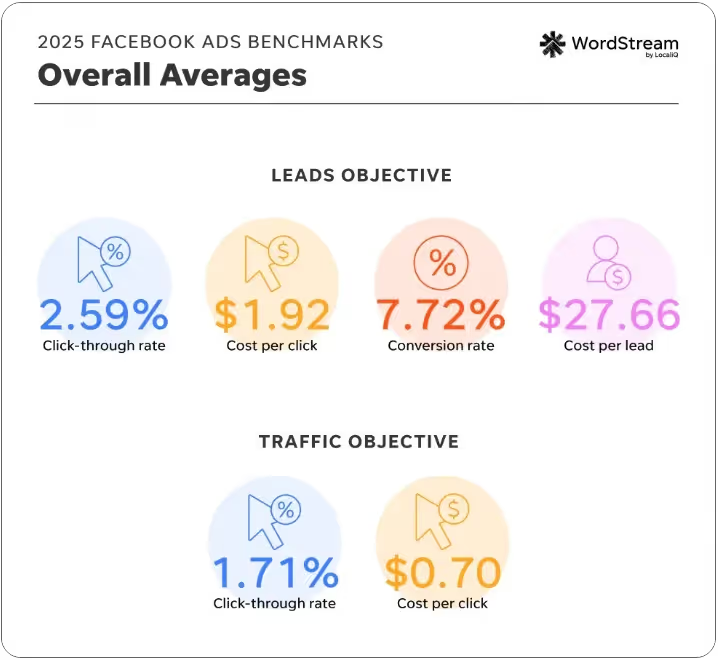
These are the average values of key KPIs for Facebook Ads, based on an analysis of 1,000 companies. (Source)
- CPC (cost per click) is the cost of attracting a user to the site.
It is the basic unit of purchase. In Meta, CPC is determined by auction competition for the audience, ad quality, and expected interaction. CPC reflects the price of audience access. In benchmarks, Facebook ads CPC varies significantly depending on audience type and targeting depth.
- CPL (cost per lead) is the cost of a single lead, or a contact obtained through advertising.
In SaaS, a lead may be a trial registration, a demo request, or another form of contact information obtained. CPL is determined by CPC and the conversion rate of the page to which the ad leads. CPL is the most common indicator used to evaluate the effectiveness of lead generation.
- Monthly spend is the actual investment amount in the channel.
It is a scale indicator. It is determined by the target number of leads and their cost. While the budget itself does not indicate effectiveness, it shows the level at which the acquisition model is working.
As previously mentioned, these metrics cannot be analyzed in isolation. CPC affects CPL, which determines the budget size for a given lead plan. Now, let's determine the current values of each for SaaS in 2026.
CPC Benchmarks for SaaS in 2026
CPC shows the cost per click on an ad in Meta Ads. For SaaS, CPC is a basic benchmark for the cost of accessing an audience. However, it does not replace CPL. The task is simple: establish a realistic price per click for SaaS to calculate CPL and future budgets.
To compare SaaS metrics to those of the market, you can use WordStream industry benchmarks, which show that the average CPC is $1.27 for technology and $2.52 for B2B. These values more accurately reflect the level of competition in the technology and professional segments of Meta Ads.
In practice, if SaaS is aimed at a broad audience and uses less narrow targeting, you can use a CPC of $0.66 as a baseline for evaluating campaign effectiveness. This is the level at which traffic is purchased relatively inexpensively.
However, if SaaS operates in the B2B segment with targeting for specific roles, industries, or narrow audiences, the actual CPC will often be closer to the B2B level of $2.52 or more. This is a consequence of higher competition for a limited pool of professional audiences.
However, CPC alone is not an indicator of effectiveness. It must be analyzed alongside lead conversion because the actual CPL is formed by the combination of "CPC × conversion rate."
If you want to structure campaigns correctly from the start, reviewing best practice Facebook ads approaches is essential.
CPL Benchmarks for SaaS
CPL is an indicator that directly affects the budget of a SaaS company. Unlike CPC, it already considers page conversion and offer quality. According to the most recent data, there are three different CPL levels for SaaS. It is important not to confuse them.
CPL Comparison Table
Here's how to interpret these figures:
- ~$40: A typical SaaS lead with a low barrier to entry
- ~$60+: A B2B SaaS lead with stricter criteria
- $150–$250: A lead closer to an SQL that requires in-depth qualification
These indicators are not mutually exclusive. They show how Facebook advertising price scales depending on qualification depth. Strong CPL performance is impossible without a clear Facebook lead generation architecture.
Monthly Budget Benchmarks for SaaS
CPC and CPL show the cost per traffic unit and lead, respectively. However, for planning purposes, it is more important to understand how much does it cost to run ads on Facebook for SaaS on a monthly basis.
Proven SaaS publishes an analysis of B2B SaaS companies' spending on Meta Ads. According to their data:
- Median monthly spend: $1,167
- 75th percentile spend: $3,486
- Average monthly spend: $9,346
This data is specific to SaaS and is based on an analysis of the Meta Ad Library and actual B2B SaaS advertising accounts. It helps answer the broader question of how much is a sponsored ad on Facebook cost in real SaaS environments, beyond theoretical benchmarks.
Here's how to interpret these figures:
- $1,167 (median): A typical budget for companies testing or scaling the channel to a limited extent
- $3,486 (75th percentile): Companies with an established acquisition model
- $9,346 (average): More aggressive scaling or mature SaaS with regular lead generation
The difference between the median and the average is explained by scaling patterns, which directly affect overall price for advertising on Facebook in SaaS. I linked the phrase itself rather than a separate mention, let me know if you'd rather it read as "our retargeting high-intent visitors service" or land in a different paragraph instead.
Monthly Spend Benchmarks
The values provided cannot be used as recommended guidelines when calculating the budget for your advertising campaigns. However, they show the range in which SaaS companies actually operate in Meta. Scaling spend efficiently requires systematic auditing, which is why many companies conduct a periodic Facebook ads audit.
How to Interpret These Numbers for Your SaaS
Without context, CPC and CPL figures alone don't mean much. This is why comparing a generic Facebook ads price list to SaaS benchmarks can be misleading. In SaaS, it's important to know where in the funnel a lead was obtained and how well it meets commercial criteria. Let's clarify what the benchmarks reflect and how to correctly interpret them:
- Facebook Ads in SaaS often work in the $40–$65 CPL range for standard B2B leads.
- Qualified leads cost significantly more, at $150+ for MQL/SQL-level leads.
- A typical SaaS budget on Meta is $1,000–$3,500 per month if the channel is being used systematically.
- More aggressive scaling strategies raise the budget to $9,000 or more per month.
The bottom line is that how much it cost to advertise on Facebook in SaaS cannot be assessed using a single metric. CPC, CPL, and budget must be considered together; otherwise, the picture will be incomplete.
In complex acquisition models, companies often compare Meta to other channels such as Facebook vs Google ads for business or even Google Ads vs LinkedIn Ads to understand cost dynamics.
Summary Table: SaaS-specific Facebook Ads Costs
In this table, we have combined all the indicators discussed. It separately indicates where the data is SaaS-specific and where it relates to Technology or B2B as the most relevant segment.
Cost Overview Table
Below is a structured summary to clarify average cost per click Facebook, CPL, and budget ranges in SaaS.
Companies that lack internal expertise often work with a specialized Facebook ads management agency. Alternatively, they benchmark performance against a list of best Facebook ads agencies to compare strategic approaches. Landing page performance should also be evaluated, and in many cases a dedicated conversion rate optimization agency can improve CPL without increasing CPC. Reviewing successful Facebook ads examples within SaaS also helps align creative expectations with cost benchmarks.
FAQs
What will Facebook ads cost for SaaS in 2026?

How much should a SaaS company spend monthly on Facebook ads?
Are Facebook Ads cheaper than Google Ads for SaaS?
How do I calculate the expected budget for Facebook Ads for SaaS?
What is a good CPC for Facebook Ads in SaaS?