
B2B Retargeting Ad Examples: Platforms, Creative, and Strategy

August 27, 2026
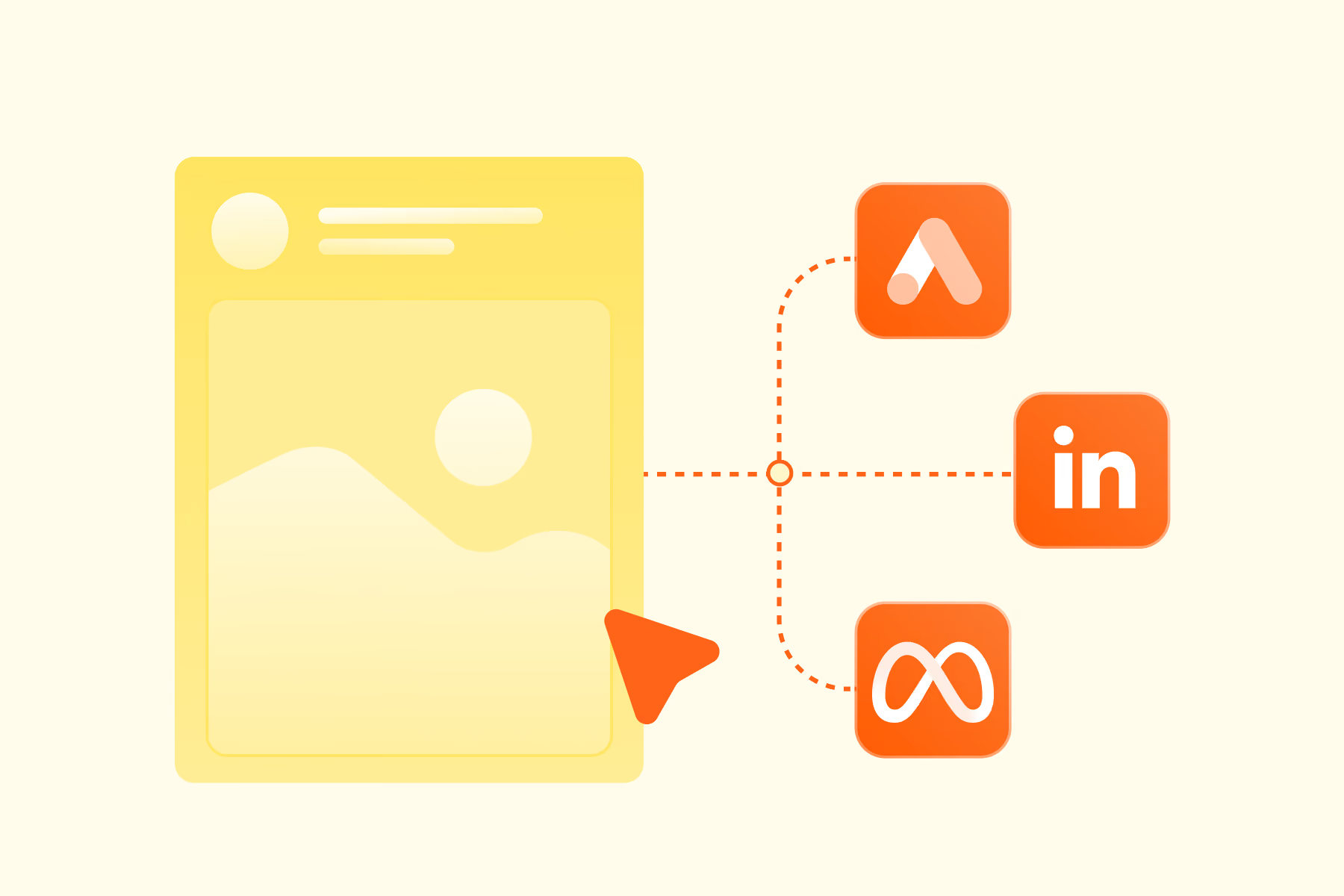
At Aimers, we don’t treat retargeting as cheaper prospecting. The strongest B2B retargeting Ad examples start with a buyer signal: what someone viewed, how recently they engaged, and what we know about their account or lifecycle stage. From there, we choose the audience, platform, creative, offer, and measurement logic. This guide shows how we apply that approach across LinkedIn, Google Display, and Meta using real campaigns and the decisions behind them.
In Brief: What the Examples Show
- Audience logic comes before platform choice: segment by behavior, recency, and lifecycle context, then activate the audience where it fits
- Retargeting should respond to a new signal instead of repeating the prospecting ad
- LinkedIn, Google Display, and Meta solve different activation problems; none is the universal best channel
- Measure B2B retargeting beyond clicks and CPL, using qualified conversions, pipeline progression, and revenue context
Why B2B Retargeting Needs a Different Logic Than Prospecting
B2B retargeting starts with context that prospecting does not have. We already know something about the buyer: a page they visited, an ad they engaged with, a form they submitted, or a CRM stage. That changes the creative, offer, and next action.
In our work at Aimers, prior behavior is a signal, not just permission to show the same ad again. A pricing-page visitor and a blog reader may both qualify for retargeting, but they should not automatically enter the same audience. One may be evaluating a solution; the other may still be defining the problem.
That matters because B2B buying is long and nonlinear. 6sense’s 2025 study of nearly 4,000 B2B buyers found an average buying cycle of 10.1 months, while the winning vendor was already on the buyer’s Day One shortlist 95% of the time.
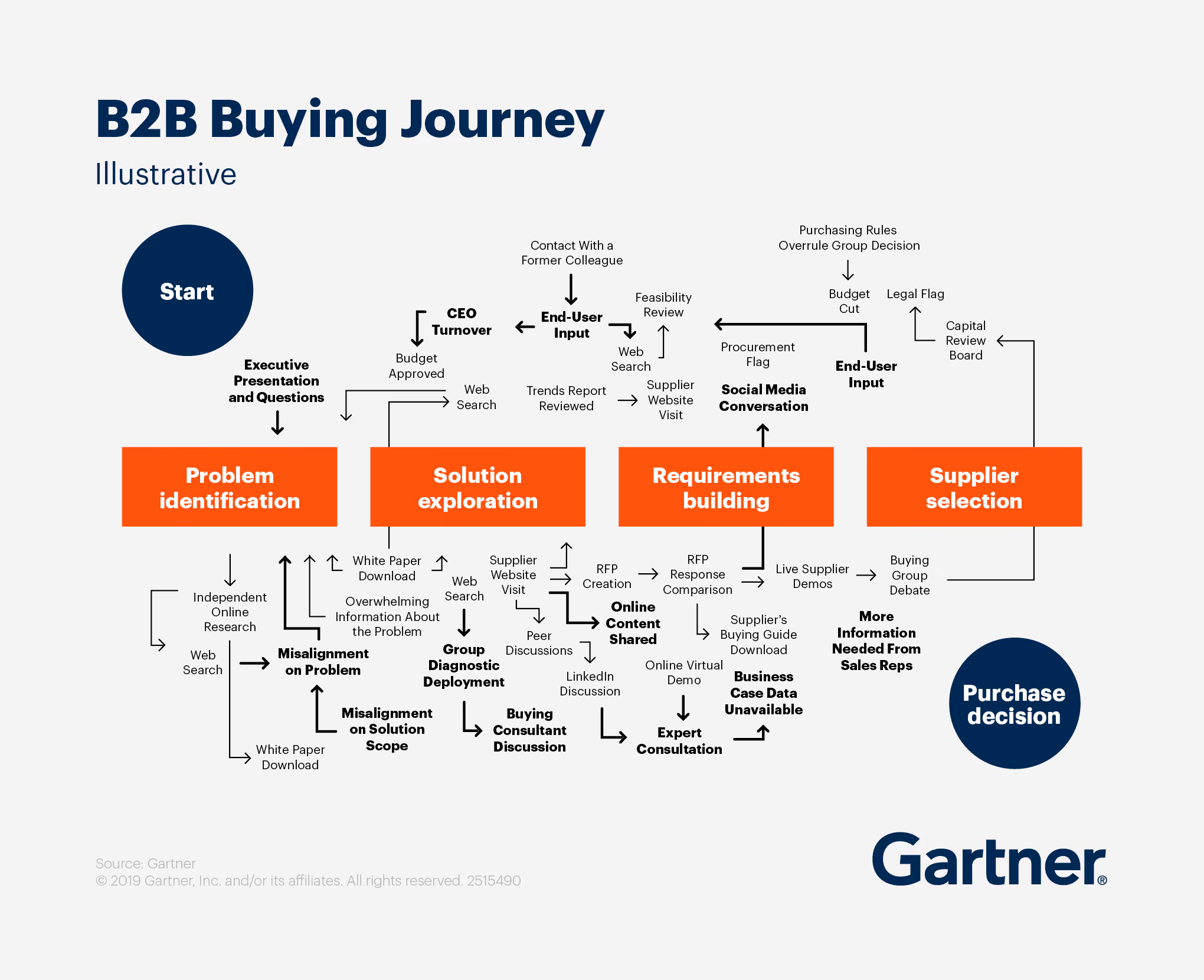
Gartner likewise describes B2B purchasing as a nonlinear process in which buyers revisit six buying jobs rather than moving through them once in a fixed order:
- Problem identification
- Solution exploration
- Requirements building
- Supplier selection
- Validation
- And consensus creation
Retargeting can therefore move directly to the question created by the previous interaction. A pricing visitor may need implementation or ROI proof. Someone who engaged with educational content may need a relevant customer case before a sales CTA makes sense. We look at direct conversion, but also at whether retargeted prospects keep moving toward qualified pipeline.
Build the Audience Before You Pick the Platform
Effective B2B retargeting starts with the reason someone entered the audience, not with whether we want to run LinkedIn, Google, or Meta. At Aimers, we build segmentation around three signals: what the buyer did, how recently they did it, and what we know about their lifecycle stage.
Segment by Intent and Page Behavior
Page behavior helps separate research from stronger evaluation signals. A generic “all website visitors” audience hides too much context. We would not treat a TOFU article visit the same as repeated visits to pricing, comparison, integration, security, or demo pages.
These are diagnostic categories, not fixed funnel stages. A pricing visit from an existing customer means something different from the same visit by a new ICP account, so lifecycle context must sit on top of behavior.
Segment by Recency, Scale, and Suppression
Recency changes the value of a signal, but we do not use one universal 7-, 30-, or 90-day rule. Windows depend on intent, buying-cycle length, audience volume, and platform delivery constraints.
LinkedIn offers 30-, 60-, 90-, 180-, or 365-day lookbacks for several engagement-based Matched Audiences, while an ad set needs at least 300 matched member accounts to run; available audiences in the EEA and Switzerland can be smaller because matching depends on member opt-in.
Google Display data segments need at least 100 active visitors or users in the previous 30 days under current eligibility rules. The practical tradeoff is precision versus usable reach. We would rather combine signals that still represent the same buyer state than create many theoretically perfect segments that cannot deliver. We also treat frequency as a diagnostic: if a small pool absorbs spend while response weakens, the fix may be new creative, a different offer, a wider window, or suppression rather than one universal frequency cap.
Suppression belongs in audience design. Once someone converts, becomes an active opportunity, or reaches a lifecycle stage where acquisition messaging no longer fits, they should leave that retargeting path.
Build CRM and Lifecycle Audiences
Known lifecycle data lets us move beyond anonymous pixel audiences. LinkedIn Matched Audiences can use uploaded company or contact lists, Google Customer Match uses first-party customer data to reach and re-engage users across Search, Shopping, Gmail, YouTube, and Display, and Meta Customer List Custom Audiences can be built from advertiser-provided data such as email addresses and phone numbers, subject to Meta’s rights, permissions, and lawful-basis requirements.
At Aimers, we segment known contacts by what should happen next:
- An inactive MQL may need stronger customer proof
- An SQL may need implementation evidence
- An active opportunity may need content that helps the buying committee reach consensus
- And a closed-won customer should usually leave acquisition retargeting unless the campaign is designed for expansion
Platform choice comes after that logic.
B2B Retargeting Ad Examples by Platform
The platform should follow the buyer signal, not the other way around. The B2B retargeting Ad examples below use the same lens: audience signal, why the platform fits, what we show, and how we measure it. Where results reflect the broader paid program rather than isolated retargeting lift, we say so explicitly.
LinkedIn Retargeting Ad Examples
LinkedIn is strongest when professional context makes the retargeting signal more useful. Website behavior can tell us that someone visited pricing; LinkedIn can add role, company, first-party list, and engagement context. Current Matched Audience options include website visits, ad and video engagement, Lead Gen Form activity, Company Page engagement, events, and Conversions API data. That is why our Linkedin retargeting Ad examples are not built around one generic visitor pool.
Mixpanel: Granular Remarketing Across Multiple Signals
For Mixpanel, we built separate audiences around Lead Gen Form engagement, Company Page engagement, website visits, completed conversion actions, and video engagement. We then launched Spotlight remarketing across regions and video campaigns using remarketing audiences and proven targeting from the account.
The audience was already known to have interacted with Mixpanel, but the type and strength of the signal differed. LinkedIn let us combine those engagement signals with professional context. We tested Spotlight Ads and video rather than relying only on the static assets already running.
Measurement went beyond platform response. We reorganized conversion tracking, standardized UTMs, set up more than 30 Lead Gen Forms, and compared campaign data with qualified-lead data in Salesforce. Across the broader LinkedIn optimization program, qualified leads increased by 164% and CPL fell by 67% in the first six months. These are account-level results, not an isolated retargeting uplift.
.avif)
That distinction is important. We would rather show where remarketing sat inside a successful paid acquisition system than assign the entire result to one tactic that was never tested in isolation. For platform mechanics, see our LinkedIn retargeting guide.
Google Display Retargeting Ad Examples
Google Display is useful when we already have a first-party website signal and want to re-engage that audience outside the original visit. Google now refers to these audiences as “your data” segments; website segments can use page-level rules and membership duration rather than treating every visitor alike.
The display retargeting Ad examples here focus on non-converting visitors and behavior-based audience design.
Demio: Display Remarketing for Non-Converting Visitors
For Demio, we ran a dedicated Display Remarketing campaign with banners and video for people who had visited the site but had not converted. We also used Search Remarketing for previous visitors who returned to Google and continued searching for webinar-related solutions.
The signal was simple but useful: prior website interest without the desired conversion. Display gave us another way to maintain visibility, while Search captured renewed active demand. We tested banners, video, and different CTAs rather than locking one creative into the warm audience.
We also connected Demio’s CRM to Google Ads and Microsoft Ads so optimization could focus on paying customers rather than trial signups. Across the broader 2024 PPC program, spend increased by 60.11%, customers increased by 109.91%, and cost per customer fell by 23.72%. These are full-program results, not isolated Display-retargeting lift.
.avif)
Yojee shows the same audience principle in a more granular setup: Aimers built remarketing audiences around key-page visits and specific Google Analytics goals. Across the broader Google Ads program, conversions increased by 66% and CPA fell by 34%.
.avif)
For setup details, see our Google Ads Remarketing guide. We do not treat Performance Max as a clean retargeting-only campaign. First-party audiences can be supplied as audience signals, but Google describes those signals as suggestions rather than hard targeting criteria, so PMax can serve beyond the supplied audience.
Meta Retargeting Ad Examples
Meta is most useful to us when a warm first-party audience already exists and we want another environment for re-engagement and creative testing. Meta Customer List Custom Audiences can use advertiser-provided first-party data, subject to the required rights, permissions, and lawful basis.
Once we already know the person or account, Meta does not need to infer the entire ICP from cold-interest signals. The Facebook retargeting Ad examples below therefore sit inside a broader acquisition system rather than replacing B2B targeting elsewhere.
Propello: Retargeting Inside a Segmented Acquisition System
For Propello, we combined remarketing with segmented prospecting across Meta and Google. The broader strategy included Search, Performance Max, Demand Gen, video, remarketing, competitor campaigns, and flexible budget allocation.
Remarketing was reserved for users who had already created a useful signal, while prospecting reached new subject-specific educators. That separation let us change the message for existing familiarity rather than reuse a cold-acquisition ad. Across the broader engagement, total sign-ups increased by 235%; for Meta over the comparison period, CPA fell by 33% while spend fell by 48%. These results reflect the full optimization program, not an isolated retargeting experiment.
.avif)
For more detail, see our Facebook retargeting guide.
LinkedIn vs. Google Display vs. Meta: What Each Platform Is Best At
There is no universal best platform for B2B retargeting. We choose based on the signal we need to activate and the job the next impression needs to do.
In practice, a buyer can engage on LinkedIn, revisit through Search, see Display later, and encounter Meta before entering pipeline. The important question is whether each campaign responds to the latest signal instead of duplicating the same message across channels.
Creative Strategy: Match the Ad to the Buying Signal
The best retargeting creative does not restart the conversation. It responds to what the buyer has already shown us. Across these B2B Ad examples, we use the audience signal to decide what the ad needs to prove, what offer fits, and how direct the CTA should be.
How Retargeting Creative Differs From Prospecting Creative
Prospecting creative has to establish relevance; retargeting creative can use existing context. The practical question is: what uncertainty is still preventing this audience from moving forward? For a colder visitor, it may be basic relevance. During evaluation, it may be product fit, implementation, compliance, ROI, or internal buy-in.
Our mdeg work shows how account-specific that can be. We tested 4–5 ads simultaneously, varying the value proposition, USP, wording, and visual direction. In that MedTech account, creatives showing real medical devices or documents generated demos more effectively than visuals built around people, abstract charts, or generic icons. We treated that as a finding about this audience and category, not a universal design rule.
We also used concrete product capabilities and regulated-industry requirements in the messaging, including encrypted data transmission and compliance with ISO 13485, ISO 27001, HIPAA, and GDPR. The point was not simply more clicks; specificity helped qualify prospects who recognized those requirements. That is how we use retargeting Ad examples: as responses to known buyer states, not isolated creatives to copy.
Proof, Offers, and CTAs by Intent Level
As intent strengthens, we usually make the proof more specific and the next step more direct.
These are not fixed stages. If someone moves from educational content to pricing, the message should change with the stronger signal. We also separate proof from generic social validation: later-stage buyers often need evidence about outcomes, workflow fit, implementation, or risk rather than another logo wall.
For us, the CTA should reflect the buyer’s current signal, not simply the conversion event the advertiser most wants to collect.
First-Party Data and Retargeting Signals in 2026
First-party data matters more for B2B retargeting, but not because Chrome has simply eliminated third-party cookies. In April 2025, Google said Chrome would maintain its existing approach to third-party-cookie choice rather than introduce the standalone prompt it had explored.
The stronger reason to invest in first-party data is operational: CRM lifecycle stage, known identity, website behavior, lead-form engagement, product activity, and qualified conversion events can tell us more about what should happen next than anonymous browser activity alone.
Google Customer Match is built around advertiser first-party customer data and can be used across eligible Google inventory. LinkedIn Conversions API connects online and offline conversion data server-to-server, can be used alongside the Insight Tag, and supports full-funnel measurement without relying on cookie-based tracking alone.
At Aimers, we see these tools as infrastructure, not a replacement for segmentation. A website pixel, CRM sync, customer list, and server-side conversion feed can all improve the signal, but the campaign still needs clear inclusion, exclusion, and lifecycle logic. That is why our B2B retargeting Ad examples are organized around buyer state rather than one tracking technology.
How to Measure B2B Retargeting Beyond CTR
At Aimers, we measure B2B retargeting closer to pipeline and revenue. CTR, CPC, frequency, and landing-page engagement remain useful diagnostics, but they do not tell us whether a campaign is moving commercially relevant accounts forward.
The closer measurement gets to revenue, the more important CRM integration becomes. We saw this with Cloudvisor: Aimers mapped the path from form submission through MQL, SQL, Opportunity, and Closed-Won, then integrated key HubSpot conversion events into Google Ads so optimization could use downstream signals. Across the broader optimization program, MQL-to-SQL conversion increased by 130% and Opportunity volume grew by 50%.
Warm audiences can make top-level efficiency look strong, but an easier click or conversion does not prove that retargeting created the opportunity. Across our B2B retargeting Ad examples, that is why we distinguish account-level program results from isolated retargeting lift.
Attribution Without Over-Crediting Retargeting
Attribution shows where retargeting appeared in the journey; it does not automatically prove causality. Last-touch models can over-credit a late retargeting interaction, while first-touch models can ignore its contribution to progression.
We therefore separate sourced pipeline from influenced pipeline when the data allows it. Metadata defines sourced pipeline as pipeline where marketing originated the opportunity, while influenced pipeline includes deals where marketing interacted with the account somewhere in the journey even if another channel sourced it.
.avif)
Retargeting often contributes to influenced pipeline rather than sourcing the opportunity, so the two should be measured separately
Multi-touch attribution can distribute credit across several interactions, and account-level models can connect activity from multiple stakeholders, but attribution remains a model rather than causal proof. When audience size and campaign design make it practical, randomized holdouts provide a stronger causal test by comparing exposed and control groups. IAB and IAB Europe describe randomized control and holdout approaches as experiment-based incremental measurement with strong causal strength, while also noting the cost and design limitations.
We do not use a universal sample-size rule for holdouts. The required sample depends on baseline conversion, expected effect, statistical power, audience size, and test design.
So our measurement logic is:
That keeps retargeting accountable without pretending every impression that appears before a closed deal deserves revenue credit.
How to Run Retargeting Across a Long B2B Buying Cycle
B2B retargeting should change when the buyer changes. We do not build one static audience, assign it a calendar window, and keep serving the same campaign until the person expires from the list. New behavior can change the audience, message, and next action.
Let New Buyer Behavior Change the Audience
A stronger new signal should usually override an older, weaker one. Someone who entered retargeting after reading a blog post but later visits pricing, security, integrations, or a demo page should no longer be treated as an early-stage content visitor.
At Aimers, we think about this as audience-state transitions:
- Content engagement → research-stage nurture
- Product activity → evaluation-stage proof
- Pricing or demo activity → commercial next step
- Active opportunity → validation or consensus support
- Closed-won → acquisition suppression
- Stalled or lost opportunity → reactivation when relevant
This is not a universal funnel model. It is a way to make segmentation respond to new information instead of letting old list membership define the buyer indefinitely.
Coordinate Retargeting With CRM and Sales
Once sales activity exists, the job of the ad should change with it. Someone who booked a demo does not need another “Book a demo” acquisition ad. An open opportunity may instead need a customer story, implementation resource, security proof, or role-specific content that helps another stakeholder evaluate the purchase.
The paid media system should therefore know when a prospect becomes an SQL, enters an opportunity, books a demo, or closes. This is especially relevant in group buying. 6sense reports that buying groups in its research average more than 10 members for deals averaging $250,000, so one person’s conversion does not necessarily mean the whole account has completed evaluation.
Suppression does not always mean “stop all advertising to the account.” It means stop the message that is no longer appropriate. Across a long cycle, the campaign should follow the latest meaningful buyer signal rather than a fixed calendar sequence.
B2B Retargeting: The Bottom Line
Effective B2B retargeting is not about following every website visitor with the same ad. It is about using known buyer signals to decide who should stay in the audience, what message should come next, which platform can activate that audience effectively, and how the campaign should be measured.
At Aimers, we treat retargeting as part of the broader acquisition and pipeline system. Behavior, recency, CRM context, creative, platform choice, and downstream measurement need to work together. When they do, retargeting can support the buyer’s next decision instead of simply adding more impressions to an already long journey.
If your retargeting still relies on broad visitor pools, fixed windows, or platform-level conversions alone, we can help you identify where the strategy, targeting, or measurement logic needs to change.
FAQs
Prospecting introduces the product to a new audience; B2B retargeting responds to a signal that already exists. That changes the creative, offer, and measurement logic. A cold prospect may need category context, while a known visitor or CRM contact should get a message that reflects what they already did. The most useful B2B Ad examples show that progression rather than just a high-performing creative.

There is no universal winner. LinkedIn is useful when professional or company context matters, Google Display for website re-engagement, and Meta for warm first-party audiences and creative testing. Audience scale can constrain the choice, so we start with whether the platform can reach the intended segment with enough precision and volume to be useful.
There is no fixed 7-, 30-, or 90-day rule. We set recency based on intent, buying-cycle length, audience volume, and delivery requirements. A recent pricing interaction may justify a shorter window than educational content, but aggressive segmentation can leave small B2B audiences unable to deliver.
The ads that work are the ones that change as the buyer’s questions change. Early interactions may call for a use case or customer story; evaluation may need implementation, comparison, security, or ROI proof; strong commercial signals can support a demo or sales CTA. The campaign should react to behavior, not wait for a calendar milestone.
Build the program around stronger first-party data. Connect website behavior with CRM stages, customer lists, qualified conversion events, and server-side data; a pixel can help, but it should not be the only signal defining audience entry or exit.
October 7, 2026
October 6, 2026