
B2B SaaS Demand Generation Strategy: A Pipeline-First Guide

Most B2B SaaS demand generation strategies fail for a simple reason: they are built around activity before they are built around revenue.
The team launches LinkedIn campaigns, runs paid search, hosts webinars, publishes content, turns on retargeting, and reports on MQL volume. The dashboard looks busy. But when sales reviews the pipeline, the quality is uneven, deal progression is slow, and leadership is still asking why marketing spend is not producing enough qualified opportunities.
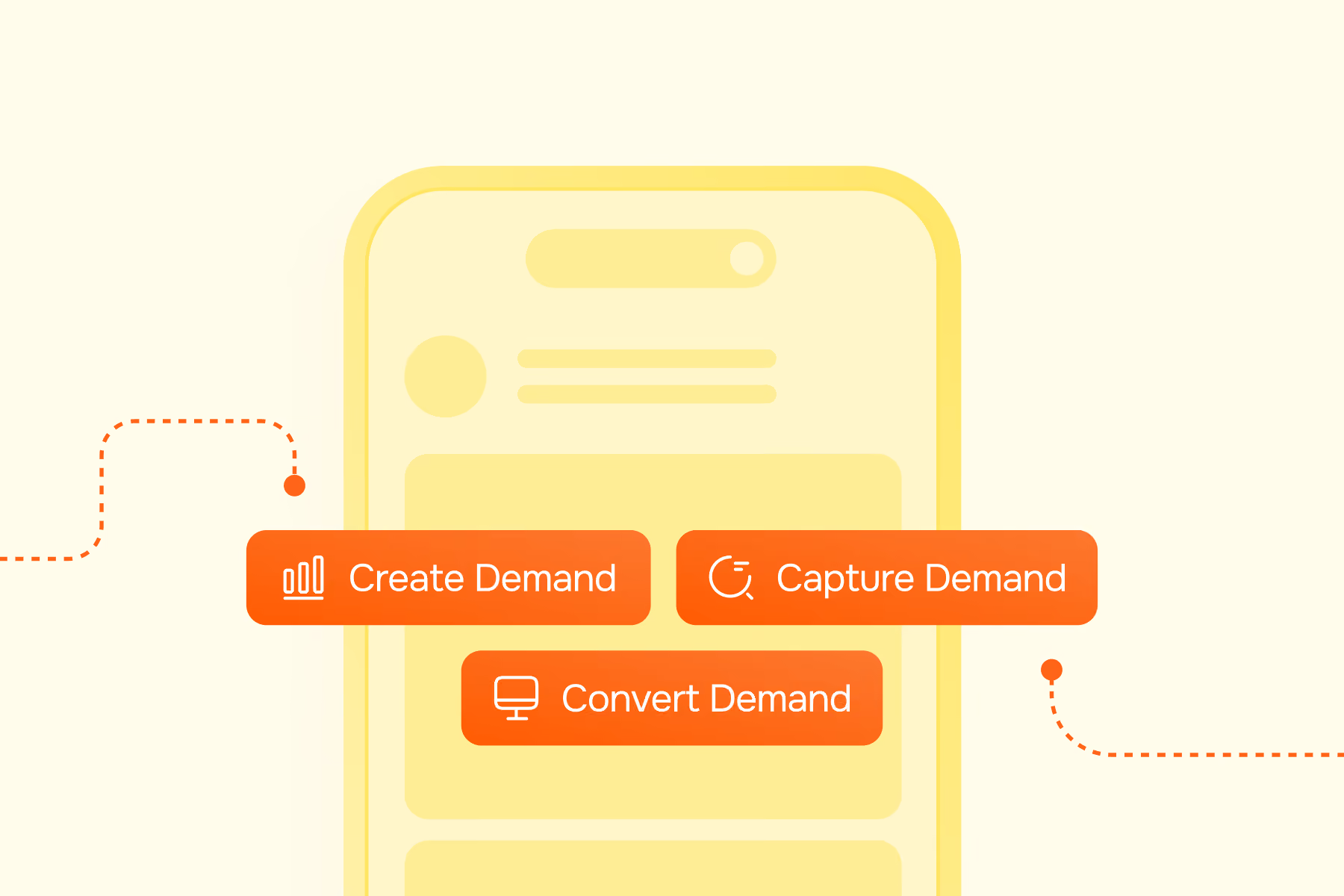
A better way to build demand generation is as a revenue system. The job is not to create interest in the abstract. The job is to create future demand, capture existing intent, convert that intent into qualified pipeline, and learn which channels, messages, audiences, and conversion paths deserve more investment.
Direct answer: a B2B SaaS demand generation strategy is an operating plan for creating and capturing buyer intent across channels such as paid search, LinkedIn Ads, SEO, content, webinars, ABM, retargeting, landing pages, and sales enablement, then measuring success by qualified pipeline, revenue efficiency, deal quality, CAC, and payback rather than raw lead volume.
Key Takeaways
- Demand generation is broader than lead generation. Lead gen collects contact information; demand gen creates, captures, and converts buying intent.
- SaaS teams need both demand creation and demand capture. Capture-only programs plateau; creation-only programs are hard to justify without pipeline discipline.
- In 2026, demand gen also needs to account for AI-assisted research, dark funnel behavior, review sites, buying committees, and account-level intent.
- ABM works best when it is integrated with paid media, content, retargeting, landing pages, and sales outreach, not treated as a separate campaign lane.
- The strongest measurement systems combine platform data, CRM progression, self-reported attribution, branded demand, account engagement, and revenue-quality metrics.
.avif)
What Is B2B Demand Generation Strategy?
A B2B demand generation strategy is the system a SaaS team uses to build awareness, educate the market, capture active buying intent, and convert that intent into qualified pipeline.
That definition matters because demand generation is often reduced to tactics: a webinar, a LinkedIn campaign, a gated report, a search ad group, or a nurture sequence. Those can all be useful, but they are not strategy by themselves.
A real strategy answers six questions:
- Which accounts and roles are most likely to become good customers?
- What does the buying committee need to understand or believe before taking action?
- Where does the market already show intent?
- Where do we need to create demand before buyers are in-market?
- Which conversion paths turn interest into sales-accepted opportunities?
- Which metrics prove that the system is improving pipeline quality and revenue efficiency?
For Aimers, this maps directly to full-funnel performance work across B2B SaaS demand generation services, paid media, CRO, landing pages, and analytics.
Demand Generation vs. Lead Generation
Lead generation is a subset of demand generation. The problem starts when teams treat them as synonyms.
The better question is not 'how many leads did we get?' It is 'how much qualified pipeline did we create, at what cost, and with what expected payback?'
What Changed in B2B SaaS Demand Gen in 2026
The core principles of demand generation are not new, but the buying environment has changed. Buyers research more independently, sales cycles involve more stakeholders, and more early-stage evaluation happens outside the channels marketers can easily track.
- AI-assisted research is now part of the buyer journey. Buyers can ask AI tools to summarize categories, compare vendors, explain tradeoffs, and build shortlists before visiting your site.
- The dark funnel is darker. Peer communities, review sites, internal Slack threads, podcasts, newsletters, and AI answers shape opinions before a form fill appears.
- Paid channels are more expensive. SaaS teams need better intent segmentation, landing page match, and sales feedback to protect CAC.
- Buying committees are more complex. One asset rarely wins the deal; different roles need different proof.
- Self-reported attribution and account-level engagement matter more because last-click reporting misses too much of the decision process.
G2's 2026 AI Search Insight Report argues that B2B software research increasingly starts in AI answers, not only traditional search results. See G2's AI search report.
Create Demand vs. Capture Demand
The most useful strategic split is simple: some channels create future demand, while others capture existing intent. Mature SaaS teams use both.
For capture programs, Aimers' SaaS PPC services and Google Ads management are especially relevant when the team needs cleaner intent segmentation and better pipeline-quality reporting.
.avif)
Where ABM Fits Into SaaS Demand Generation
ABM is not the opposite of demand generation. For B2B SaaS teams selling into defined segments or enterprise accounts, ABM is one way to focus demand generation around the accounts that matter most.
ABM is usually useful when:
- the addressable market is narrow enough to name target accounts
- ACV is high enough to justify account-level personalization
- the buying committee includes several roles
- sales has a clear account list and a reason to prioritize it
- marketing can support account-level awareness, retargeting, landing pages, and proof assets
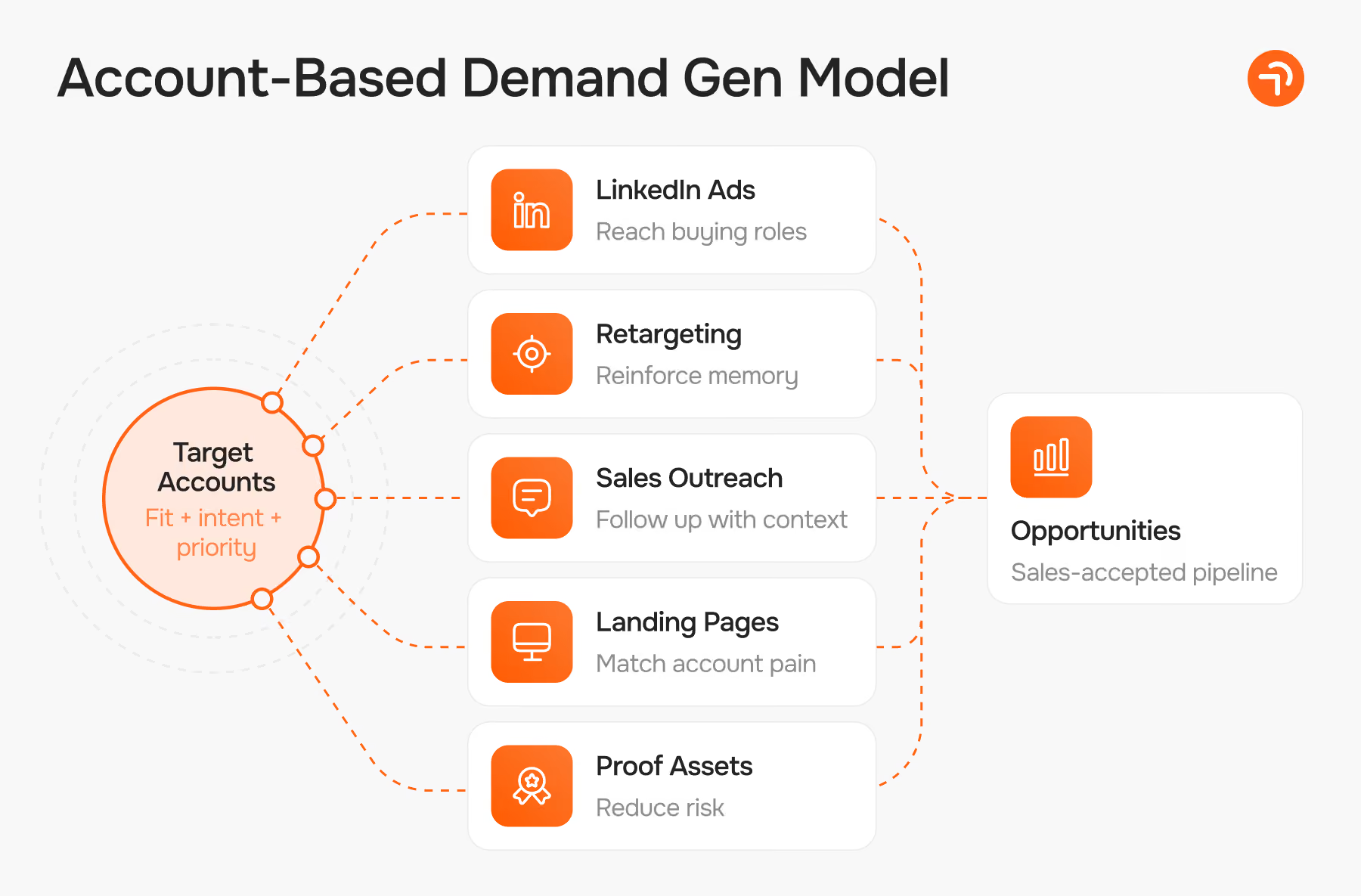
The mistake is treating ABM as a one-off LinkedIn campaign. A stronger account-based demand gen motion connects LinkedIn audience building, retargeting, account-specific messaging, sales outreach, comparison content, landing pages, and CRM feedback.
This is where LinkedIn Ads and paid social media can support demand creation when audiences are tightly defined.
How to Build a B2B SaaS Demand Generation Strategy
1. Start With ICP and Buying Committee Clarity
A demand gen strategy breaks when 'the audience' is too broad. SaaS teams need to define the company fit, buyer roles, pain points, objections, trigger events, and decision criteria before selecting channels.
A PLG product with low-friction signup does not need the same demand gen architecture as a sales-led platform with a six-month buying cycle. Same market, different psychology.
2. Map Research Behavior, Not Just Funnel Stages
Modern buyers move between search, AI tools, LinkedIn, review sites, vendor websites, peer recommendations, webinars, and sales conversations. A useful journey map should show where the buyer learns, compares, validates, and decides.
- Awareness: buyers are problem-aware but not vendor-ready.
- Consideration: buyers compare approaches, categories, vendors, and tradeoffs.
- Decision: buyers need proof, pricing context, implementation confidence, and low-friction next steps.
- Expansion: customers look for more value, new use cases, or broader adoption.
3. Choose Channels by Funnel Role
Do not choose channels because they are popular. Choose them because they play a clear role in creating, capturing, or converting demand.
4. Build Conversion Paths That Match Intent
Demand gen often fails after the click. If the landing page is generic, the CTA is wrong for the stage, the form asks too much, or sales follow-up is slow, qualified demand leaks out of the system.
That is why landing page design and conversion rate optimization belong inside demand gen strategy, not after it.
Strategy by SaaS Stage
What to Measure Instead of MQL Volume
MQLs are not useless, but they are incomplete. If MQL volume rises while sales acceptance, opportunity creation, or win rate drops, the system is optimizing the wrong thing.
Benchmarks vary by stage and ACV, but recent SaaS benchmark discussions increasingly emphasize pipeline coverage, CAC payback, SQL quality, and channel-level close rates over raw MQL counts. For one benchmark view, see Dupple's 2026 B2B SaaS pipeline benchmarks.
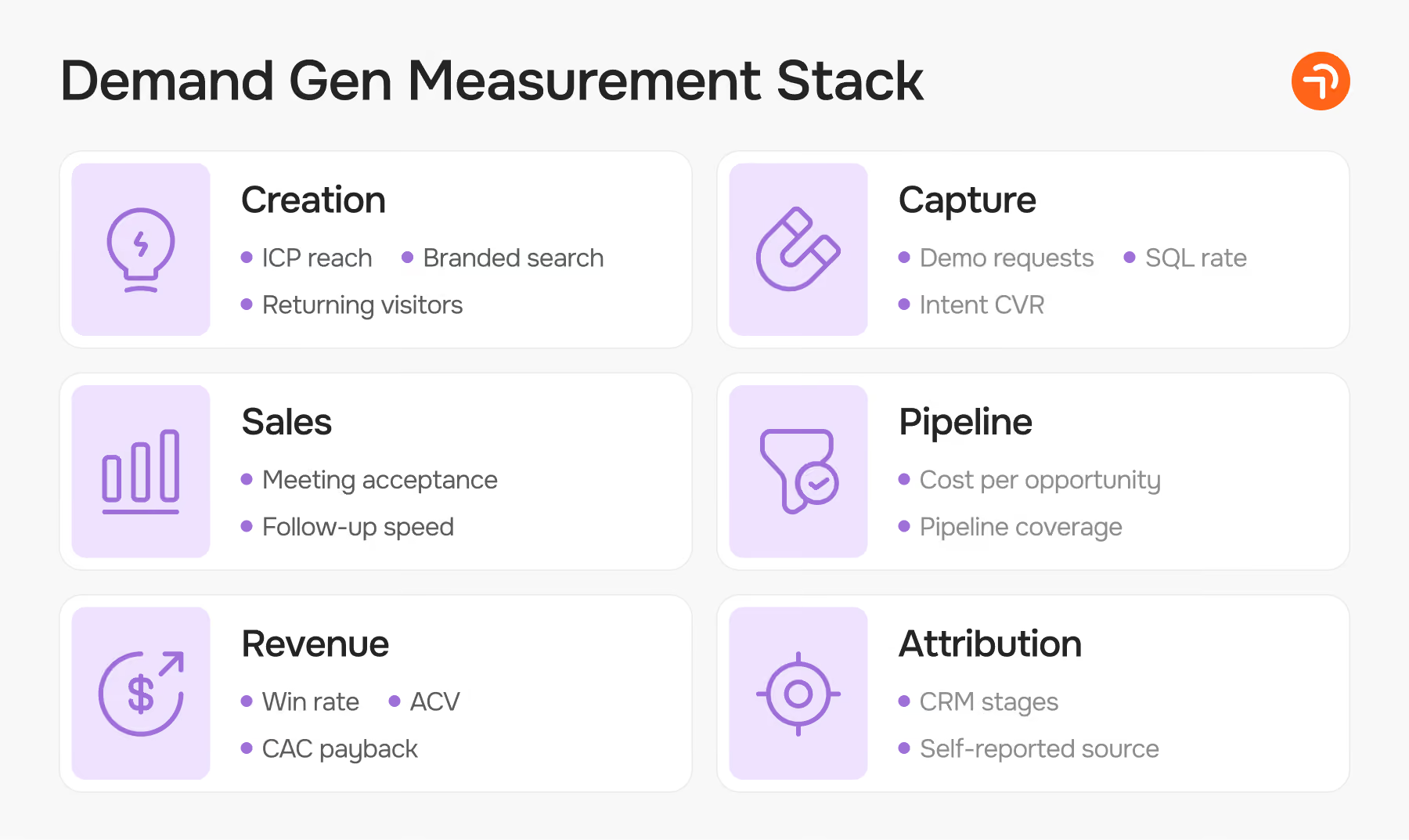
If tracking is fragmented, Aimers' analytics services can help connect channel activity, landing page performance, and CRM outcomes.
A Practical 90-Day Demand Gen Framework
A PPC audit is often the fastest way to find capture-demand waste when search campaigns, landing pages, and conversion tracking have drifted over time.
.avif)
Aimers Field Observations
The best SaaS demand gen programs are often boring in the right way: clear ICP, clear channel roles, message-matched pages, sales feedback, and disciplined measurement. They do not chase every trend. They build a system that can be diagnosed.
The patterns Aimers often sees are more specific:
- Google Ads may generate demos, but SQL quality drops when campaigns optimize for form fills instead of qualified opportunities.
- LinkedIn can build the right awareness, but it gets expensive when audience definitions are broad and the offer is generic.
- Landing pages often underperform because they are reused across audiences with different pain points, buying stages, and objections.
- Retargeting is frequently treated as a reminder campaign instead of a stage-specific path back to proof, comparison, or demo content.
- Reporting can make the wrong programs look successful when it stops at platform conversions and never reaches CRM progression.
This is why Aimers typically connects media strategy with landing page quality, CRO, and measurement discipline. You can see examples of that performance approach in Aimers case studies.
Common Mistakes B2B SaaS Teams Make
- Overinvesting in one channel. A channel can be efficient and still be strategically fragile.
- Confusing activity with outcomes. Impressions, traffic, downloads, and MQLs are not business outcomes unless they translate into opportunities.
- Ignoring AI search and dark funnel influence. Buyers often form opinions before any trackable conversion appears.
- Treating ABM as a campaign instead of an account-level operating motion.
- Sending every audience to the same landing page and CTA.
- Measuring everything by MQLs, which usually rewards volume inflation instead of pipeline quality.
- Skipping sales feedback, which leaves marketing optimizing for signals sales does not trust.
Final Takeaway: Build Demand Gen Like a Revenue System
The strongest B2B SaaS demand generation strategy is not a list of channels. It is a system for creating future demand, capturing existing intent, converting that intent into qualified opportunities, and learning which programs improve revenue efficiency.
The teams that win are not always the teams doing the most. They are the teams with the clearest ICP, strongest channel roles, best conversion paths, tightest sales feedback, and most honest measurement.
If your team needs help finding where demand is leaking across paid media, landing pages, CRO, and analytics, contact Aimers or start with a demand generation audit.
FAQs
What is the main goal of a B2B SaaS demand generation strategy?

What is the difference between demand generation and lead generation?
Which channels are best for SaaS demand generation?
Where does ABM fit into demand generation?
How does AI search affect demand generation?