
Demand Generation vs Lead Generation: Key Differences and How to Use Both

September 23, 2026
If marketing reports stronger performance while sales keeps asking where the pipeline is, the channel may not be the problem. The connection between demand generation and lead generation often is.
At Aimers, we see teams push paid search harder as CPL rises, judge LinkedIn by immediate demo requests, or celebrate cheaper leads while MQL-to-SQL conversion falls. Demand generation is the broader system for creating, capturing, and converting buying intent. Lead generation is one motion inside it, focused on turning visible interest into prospects marketing and sales can qualify and pursue.
That makes the useful demand generation vs lead generation question much more practical: does your market need more reasons to care, a better path to convert, or stronger qualification after the form fill? Below, we break down how to diagnose that bottleneck, choose the right mix, measure both motions against revenue, and turn them into a workable 90-day plan.
Demand Generation vs Lead Generation: The Short Answer
Demand generation creates, captures, and converts buying intent across the revenue journey; lead generation turns identifiable interest into prospects that marketing and sales can qualify. In B2B SaaS, lead generation is part of the demand generation system, not a competing strategy. Our B2B SaaS demand generation strategy uses this pipeline-first view to connect future demand, active intent, conversion, and downstream revenue quality.
The operating sequence is therefore:
A buyer may encounter ungated content or a LinkedIn campaign long before becoming identifiable, return through search or an answer engine when the problem becomes urgent, and only then submit a demo form. Lead generation captures the visible hand-raise. A mature demand generation strategy also accounts for the work that made that hand-raise more likely in the first place.
What Is SaaS Demand Generation?
SaaS demand generation is the system for creating buying intent, capturing it when buyers enter the market, and converting it into qualified pipeline. It extends beyond awareness because recognition without an evaluation path rarely produces revenue.
That broader view reflects how B2B buyers behave. In 6sense’s 2025 study of nearly 4,000 buyers, buyers first contacted sellers 61% of the way through the journey, and the eventual winner appeared on the Day One shortlist in 95% of purchases.
Demand Creation
Demand creation gives ICP-fit buyers a reason to care before they are actively comparing vendors. It uses category education, original research, thought leadership, educational SEO, webinars, paid social, and customer proof to connect a costly problem with a credible solution.
Modern research also happens beyond the vendor website. G2’s 2026 AI Search Insight Report found that 51% of B2B software buyers start their research with an AI chatbot more often than Google. Buyers may learn through answer engines, review sites, communities, peer recommendations, or forwarded content without creating a clean attribution event.
%20(1).png)
This expands the dark funnel. A B2B SaaS demand generation strategy must distribute useful, credible information where research happens, while keeping the audience narrow enough to produce future commercial value. In B2B demand generation, broad exposure has little value unless the audience can eventually buy.
Demand Capture
Demand capture gives active buyers a measurable route into evaluation. High-intent paid search, commercial SEO, comparison pages, retargeting, pricing and product pages, webinars, trials, and demos help buyers act once intent appears.
Lead generation becomes visible here, but the terms remain distinct. Demand capture can include anonymous account activity; lead generation begins when the company can identify and qualify a person or account. A SaaS demand generation agency should therefore look beyond CPL and ask whether captured buyers become SQLs, opportunities, and revenue.
Demand Conversion
Demand conversion turns captured intent into commercial progress. The landing page, offer, qualification logic, and sales follow-up should reflect what marketing already knows about the buyer.
A cold account may need an ungated comparison or case study. Someone searching for a competitor alternative may be ready for pricing, a trial, or a demo. Sending both to the same form ignores buyer state and usually hurts either conversion or lead quality.
What Is SaaS Lead Generation?
SaaS lead generation turns identifiable interest into qualified prospects and gives marketing or sales a clear next action. A sound lead generation strategy covers capture, qualification, routing, and feedback. Leads may come from demos, trials, webinars, gated assets, retargeting, or other conversions where the buyer provides enough information to evaluate fit and intent.
Lead Capture
Lead capture creates an identifiable conversion point with an offer appropriate to the buyer’s stage. Active evaluators may request pricing, a consultation, a trial, or a demo. Earlier-stage buyers may register for a webinar or exchange details for genuinely useful gated content.
The form alone does not make effective B2B lead generation. A long demo form may work for a high-intent search visitor and fail with a cold LinkedIn audience. A SaaS PPC agency should match the query or audience, message, landing page, and ask instead of forcing all traffic toward the same conversion.
Lead Qualification and Routing
Qualification separates raw form fills from prospects worth further investment, while routing turns that judgment into action. An MQL meets agreed marketing criteria such as ICP fit, role, company profile, use case, or engagement. An SQL is a lead that sales accepts as worth pursuing.
The MQL to SQL rate exposes quality problems that CPL cannot. If form fills rise while fewer MQLs become SQLs, acquisition may be getting cheaper without improving. In our Mixpanel paid acquisition program, we standardized conversion tracking, restructured LinkedIn campaigns, and expanded remarketing. Qualified leads increased 164% while CPL fell 67% during the first six months.
%20(1).png)
Routing should preserve source, campaign, offer, account, role, use case, and relevant engagement history. A high-fit demo request may need immediate sales follow-up; a webinar lead may belong in nurture until stronger intent appears. A SaaS lead generation agency should optimize this full lead generation strategy against sales acceptance and pipeline contribution, not contact volume alone.
Which Should B2B SaaS Teams Prioritize?
B2B SaaS teams should prioritize the part of the demand generation vs lead generation system that is constraining qualified pipeline now. Company stage, ACV, category maturity, sales cycle, buyer intent, sales capacity, and payback pressure determine the mix more reliably than a standard budget split. Those inputs turn a broad demand generation vs lead generation debate into a specific investment decision.
When Demand Generation Should Lead
Demand generation should receive more investment when the market is not producing enough qualified intent to capture. Common signals include low category awareness, limited commercial search, weak branded demand, long sales cycles, and sales feedback that prospects need substantial education.
This matters more with high ACV and a complex buying committee. 6sense reported an average B2B buying cycle of 10.1 months in 2025, while LinkedIn describes a typical buying committee as roughly 6–10 people. B2B demand generation may need to build familiarity and trust with several stakeholders before one person submits a demo request.
In this situation, forcing more lead capture can lower CPL while filling the sales team’s queue with low-intent contacts. Generate demand when bottom-funnel conversion is sound but too few qualified buyers reach it.
When Lead Generation Should Lead
Lead generation deserves more investment when qualified demand already exists and the company can act on it. Strong category and competitor searches, repeat product visits, healthy trial behavior, reliable MQL-to-SQL and SQL-to-opportunity rates, and enough sales capacity all indicate an opportunity to capture demand more aggressively.
This is especially relevant under current-quarter pipeline pressure. Paid search, commercial SEO, retargeting, comparison pages, and stronger demo or trial paths can convert existing buyer intent faster than broad awareness programs. Upstream activity still matters because buyers often choose vendors they already recognize and trust. The lead generation strategy must still account for that prior influence.
Let Budget Follow the Bottleneck
There is no universal demand gen vs lead gen budget split. Benchmarkit’s 2025 SaaS benchmarks show why: CAC Ratio and CAC Payback Period vary materially with ACV, so neither acquisition economics nor budget allocation should be judged against a single benchmark.
Use the evidence instead:
- If category awareness and commercial search are low, generate demand.
- If buyers are actively comparing but few convert, improve the path used to capture demand.
- If lead volume is high but sales acceptance falls, fix targeting, offers, qualification, or follow-up before increasing spend.
- If bottom-funnel economics are strong but volume has plateaued, expand the pool of future buyers.
That turns the lead gen vs demand gen choice into a bottleneck decision rather than a philosophical debate. It also keeps the broader demand generation vs lead generation discussion tied to revenue.
How Demand Generation and Lead Generation Work Together
Demand generation and lead generation work as one revenue system: create demand, capture demand, convert it, then use revenue quality to improve the next cycle. A buyer may first encounter an ungated article or LinkedIn post, return through search, compare vendors, and later request a demo. Marketing must support both the invisible research and the identifiable conversion.
.jpg)
Demand generation and lead generation operate as a connected revenue system rather than separate acquisition strategies.
1. Create Demand Before Buyers Are Ready
Demand creation builds awareness, relevance, and trust among ICP-fit buyers before a sales conversation makes sense. Thought leadership, ungated content, educational SEO, customer evidence, webinars, and paid distribution help buyers understand the problem, the value of solving it, and why the company belongs in the consideration set.
The next step does not need to be a form fill. It needs to make the company easier to remember, verify, and find when urgency develops.
2. Capture Demand When Intent Appears
Capture becomes more direct when buyers behave like evaluators. Category or competitor searches, repeat product visits, pricing activity, high-fit account engagement, and comparison-page traffic justify clearer routes to pricing, trials, demos, consultations, event registration, or valuable gated content.
The same channel can perform different jobs. LinkedIn can distribute category education or capture registrations. Paid search can answer problem-aware queries or convert active category demand. SEO can build awareness through expert content and generate demo requests through commercial pages. Our PPC strategy for SaaS and B2B SaaS PPC strategies show how campaign intent, not the channel label, defines the role.
3. Convert and Learn From Revenue Quality
Conversion should match the buyer’s state, and downstream results should reshape the next campaign. A cold audience may need education and proof; an active evaluator needs differentiation, commercial context, and an efficient route to sales.
We applied this full-funnel logic in our PPC program for Demio, structuring campaigns across awareness, consideration, and conversion. The broader program contributed to a 110% increase in customers and a 24% decrease in cost per customer.
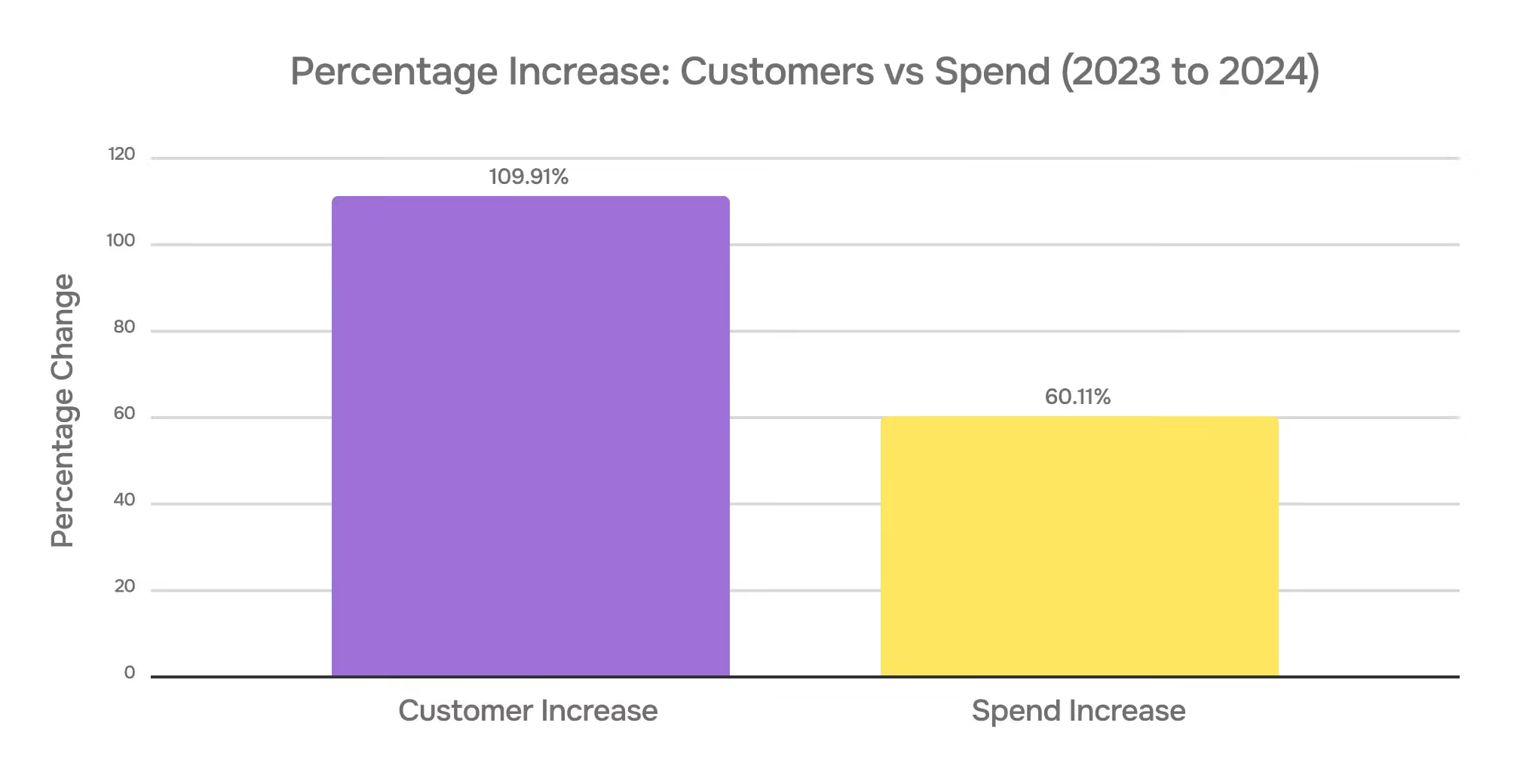
The mechanism matters: upper-funnel campaigns expanded reach, mid-funnel activity captured evaluation, and bottom-funnel campaigns focused on branded, remarketing, and conversion intent. Customer data, not clicks or signups alone, guided the feedback loop.
How to Measure Demand Generation and Lead Generation Without Chasing Vanity Metrics
Demand generation and lead generation need different leading indicators, but both should ultimately be judged against pipeline quality and revenue. A lead gen vs demand gen scorecard should be asymmetric by design: platform metrics and CPL diagnose campaign behavior, while opportunities, pipeline, and revenue determine commercial value.
Track four layers:
- Demand generation: ICP reach, target-account engagement, return visits, branded search, direct traffic, content engagement, and influenced pipeline. These show whether more of the right buyers are becoming familiar with the problem, category, and brand.
- Lead generation: Form fills, demo requests, MQLs, SQLs, sales acceptance, CPL, MQL to SQL rate, cost per SQL, and cost per opportunity. These show whether identifiable interest has enough fit and intent to justify follow-up.
- Shared revenue: Opportunities created, sourced and influenced pipeline, pipeline velocity, win rate, CAC, payback, and closed-won revenue. These determine whether either motion creates economic value.
- Data quality: CRM source coverage, lifecycle accuracy, UTMs, GA4 events, self-reported attribution, and offline conversion data. These determine whether the team has enough evidence to make a budget decision.
Read Leading Indicators in the Context of the Sales Cycle
Demand generation metrics should indicate whether future buying probability is rising among the right accounts. Reach or engagement alone does not prove revenue; the stronger test is whether exposed accounts later enter the funnel, progress, and contribute to influenced pipeline.
The reporting window complicates that test. Dreamdata’s 2025 LinkedIn Ads benchmark puts the average B2B customer journey at 211 days. Meanwhile, LinkedIn’s measurement research reports that 66% of marketers are expected to justify spend monthly and 87% struggle to measure long-term campaign impact.
%20(1).png)
Monthly reporting should therefore show credible movement in ICP engagement and account progression, then validate it against pipeline as the buying window matures. For lead generation, follow the visible sequence:
If CPL falls while sales acceptance or SQL-to-opportunity conversion also falls, the campaign is probably finding cheaper people, not better buyers. A higher CPL can be rational when it produces opportunities and customers more efficiently.
Separate Sourced and Influenced Pipeline
Sourced pipeline is opportunity value marketing receives credit for originating; influenced pipeline includes opportunities that interacted with marketing during the journey. Keeping them separate prevents two opposite errors.
Reporting only sourced pipeline understates demand activity that shapes a long evaluation. Combining both into one headline number can overstate what marketing created. Review each view alongside opportunity creation, win rate, CAC, payback, and closed revenue.
.jpg)
Sourced pipeline identifies where an opportunity originated, while influenced pipeline captures additional marketing interactions across the journey.
Use Attribution as Evidence, Not a Perfect History
Attribution is the method used to connect marketing touches with later buyer actions and revenue. It helps teams decide where to invest, but it cannot observe the entire dark funnel.
Peer recommendations, community conversations, podcasts, AI-assisted research, review sites, and internal sharing often leave no trackable event. Last-click attribution may credit branded search without explaining why the buyer searched. Self-reported attribution, simply asking buyers how they heard about the company or what influenced them, fills part of that gap when compared with CRM and analytics data.
The practical objective is a defensible budget signal, not a perfect reconstruction of every touch.
Feed CRM Outcomes Back Into Acquisition
Measurement improves when SQL, opportunity, and closed-won outcomes flow back to the campaigns that generated the leads. Otherwise, an ad platform sees every form fill as equally valuable.
Google’s Enhanced Conversions for Leads uses hashed first-party lead data to connect later offline outcomes with ad interactions, giving measurement and bidding systems stronger downstream signals.
In our Cloudvisor Performance Max program, we mapped Form → MQL → SQL → Opportunity → Closed-Won and fed HubSpot conversion events into Google Ads. Four weeks after full-funnel implementation, MQL-to-SQL conversion increased 130.3% compared with the implementation week, and opportunity volume grew 50%.
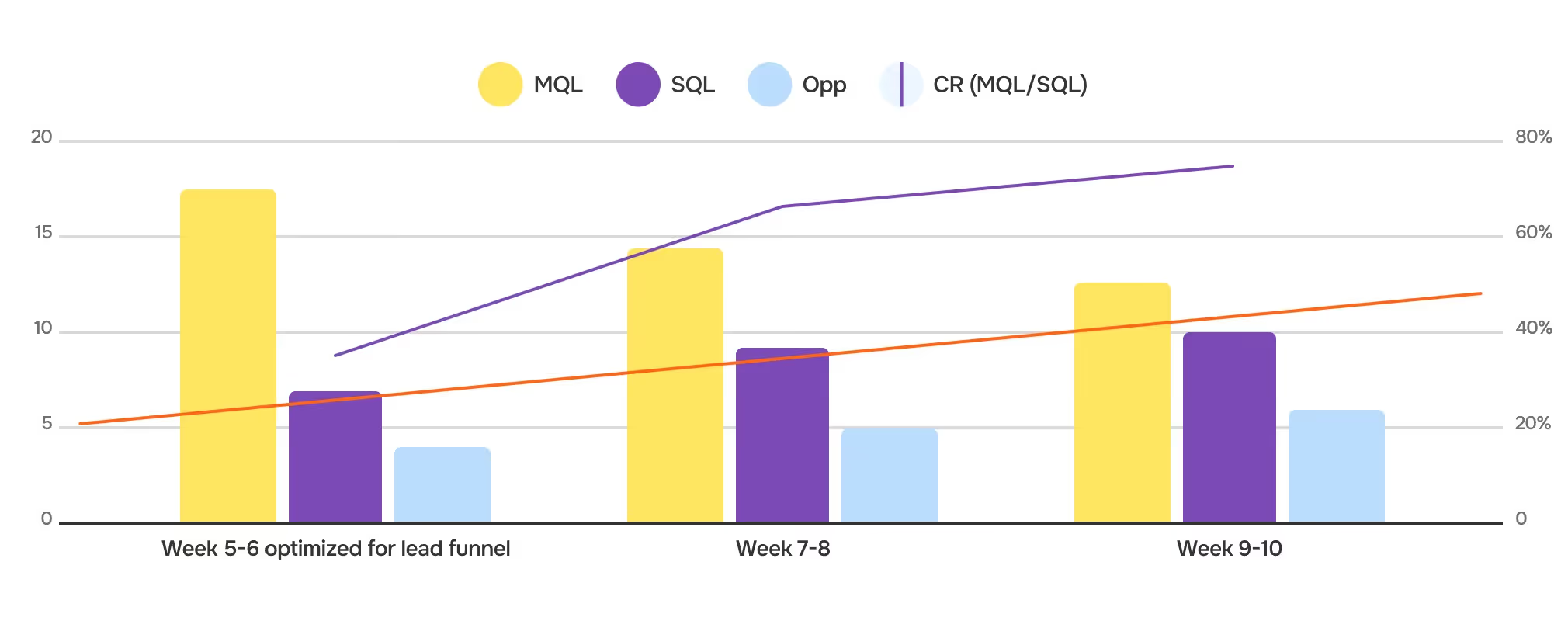
The Cloudvisor result illustrates the mechanism rather than a universal benchmark. Better downstream signals allowed optimization to move from lead volume toward pipeline quality.
Common Mistakes B2B SaaS Teams Make
Teams comparing demand gen vs lead gen often optimize one stage without checking the next. The same problem appears when lead gen vs demand gen becomes an ownership debate instead of a pipeline diagnosis. Four patterns account for much of the waste:
- Optimizing the easiest metric: CTR, conversion rate, form fills, and CPL diagnose campaign behavior. Always inspect the next revenue stage, from MQLs to SQLs, opportunities, win rate, CAC, payback, and closed revenue.
- Asking for too much too early: Cold audiences often need ungated content and proof before a demo. Gated content can work when the value justifies the exchange and follow-up reflects buyer intent.
- Generating attention without a capture path: Thought leadership and educational content still need routes to comparisons, product pages, retargeting, trials, demos, or nurture once intent grows.
- Using different definitions of quality: Marketing and the sales team need stable MQL, SQL, opportunity, and disqualification criteria. The sales team’s feedback should show which audiences, offers, and campaigns create qualified pipeline.
The diagnostic logic stays practical. Generate demand when awareness is weak. Improve the path to capture demand when intent exists but conversion is poor. Fix targeting, qualification, routing, or follow-up when contacts enter the CRM but rarely become SQLs.
A 90-Day Plan to Use Demand Generation and Lead Generation Together
A 90-day plan should protect existing demand, build the missing demand layer, and use CRM outcomes to decide what to scale next. It may not capture the full revenue impact of a long sales cycle, but it can repair the operating system around targeting, conversion, attribution, and sales feedback. For teams weighing lead gen vs demand gen priorities, one quarter is enough to test the operating assumptions even if revenue matures later.
.jpg)
A 90-day operating sequence for diagnosing the funnel, activating both motions, and optimizing toward pipeline quality.
Days 1–30: Diagnose the Bottleneck
The first month should locate where pipeline breaks before the team launches more activity. Review company stage, ICP and buying committee, ACV, category maturity, sales cycle, current-quarter pipeline pressure, and sales capacity. Then map performance across:
Break results down by channel, campaign, audience, offer, and landing page. Expensive CPL with strong opportunity creation needs a different response from cheap CPL with weak MQL-to-SQL conversion. Fix immediate leaks such as broken tracking, unclear demo pages, slow routing, weak mobile experiences, or missing CRM source data.
Days 31–60: Run Creation and Capture as Different Jobs
The second month should activate both motions with different messages and conversion expectations. Use educational SEO, LinkedIn distribution, webinars, customer evidence, and ungated content to generate demand among ICP-fit accounts. Use commercial search, comparison pages, retargeting, pricing, trials, demos, and selected gated content to capture demand from active evaluators.
Judge creation through relevant account engagement and movement. Judge capture through conversion rate, qualified leads, sales acceptance, SQLs, and cost per opportunity. This keeps the demand gen vs lead gen distinction useful without separating the motions into competing programs, and makes the broader demand generation vs lead generation model easier to operate.
Days 61–90: Optimize Toward Pipeline Quality
The final month should use sales and CRM outcomes to change targeting, offers, bidding, and budget. Identify which campaigns produce accepted SQLs, opportunities, valuable accounts, stronger win rates, sourced or influenced pipeline, and viable CAC and payback.
Classify each motion:
- Scale: it produces qualified pipeline at acceptable economics.
- Iterate: the audience is relevant, but the message, offer, conversion path, or qualification needs work.
- Continue measuring: leading indicators are credible, but the revenue window is incomplete.
Scale proven capture when buyer intent exists and sales can absorb it. Continue demand creation when relevant account engagement is developing within the expected buying cycle. Stop or redesign work when neither leading indicators nor revenue quality support the hypothesis.
Build the System Your Pipeline Actually Needs
Mature B2B SaaS teams do not choose between demand generation and lead generation; they fund the part of the revenue system that needs more support now. Low awareness calls for more B2B demand generation. Existing buyer intent with too few conversions calls for better capture. Rising form fills with weak MQL-to-SQL conversion points to targeting, qualification, landing pages, or sales follow-up. A demand gen vs lead gen review should also ask whether buyers have enough trust to advance. That is the useful conclusion to the demand generation vs lead generation debate.
At Aimers, we help SaaS teams diagnose those bottlenecks across paid acquisition, CRO, attribution, and CRM feedback. If your campaigns produce activity but not enough qualified pipeline, a PPC audit can show what to fix and scale next.
FAQs
What Is the Difference Between Demand Generation and Lead Generation?

Is Lead Generation Part of Demand Generation?
When Should B2B SaaS Companies Prioritize Demand Generation or Lead Generation?
How Do Demand Generation and Lead Generation Work Together?
What Metrics Should You Track for Demand Generation and Lead Generation?