
The State of SaaS PPC in 2026: What the Data Means for B2B Growth Teams

SaaS PPC in 2026 is not broken. It is just less forgiving.
Clicks cost more. AI automation controls more of the auction. Attribution is blurrier. LinkedIn keeps charging premium prices for B2B buyers. Google Search is no longer only a bottom-funnel channel because AI Overviews, AI Mode, and broader query matching are pulling search into earlier discovery moments.
For B2B growth teams, the question is no longer, "Can we get cheaper leads?" Sometimes you can. Usually, the better question is, "Are we buying the right pipeline at a CAC we can defend?"
This report-style guide covers the state of SaaS PPC in 2026: benchmarks, platform shifts, AI automation, budget allocation, attribution, and what rising CPCs mean for acquisition strategy.
Quick Highlights
- SaaS PPC in 2026 is defined by higher CPCs, more AI-assisted campaign management, and less room for weak CAC payback.
- Benchmarks are useful for planning, but the best teams replace them with their own CRM, pipeline, and retention data.
- Search still matters, but “Google Ads” should not be read as one blended number. Brand, non-brand, competitor, pain-point, Performance Max, and Microsoft campaigns need separate expectations.
- LinkedIn CPL can look painful, but it can still be justified when targeting, account fit, buying committee coverage, and pipeline quality are strong.
- Microsoft Ads remains underused in B2B SaaS, especially for teams already winning in Google Search and able to validate Microsoft performance with CRM-level tracking.
- AI automation can scale SaaS PPC, but only when it learns from clean conversion goals, offline lifecycle data, meaningful conversion values, and enough qualified volume.
- Budget cuts should follow channel role and pipeline quality, not the cheapest front-end CPL.
- Attribution is no longer a single-platform reporting problem. It is a first-party data, CRM, offline conversion, self-reported attribution, and incrementality problem.
- The biggest SaaS PPC market trends are pushing teams away from lead volume and toward qualified pipeline, CAC payback, retention, and LTV:CAC.
Why the SaaS PPC Landscape Looks Different in 2026
The SaaS PPC market trends that matter most in 2026 are not cosmetic. They change how teams plan spend, judge performance, and report to leadership.
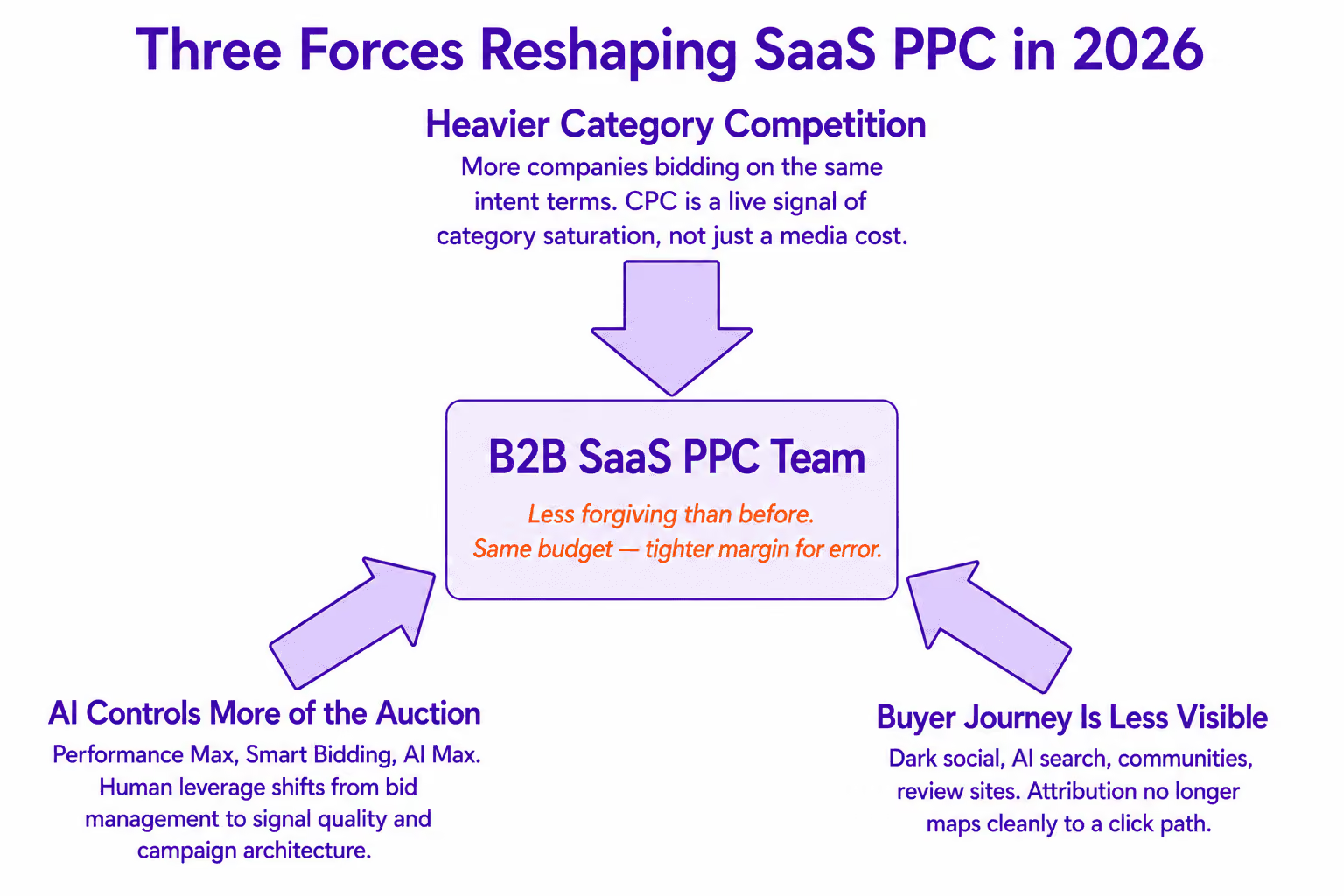
First, competition is heavier in most mature B2B SaaS categories. More companies are bidding on the same intent terms: "best CRM for agencies," "SOC 2 automation software," "customer support AI platform," "HubSpot alternative," and so on. In concentrated markets, CPC is not just a media metric. It is a live signal of category competition.
Second, Google is moving more campaign management into AI-assisted systems. Performance Max uses Google AI across bidding, budget optimization, audiences, creatives, attribution, and placements. Smart Bidding uses auction-time signals to optimize for conversions or conversion value. Human PPC teams now spend less time manually adjusting bids and more time feeding the system better signals.
Third, the buyer journey is less visible. AI search, dark social, review sites, communities, sales calls, partner referrals, and product-led usage all influence pipeline before a paid conversion appears in the ad account. Makreate's 2026 SaaS marketing report describes a similar pattern: CAC pressure has risen, AI search is changing click behavior, and attribution is harder to trust as a clean click path.
The result: a SaaS PPC benchmark is useful only if it is connected to vertical, sales motion, ACV, conversion quality, and retention. A $450 CPL can be disastrous for a $99/month tool and reasonable for enterprise SaaS with a six-figure ACV.
CPC and CPL Benchmarks by Platform and Channel Role
No SaaS PPC benchmark should be treated as universal. Benchmarks shift by vertical, geography, funnel stage, account maturity, brand strength, offer, sales cycle, and how strictly a team defines a qualified lead.
Still, planning ranges help. The table below gives practical B2B SaaS PPC ranges by channel role. Use them for forecasting and diagnosis, not as fixed targets.
For Google Search, GrowthSpree’s 2026 SaaS Google Ads benchmark data is a useful reference point because it analyzes $60M+ in managed ad spend across 300+ B2B SaaS accounts and breaks results down by vertical, ACV, and sales cycle length. For paid social and other channels, the ranges should be read as planning ranges that need to be validated against your own CRM, opportunity quality, and CAC payback.
The more important number is not CPL. It is cost per qualified opportunity, pipeline created, CAC payback, and retention. A $200 lead that never becomes sales-qualified is not cheaper than a $700 lead that turns into a real opportunity.
Google Ads: Non-Brand vs. Competitor Conquesting Economics
Google Search still carries some of the clearest purchase intent in SaaS PPC. But not all Search spend behaves the same.
Brand campaigns usually have low CPC, high conversion rate, and messy incrementality. They often capture demand the company already created somewhere else. Non-brand campaigns are the real acquisition test: they show whether your product can win demand from people searching for a problem, use case, or category. Competitor conquesting is different again. CPC is often higher, conversion rate can be lower, and sales cycles may be longer because buyers are comparing switching costs, trust, procurement risk, and existing vendor relationships.
Here is how to read the economics:
The more important number is not CPL. It is cost per qualified opportunity, pipeline created, CAC payback, and retention. A $200 lead that never becomes sales-qualified is not cheaper than a $700 lead that turns into a real opportunity.
Google Ads: Non-Brand vs. Competitor Conquesting Economics
Google Search still carries some of the clearest purchase intent in SaaS PPC. But not all Search spend behaves the same.
Brand campaigns usually have low CPC, high conversion rate, and messy incrementality. They often capture demand the company already created somewhere else. Non-brand campaigns are the real acquisition test: they show whether your product can win demand from people searching for a problem, use case, or category. Competitor conquesting is different again. CPC is often higher, conversion rate can be lower, and sales cycles may be longer because buyers are comparing switching costs, trust, procurement risk, and existing vendor relationships.
Here is how to read the economics:
Competitors can still earn a budget even when front-end CPL looks bad. If those accounts are high-fit, sales-ready, and likely to expand, the unit economics may work. But the landing page must be specific. Sending competitor traffic to a generic demo page is usually a waste.
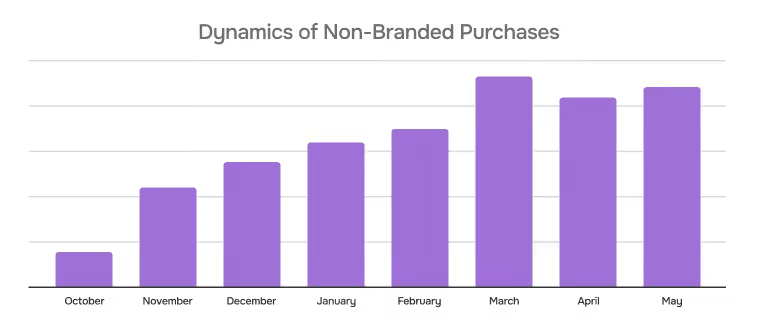
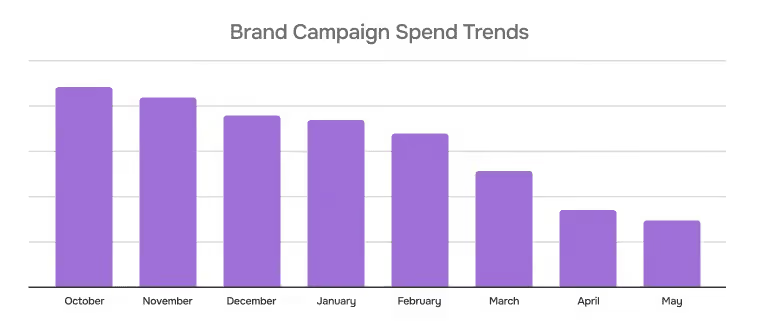
The same logic applies to brand and non-brand budget allocation. In our work with ReliableSite, we rebuilt the Google Ads structure to reduce reliance on branded demand and scale non-branded purchases. The result was a 4x increase in non-branded sales and a 64% reduction in branded costs. That is the kind of shift that makes PPC reporting more useful: less blended efficiency, more real acquisition signal.
For planning help, we’ve covered SaaS PPC budget planning in more detail.
LinkedIn and Meta: When Higher CPL Is Still Justified
LinkedIn Ads often looks expensive in a spreadsheet. The CPC is high, the CPL is high, and finance may ask why Google leads are cheaper.
The better answer: LinkedIn is not usually buying cheap clicks. It is buying professional precision.
LinkedIn Ads gives B2B teams access to professional targeting attributes such as job title, company, industry, seniority, and more. That makes it one of the cleanest paid channels for reaching a defined buying committee, especially when the target market is narrow and the sales cycle depends on multiple roles.
LinkedIn spend is easier to justify when:
- You sell to specific roles or buying committees;
- ACV is high enough to support expensive lead acquisition;
- The offer is useful before the buyer is ready for a demo;
- Sales follows up based on account context, not just form fills;
- Reporting connects campaigns to opportunity quality.
The risk is judging LinkedIn by the same expectations as non-brand Search. Search captures existing intent. LinkedIn often creates or accelerates demand inside the right accounts. That means CPL can look worse while pipeline influence is stronger.
Meta has a different role. For B2B SaaS, it usually works best for retargeting, founder-led creative, webinars, and lower-cost message testing before you move winning angles into LinkedIn or Google. It should not usually carry the same pipeline expectations as high-intent Search or tightly targeted LinkedIn campaigns.
Microsoft Ads: The Underutilized B2B Channel
Microsoft Ads is not glamorous, which may be why some SaaS teams ignore it.
That can be a mistake.
For teams already seeing strong Google Search results, Microsoft can add incremental search demand at lower competition in some categories. Volume is smaller, but B2B intent can be solid, especially in business software, finance, IT, and enterprise services.
Microsoft also has a specific B2B advantage: it supports LinkedIn profile targeting across several campaign types, including Search campaigns. That does not make it a replacement for LinkedIn Ads, but it can make Microsoft more useful for B2B SaaS teams that want search demand with additional professional targeting logic.
The practical rule: do not build your entire acquisition strategy around Microsoft Ads. But if non-brand Google Search is working, test Microsoft with separate budgets and CRM-level conversion tracking. If the channel produces lower volume but better-qualified pipeline, protect it.
How AI Automation Is Reshaping SaaS Campaign Management
AI automation is not coming to SaaS PPC. It is already here.
Google’s own documentation says Performance Max uses Google AI across bidding, budget optimization, audiences, creatives, attribution, and more. Smart Bidding uses Google AI to optimize for conversions or conversion value in each auction, using auction-time bidding and contextual signals that no human team could process at the same speed.
That changes the PPC manager’s job. The work is less about pulling bid levers every day and more about making sure the system is learning from the right business signals.
For SaaS teams, that means:
- Choosing the right primary conversion goals;
- Importing offline conversion and revenue data;
- Excluding junk conversions from optimization;
- Structuring campaigns around business logic, not just platform defaults;
- Writing stronger creative and landing page inputs;
- Protecting brand and competitor budgets from blended reporting;
- Reviewing search terms, placements, assets, and landing pages;
- Diagnosing whether automation is optimizing toward pipeline quality or just conversion volume.
In other words, automation does not remove strategy. It punishes weak strategy faster.
Performance Max and AI Max: What SaaS Marketers Lose and Gain
Performance Max can help SaaS teams expand beyond keyword-based Search into Google inventory such as YouTube, Display, Discover, Gmail, Maps, and Search. AI Max for Search pushes a similar direction inside Search campaigns: broader search term matching, text customization, and final URL expansion based on user intent and landing page relevance.
That can be useful when the account already has strong conversion tracking, clean CRM feedback, clear ICP logic, and landing pages that match different types of intent.
For SaaS, the trade-off is simple: AI systems can scale what is already structurally sound. They cannot reliably fix poor tracking, vague ICP targeting, weak offers, generic landing pages, or missing sales feedback.
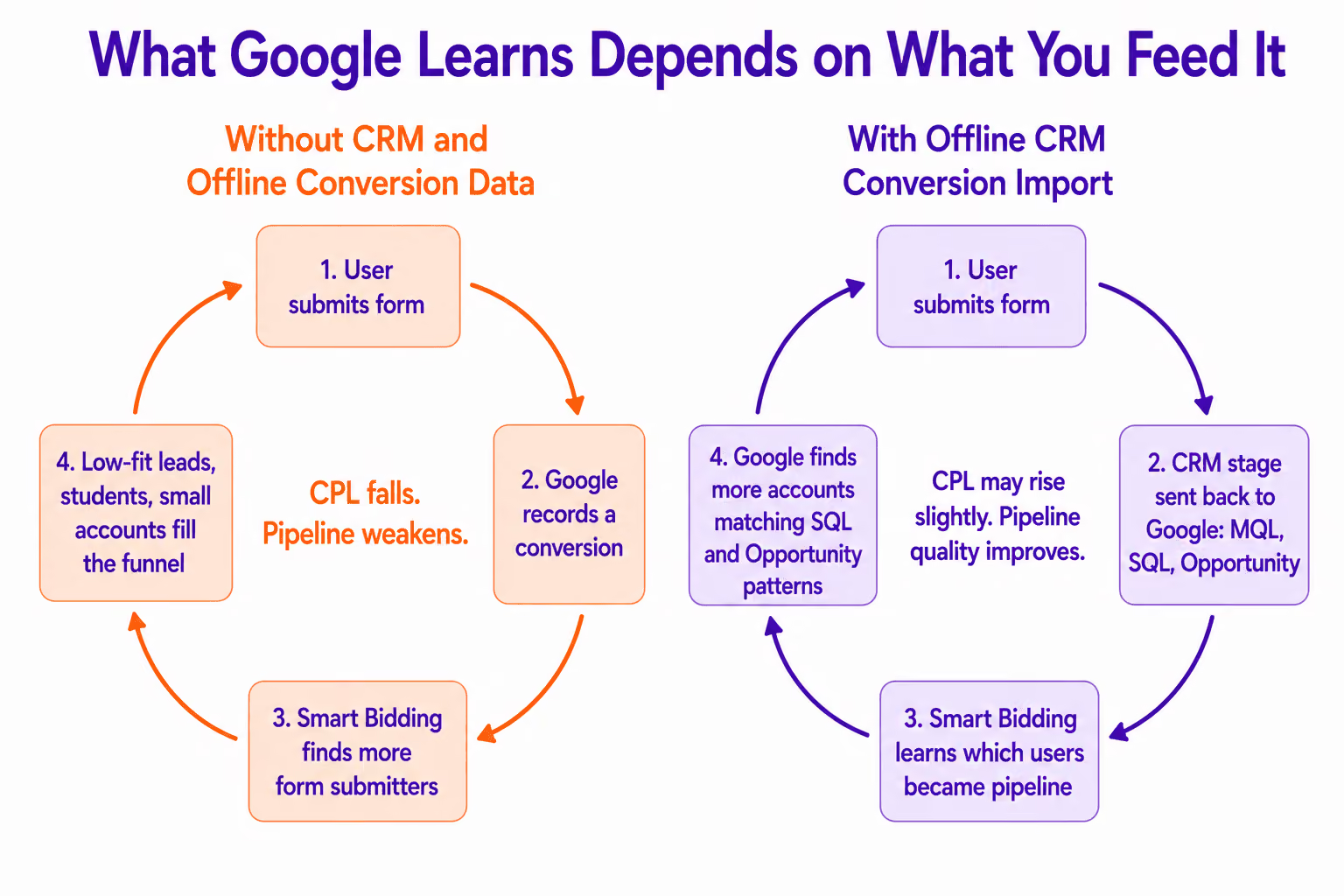
That is why AI-driven campaign expansion should not be treated as a shortcut around strategy. It should be treated as a multiplier. If the account teaches Google what a qualified opportunity looks like, automation can help find more of them. If the account teaches Google that every form fill has the same value, automation will usually find more form fills.
Smart Bidding Failure Scenarios: The Conversion Volume Problem
Smart Bidding is only as good as the signal it receives.
Google notes that, for best results, some Smart Bidding strategies rely on a minimum volume of historical conversion data, depending on the campaign type. That matters in B2B SaaS because many accounts do not generate hundreds of clean qualified conversions every month. The signal is often low-volume, delayed, or split across CRM stages.
Common failure scenarios include:
The fix is not to reject automation. The fix is to feed it better data: qualified lead, opportunity, and revenue signals; conversion values; clear primary goals; and enough volume before aggressive targets.
A good example is our work with Cloudvisor, a cloud management SaaS. Their Performance Max campaign had previously generated low-intent and spammy leads because the system was optimizing toward surface-level form submissions. We mapped the full funnel from form submission to MQL, SQL, Opportunity, and Closed-Won, then integrated key HubSpot conversion events into Google Ads so the campaign could optimize toward better downstream signals. As a result, Cloudvisor increased its MQL-to-SQL conversion rate by 130.3% and grew Opportunity volume by 50%.
The lesson is not that Performance Max is good or bad by default. The lesson is that SaaS automation depends on the quality of the feedback loop. Clean CRM stages, meaningful conversion values, and offline conversion imports make automation more useful. Weak tracking makes it faster at scaling the wrong leads.
Platform Mix and Budget Allocation Under Efficiency Pressure
When budgets get cut, SaaS PPC teams often make one of two mistakes: they cut every channel evenly, or they protect only the cheapest CPL. Both moves can hurt pipeline quality.
A better budget decision starts with channel role. Google non-brand Search, competitor campaigns, LinkedIn, retargeting, YouTube, and Microsoft Ads do not do the same job. Some channels create new high-intent demand. Some influence named accounts. Some accelerate existing buyers. Some only look efficient because they capture people who were already close to converting.
In 2026, budget allocation should follow qualified pipeline, not surface-level efficiency.
The practical rule: protect the channels that can explain their role in the funnel.
That usually means keeping high-intent Google Search, proven competitor campaigns with strong sales feedback, LinkedIn campaigns aimed at named accounts or clear buying roles, retargeting for high-intent visitors, and Microsoft campaigns that quietly produce efficient opportunities.
Cut campaigns that cannot explain their role. If an “awareness” campaign cannot show engagement, assisted pipeline, sales lift, retargeting value, or audience learning, it needs a better measurement plan before it gets more budget.
The point is not to defend every channel. The point is to avoid cutting the channels that create future revenue just because they do not have the lowest front-end CPL.
For a deeper strategic framework, we’ve covered PPC strategy for SaaS in more detail.
Competitor Conquesting: The Counterintuitive Budget Case
Competitor campaigns often look inefficient at the lead level. They are expensive, can trigger legal or brand reviews, and may produce lower landing page conversion rates than non-brand category Search. In the right SaaS category, they can still be worth protecting.
Why? Because competitor searchers already understand the category. They may be dissatisfied, comparing renewal options, building a shortlist, or looking for a replacement before the next contract cycle. That is valuable intent, even if it does not convert cheaply.
The key is message fit and measurement discipline:
- Do not overclaim
- Avoid trademark misuse in ad copy
- Send traffic to a fair comparison page
- Explain switching costs honestly
- Show proof by use case, not generic “we are better” claims
- Segment competitor campaigns from non-brand Search
- Measure opportunity quality, not just landing page CVR
Competitor conquesting is not a volume play. It is a selective pipeline play. Protect it when competitor-sourced opportunities show strong ACV, close rate, or expansion potential. Cut it when traffic bounces, comparison pages underperform, or sales cannot convert switching conversations.
Attribution, Full-Funnel Measurement, and the First-Party Data Imperative
Attribution is one of the hardest parts of the state of SaaS PPC in 2026.
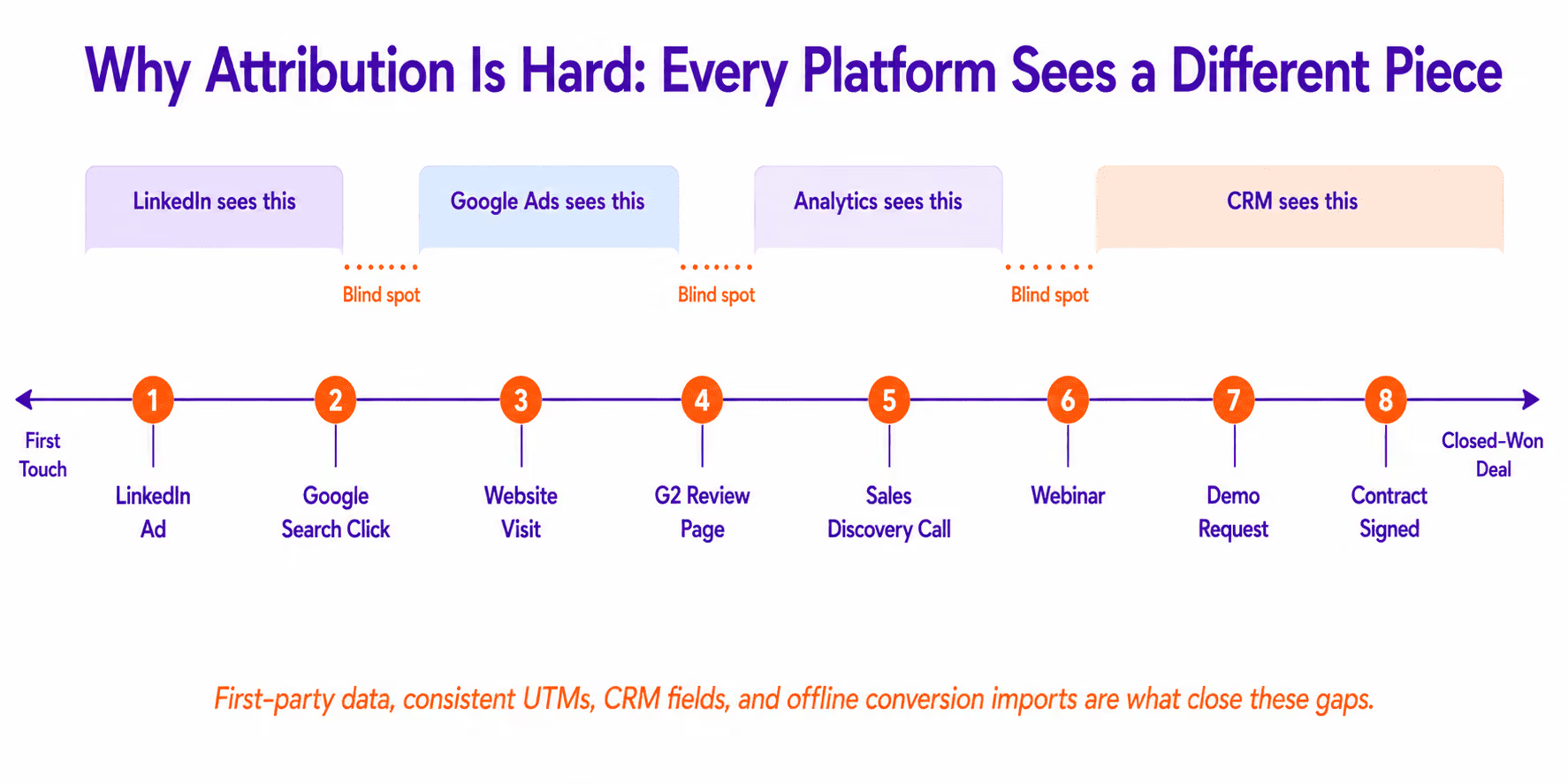
Platform dashboards still matter, but they are not enough. Google, LinkedIn, Meta, CRM, analytics, sales calls, communities, review sites, and product usage all see different pieces of the buyer journey. Makreate’s 2026 SaaS marketing report describes the same attribution pressure: dark funnel activity, AI chatbots, peer recommendations, privacy changes, and cross-device behavior make clean click paths harder to trust.
That does not mean SaaS teams should ignore attribution. It means attribution has to move closer to first-party data and pipeline reality.
The teams handling this well are building first-party measurement systems:
- UTMs that are consistent, enforced, and documented;
- CRM fields for source, campaign, lifecycle stage, and sales feedback;
- offline conversion imports or enhanced conversions for leads into ad platforms;
- self-reported attribution on high-intent forms;
- pipeline reporting by account, campaign, and lifecycle stage;
- incrementality tests where spend is large enough;
- lead scoring that separates fit from activity;
- retention and expansion reporting by acquisition source.
Google’s own documentation supports this direction. Offline conversion imports and enhanced conversions for leads allow advertisers to send later funnel events back into Google Ads, helping connect ad interactions with qualified leads or offline sales outcomes.
This is where a PPC audit often finds more value than a bid tweak. If tracking is wrong, optimization is theatre.
Attribution should answer three questions:
- Which campaigns create qualified pipeline?
- Which campaigns accelerate existing opportunities?
- Which campaigns produce customers with strong retention?
That third question matters more in 2026 because rising acquisition costs make retention part of PPC strategy. HockeyStack’s State of Google Ads report, based on data from 198 B2B SaaS companies and $150M+ in spend, makes the same point from a paid media angle: Google Ads performance should be read beyond front-end conversions, with attention to qualified opportunities, closed-won impact, and company-size differences.
For teams that cannot connect PPC spend to CRM stages, pipeline, and retention, the real bottleneck may not be bidding. It may be measurement architecture. We’ve covered analytics and attribution setup in more detail in our analytics services.
What Rising CPCs Mean for SaaS CAC and Unit Economics
Rising CPCs do not mean paid acquisition is failing. They mean your unit economics have less room for sloppy conversion.
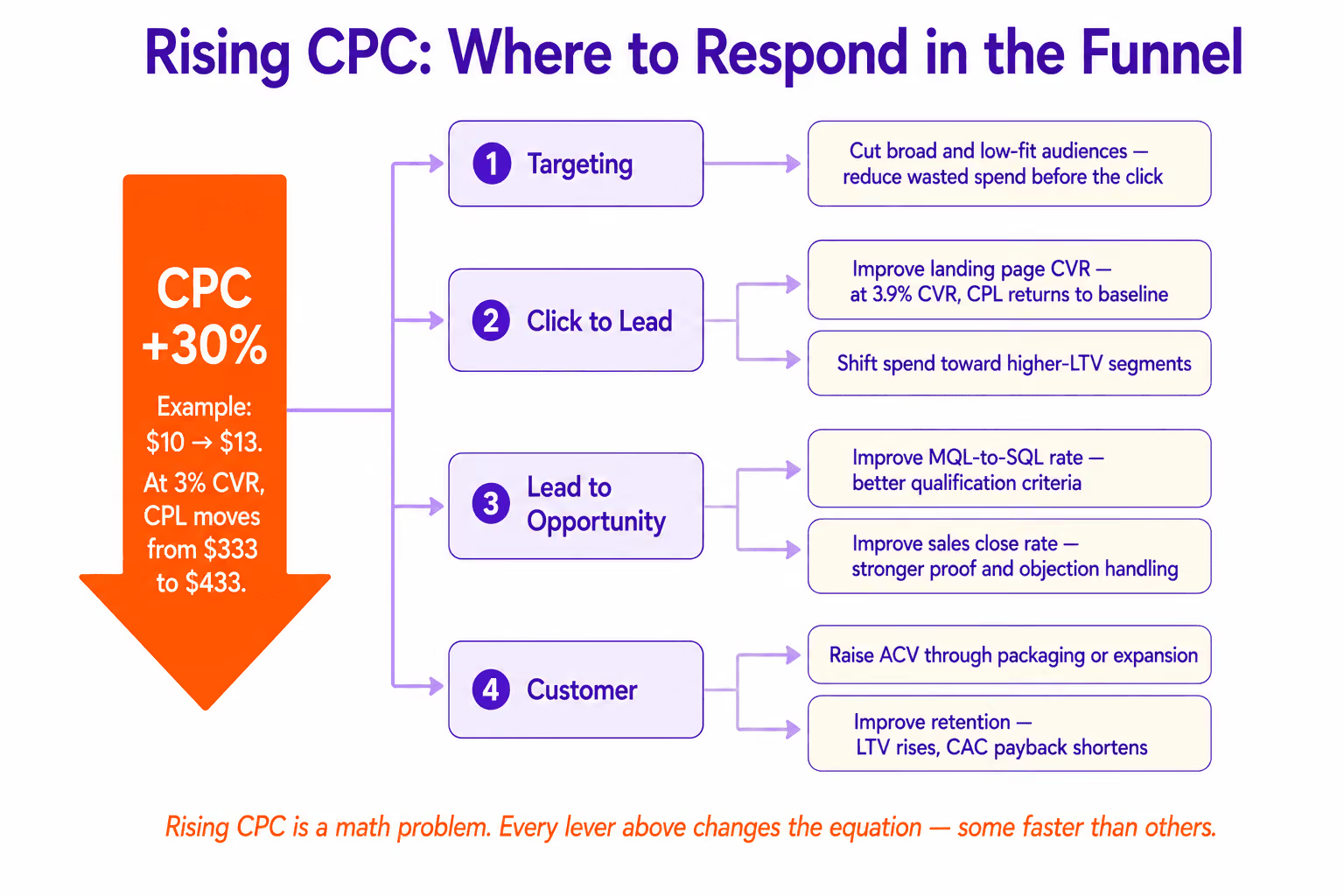
If CPC increases by 30%, every weak point in the funnel becomes more expensive. For example, if CPC rises from $10 to $13 and landing page conversion rate stays at 3%, CPL moves from about $333 to about $433. To get back to the old CPL without lowering CPC, the landing page conversion rate would need to rise to roughly 3.9%.
That is why rising CPCs should not trigger only bid cuts. SaaS teams have several levers:
- Improve landing page conversion
- Improve lead-to-opportunity rate
- Improve sales close rate
- Shift spend toward higher-LTV segments
- Raise ACV through packaging or expansion
- Improve retention so LTV increases
- Cut waste from broad or low-fit targeting
The important point is that CAC is not only a media-buying problem. It is a funnel and revenue-quality problem. A higher CPC can still work if the traffic converts into better opportunities, larger accounts, shorter payback, or customers with stronger retention.
That is why retention belongs in a PPC conversation. If paid campaigns bring in customers that churn after three months, the channel is not healthy even if CPL looks good. If a more expensive channel brings in customers that expand and renew, the higher front-end CAC may be fine. ChartMogul’s SaaS retention benchmarks make the same point from a growth perspective: companies with retention rates above 85% grow 1.5-3x faster.
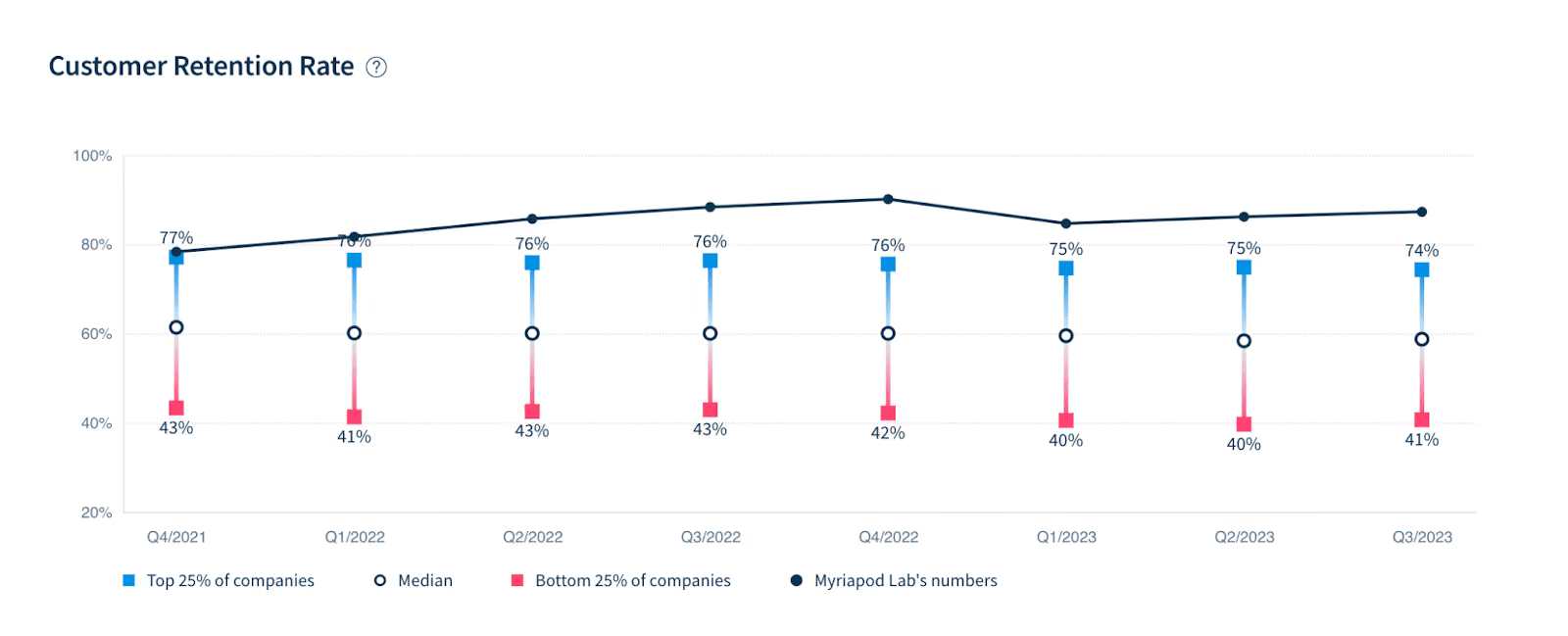
In 2026, the best SaaS PPC benchmark is not “average CPL.” It is payback by segment.
Without retention and expansion visibility, paid acquisition can accidentally optimize toward the wrong customers. The account may look efficient at the lead level while quietly sending budget toward segments that do not retain, expand, or pay back fast enough.
What the State of SaaS PPC Tells B2B Growth Teams About 2026 and Beyond
The state of SaaS PPC is not a story about one platform winning. It is a story about operational maturity.
The teams that perform well in 2026 will not be the ones chasing the lowest CPC or defending every channel equally. They will be the teams that know their ICP, protect high-intent demand, use automation with clean conversion signals, connect spend to pipeline, and measure whether paid acquisition brings customers that retain and expand.
Here is the practical playbook:
If you are reviewing 2026 budgets, do not ask only where spend should go down. Ask where the data is weak, where targeting is too broad, where the landing page does not match intent, and where sales feedback is missing.
That is the real shift in SaaS PPC. The channel is not just a media-buying problem anymore. It is a connected system of paid search, paid social, landing pages, analytics, CRM data, bidding strategy, and revenue feedback.
Aimers works with B2B SaaS and tech companies that need this system connected to pipeline. If your team needs paid search, paid social, analytics, and CRO working from the same revenue data, we can help turn PPC from a lead-volume channel into a pipeline-focused acquisition engine.
FAQs
What Is the State of SaaS PPC in 2026?

What Is a Good SaaS PPC Benchmark?
How Is AI Changing SaaS PPC Campaigns?
Should SaaS Companies Still Invest in LinkedIn Ads?
How Should SaaS Teams Allocate PPC Budget in 2026?