

LinkedIn Carousel Ads Guide for SaaS: Creative, Targeting, and ROI

June 3, 2026

A LinkedIn Sponsored Content Carousel ad is a Sponsored Content format consisting of two to ten cards, each with its own headline, image, and destination URL. Users can swipe through the cards directly in the feed without leaving LinkedIn. Each swipe increases interaction time with the ad. LinkedIn can interpret this as a quality signal and expand distribution.
LinkedIn carousel ads consistently outperform single-image formats on engagement metrics, giving advertisers more opportunities to communicate multiple messages within a single ad. Socialinsider’s 2025 LinkedIn Benchmarks report states that multi-image carousels have an average engagement rate of 6.60%, the highest among all formats on the platform. For optimized B2B SaaS carousel campaigns, CTR is typically 0.8–1.2%, compared to the industry median of 0.45–0.65%.
%20(1)%20(1).avif)
Why is this particularly important for SaaS? A single-image ad only offers one chance to convey one message. For B2B SaaS, where the product solves multiple problems, involves various stakeholders, and requires justification before purchase, one ad is insufficient. A carousel ad allows you to present a complete sequence within a single ad unit: problem → solution → proof → call to action. Each card serves as a separate argument, and together, they form a cohesive narrative that guides users through the sales funnel.
Today, we will explain how to use LinkedIn Carousel Ads for SaaS, including which structures work best, how to set up targeting at different stages of the funnel, which metrics are worth tracking. We will also discuss when this format is advantageous over single-image ads.
Carousel Ad Specs: What You Need Before Launching
Launching LinkedIn Carousel ads requires careful preparation. Technical errors can affect performance. For instance, LinkedIn may crop the image, hide part of the text, or cut off the headline. Therefore, it is better to check the specifications before going live rather than during the campaign upload phase.
Key parameters to check:
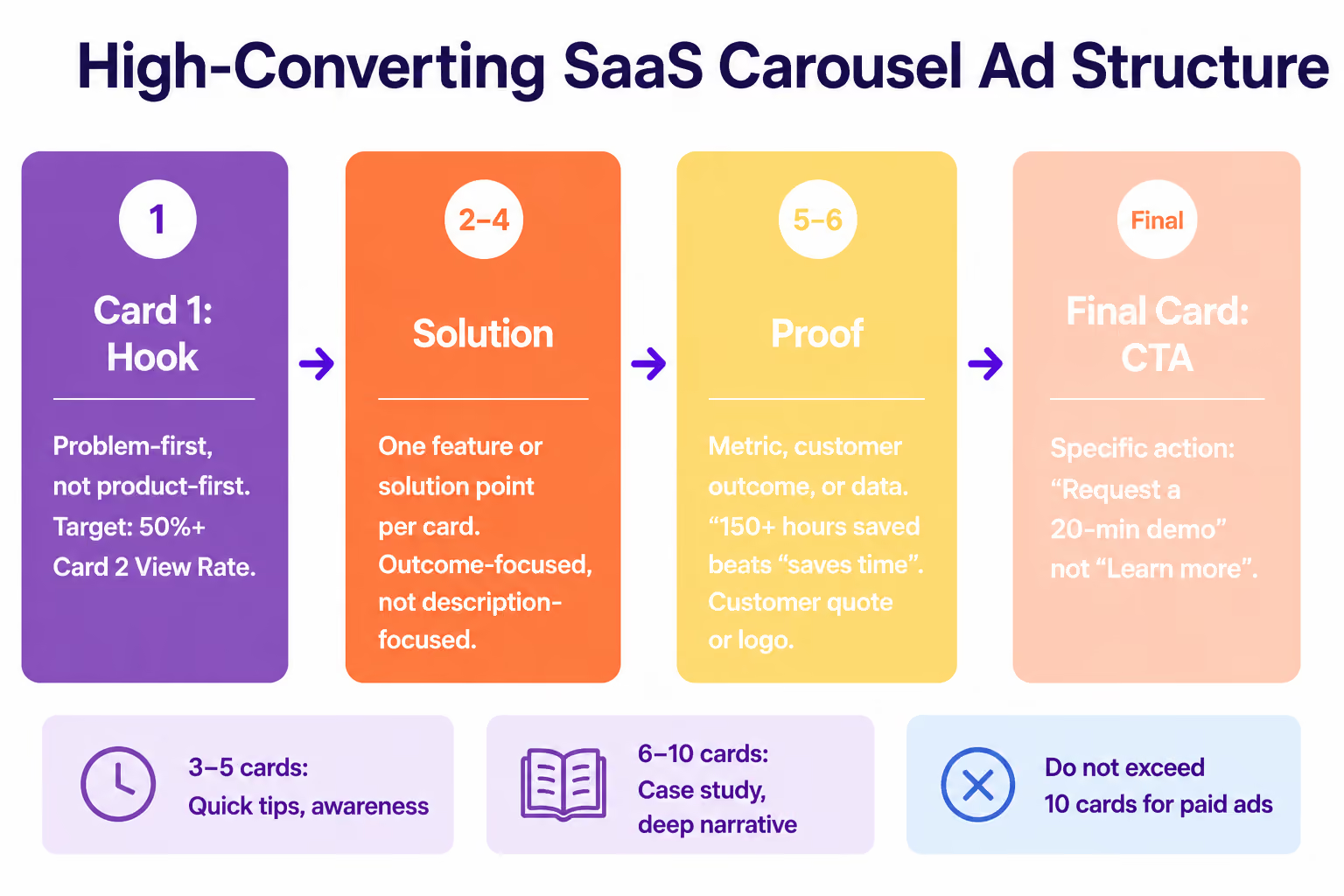
- Card count: Two to ten cards. For B2B SaaS, three to five cards are usually sufficient for awareness content and six to ten for case studies, product scenarios, and detailed storytelling. You cannot use more than ten cards in paid campaigns
- Image size: 1080 × 1080 px with a 1:1 aspect ratio. Other aspect ratios may result in auto-cropping, which can be problematic for UI screenshots, diagrams, and cards with text
- File format: JPG or PNG with a maximum size of 10 MB per card. PNG is better suited for interfaces and screenshots, while JPG is better suited for photos.
- Text limits: headline up to 45 characters per card; intro text up to 255 characters. For SaaS, it is better to build the headline around a result or problem rather than a feature name
- Each card can link to a separate URL. This is useful for testing multiple offers within a single carousel but requires UTM parameters for proper per-card tracking.
- Engagement benchmarks: The Card 2 view rate should be above 50%. If the rate is below 40%, the problem is usually with the hook on the first card. A strong carousel has a completion rate of 20–30%. If the rate is below 15%, check for drop-off on cards 3–4
Carousel ads should not be confused with organic carousel posts. Carousel ads are launched through Campaign Manager and consist of two to ten image cards. An organic LinkedIn Carousel post is usually uploaded as a PDF, PPTX, or DOC document. These formats have different requirements, production processes, and distribution logic.
The available objectives for LinkedIn Carousel ads campaign in Campaign Manager are Brand Awareness, Website Visits, Lead Generation, and Website Conversions. Choose the objective based on funnel stage because it determines how LinkedIn will optimize delivery.
Targeting for Carousel Ads: Reaching the Right Accounts at the Right Funnel Stage
In LinkedIn Carousel ads B2B marketing, the format can work at different stages of the sales funnel, but the target audience should differ by funnel stage. The same funnel logic applies here as in other formats. For example, a carousel ad aimed at raising brand awareness and one targeting visitors to the pricing page should have different CTAs, messaging, and expected metrics.
For B2B SaaS, basic targeting is usually based on a combination of job function, seniority, and company size. This helps filter out irrelevant job titles and companies that are too small or large. For MOFU and BOFU, Matched Audiences are usually layered on top. These audiences can include users who visited the pricing page, demo page, or other high-intent pages via the LinkedIn Insight Tag. In these segments, carousel ads are most effective because they present multiple arguments before conversion instead of a single short message.
One particular advantage of LinkedIn Carousel ads B2B campaigns is the ability to track clicks at the individual card level (per-card URL tracking). Each card can lead to a separate URL, creating role-specific intent signals. For example, a CFO might click on a card with ROI data, while a VP of Engineering might click on technical documentation. These clicks should trigger different sales follow-up scenarios.
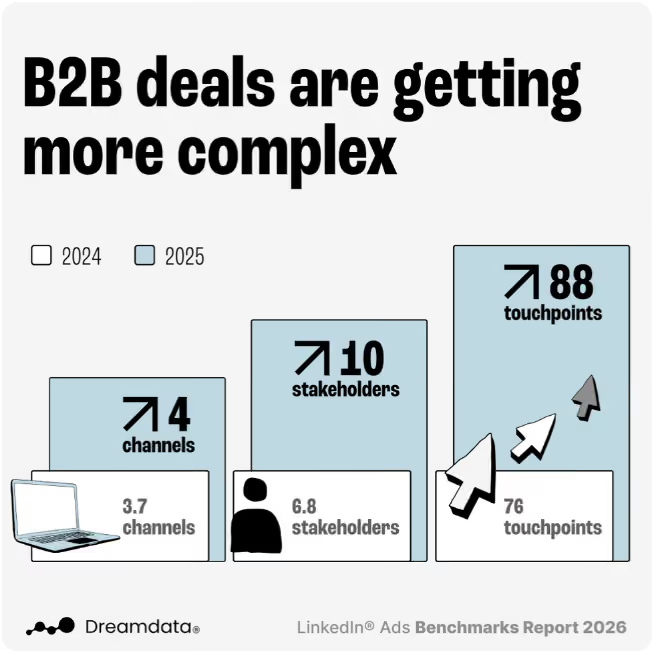
For ABM, carousel ads can be stronger than single-image ads because they let teams distribute arguments across multiple cards. According to Dreamdata, the average B2B buying journey involves 10 stakeholders, 88 touchpoints, and four channels. Unlike single images, carousel ads allow you to distribute arguments across cards and guide each role to the relevant content.
Carousel ads typically perform better for retargeting than for cold audiences. According to LinkedIn retargeting benchmarks, Insight Tag retargeting yields a CTR that is approximately 30% higher than that of cold audiences. Therefore, one of the most practical SaaS applications is showing carousel ads to visitors to pricing and demo pages featuring multiple value propositions, social proof, or product angles.
At Aimers, our LinkedIn Carousel ads strategy is to explain complex SaaS products in stages, moving from the problem to the workflow and then to proof and a CTA. In one project, publishing organic carousel posts through the LinkedIn Company Page drove higher engagement than paid campaigns with similar content. This does not mean that organic content can replace paid ads entirely. However, it suggests that the format has high engagement potential regardless of the distribution channel.
Creative Framework for SaaS Carousel Ads That Drive Conversions
For LinkedIn Carousel ads SaaS campaigns, effectiveness depends more on structure than on visual design. The order of the cards influences how users interact and decide on their next step.
The logic behind the card order for B2B SaaS is as follows:
- Card 1: Hook. Focus on the user’s problem or pain point, not the product. The goal is to get users to swipe. LinkedIn’s recommendation for SaaS is to showcase a specific insight or context relevant to the audience. Target metric: Card 2 view rate ≥50%. If it is below 40%, the issue lies with Card 1.
- Cards 2–4 – Solution: Present one aspect of the solution per card, focusing on the result rather than a feature description. Example: “Reduces onboarding time by 60%” is more effective than “Automated onboarding.”
- Cards 5–7 – Proof: Provide proof with metrics, client results, and specific data. Example: “150+ hours of manual labor saved.” General statements such as “Saves time” are less effective.
- Final Card – CTA: A specific action, such as “Request a 20-minute demo.” Each card can have its own CTA that matches its content.
Number of cards: three to five for short tips and awareness content, and six to ten for case studies and detailed storytelling. A/B testing can identify the strongest sequence for maximum engagement and completion rate.
The strongest LinkedIn Carousel ad examples usually fit one of three structures: feature comparison, customer story arc, or benchmark report
- Feature Comparison: One feature per card with a result rather than a description. This format works well for users who are evaluating and comparing products.
- Customer Story Arc: This format follows a sequence of “Company – Problem – Solution – Result – Quote – CTA.” Example: Nudge Security used this approach to guide users step-by-step through a case study, building trust until conversion. The result was saving over 150 hours of manual labor
- Benchmark Report: One insight per card with a practical conclusion. This works well for TOFU, positions the company as a thought leader, and drives engagement among an audience not yet ready for a demo. The same structure is also common in strong LinkedIn Carousel post examples, especially when the goal is organic thought leadership before paid retargeting
How SaaS Teams Use Carousel Ads Across the Funnel
Depending on funnel stage, the same carousel format can serve different purposes. Audience, CTA, and content logic all change. Carousels designed for brand awareness and retargeting look like two distinct ad formats.
TOFU: Brand Awareness and Thought Leadership
At the top of the funnel (TOFU), carousels are more often used for educational content to promote brand awareness and thought leadership. Industry research, benchmark data, and formats like “Three Mistakes SaaS Teams Make When Managing X” work well here. Among broader LinkedIn ads examples, this type of carousel is useful because it creates engagement before asking for a conversion. The goal is to generate interest and showcase the company’s expertise, not to make direct sales.
For these campaigns, it’s more important to focus on engagement rate, reach, and impressions than on CPL. LinkedIn also recommends using carousel ads for brand storytelling and establishing yourself as an expert.
MOFU: Customer Stories and Social Proof
At the consideration stage, carousel ads allow you to present a customer’s story sequentially: problem, solution, and result. Nudge Security used this approach, guiding users through a case study step by step. Instead of making product promises, real data and measurable results carry the message.
MOFU and BOFU: Product Education
For complex SaaS products, carousel ads often function as mini-demos. Workvivo by Zoom used a carousel to provide a visual overview of the platform, with each card revealing a different part of the interface. This format helps decision-makers understand the product before requesting a demo.
BOFU: Retargeting With Multiple Value Propositions
In our experience, this is where carousel ads show one of their strongest advantages. Instead of a single selling point, you can sequentially showcase several differentiators, use cases, or customer outcomes. For users who are already comparing solutions, this is often enough to move them to the next step in the funnel.
ABM: Reaching Multiple Stakeholders
ABM remains one of the most interesting scenarios for carousel ads. Different cards can lead to content tailored for different members of the buying committee: financial materials for CFOs, technical resources for engineering leadership, and product materials for future internal champions.
Per-card URL tracking adds another advantage. Clicks on different cards help you understand which topics interest specific roles and how to structure further follow-up.
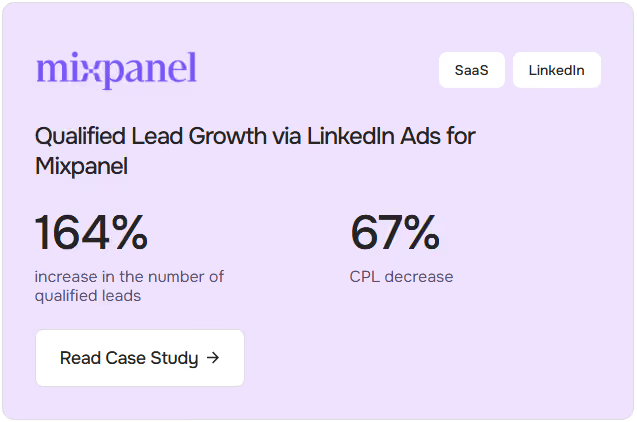
In Aimers’ projects for SaaS companies, precise LinkedIn targeting combined with carousel creatives helped increase qualified lead volume by 20–30%. In our case studies for Mixpanel, ShipBob, and Orion Labs, sales opportunities grew by 60% to 4× while simultaneously reducing CPL.
ROI Framework: Measuring Carousel Performance in B2B SaaS
CTR and engagement rate are not enough to evaluate LinkedIn Carousel Ads for B2B SaaS. While these metrics are displayed in Campaign Manager, the 3–6-month sales cycle makes them incomplete. ROI assessment should depend on the campaign’s objective and downstream results.
LinkedIn recommends the following metrics by objective:
- Brand Awareness: impressions + engagement rate
- Website Visits: CTR
- Demand Generation: conversion rate + CPL + cost per conversion
For LinkedIn Carousel ads optimization, these metrics are available in the Performance tab, broken down by card. It is also useful to monitor the Card 2 view rate (target: over 50%) and completion rate (target: 20–30%). These metrics can indicate downstream conversion potential even before CPL data accumulates. If the Card 2 view rate is below 40%, the issue is usually with the first card rather than with targeting or budget.
For B2B SaaS, CPL alone does not tell the whole story. The best LinkedIn ads agencies usually compare carousel performance by SQL rate, cost per opportunity, and pipeline quality, not CPL alone. Retargeting carousel leads often have a higher SQL rate than leads from cold campaigns with a single image, even with a similar CPL. MQLs and SQLs from carousel campaigns should be tracked and compared separately with other formats at the same funnel stages.
To evaluate lead quality, you can use the MQL-to-SQL conversion rate of 14–18%, based on B2B PPC benchmarks, as a reference point. However, LinkedIn carousel campaigns should be evaluated using your own CRM data for the same audiences and funnel stages.
When evaluating LinkedIn ads costs, CPC alone is too narrow. Although LinkedIn often has a higher CPC than Meta, it can generate a higher-quality pipeline. ROI calculations should consider a 180-day pipeline-to-spend ratio, not just the 30-day CPC. Evaluating LinkedIn using short-term attribution windows can lead to a systematic underestimation of the channel’s contribution.
Carousel Ads Performance Benchmarks for B2B SaaS
Benchmarks can help evaluate LinkedIn Carousel ad performance, but they need to be used carefully. Industry-wide averages provide little guidance for B2B SaaS. In our experience, the variation in results among SaaS clients is usually not due to the carousel format itself, but rather to audience size, niche competitiveness, and product complexity.
CTR
According to the latest LinkedIn benchmark studies, the median CTR for carousel ads is around 0.55%, which is slightly higher than single-image and video formats. For teams comparing LinkedIn video ads examples with carousel performance, the main difference is not only CTR but how much context each format can deliver before the click. At the same time, retargeting campaigns regularly reach 0.9–1.4%, and well-optimized SaaS campaigns can consistently stay above 1.0%. For most teams, this metric is the first sign that the creative and targeting are truly working together.
CPL
CPL depends heavily on the offer. Content-based offers are usually the cheapest way to generate leads, while demo requests and sales inquiries are naturally more expensive. For SaaS teams, it is more useful to look at a range rather than a single figure. In most cases, CPL falls somewhere between $100 and $250, though individual campaigns may fall outside this range due to the audience, region, or the product’s ACV.
For example, at Aimers, we ran a campaign for a healthcare SaaS client. The average CPL for Carousel campaigns was around $200. Meanwhile, for another client in the tech sector with a broader audience, the CPL was roughly half that amount. The difference was driven not by the format, but by audience size, competition levels, and the precision of the targeting setup.
CPC
The average CPC for B2B SaaS typically ranges from $8 to $15. This is normal for LinkedIn and rarely warrants optimization on its own. In SaaS, CPC almost never becomes the primary decision-making metric. It is far more important to understand how much pipeline and SQL the traffic generated by these clicks creates.
Lead Generation Form Conversion Rate
Native lead generation forms on LinkedIn have a significantly higher conversion rate than external landing pages. According to Digital Applied, the average conversion rate (CVR) for these forms is 6.1%, whereas external landing pages achieve only 1.2% to 2.4%. For the B2B SaaS sector specifically, the conversion rate is 8.2%, the highest among all categories.
Methodology affects these figures significantly. MetadataOne records conversion rates ranging from 10% to 18% (median 13%) for Lead Gen Forms, while external landing pages convert at 2% to 6% (median 3.5%). This difference comes from the fact that Digital Applied counts all form submissions, while MetadataOne only counts qualified submissions. For teams using conversion rate optimization services, this distinction matters because form volume and qualified conversion rate can tell very different stories. This is particularly important for SaaS because reducing the number of steps between a click and a conversion often has a greater impact on results than changing the creative.
At Aimers, we use LinkedIn Carousel ads for lead generation together with Lead Gen Forms, which can affect conversion rate significantly. In one of our projects, for example, switching to Lead Gen Forms while keeping the carousel format increased the conversion rate from 4% to 11% for the same audience. In this case, growth was driven by reducing friction in the form. However, carousel ads provide users with enough context before conversion to make the form more effective.
ROAS and Pipeline Impact
The more important question starts after CPL. The latest LinkedIn benchmark studies show that the channel continues to be one of the strongest sources of B2B pipeline. Average ROAS exceeds 121%, and for top-performing accounts, it reaches nearly 279%. At the same time, the difference between average and top results is more often explained by the quality of targeting and the offer than by the choice of ad format.
The median pipeline generated per dollar spent is $5.21, while top performers generate $15.20. These figures suggest that LinkedIn can generate not only clicks, but also qualified sales opportunities.
Benchmark Table for B2B SaaS
Key Takeaways for B2B SaaS Teams
Based on our experience as a LinkedIn ads agency, carousel ads are not necessary for every LinkedIn campaign. This ad format works best for complex products with multiple value propositions, long sales cycles, and situations where multiple stakeholders within a single buying group need to be addressed. However, if the offer is simple and centered around a single message, a single-image ad can deliver the same results at a lower production cost.
During final campaign review, these LinkedIn Carousel ads best practices are the five areas we recommend checking first:
- Carousel ads are effective at every stage of the funnel, but they do not all follow the same logic. For TOFU, insights, benchmarks, and thought leadership are best. For MOFU, customer stories or product showcases work well. For BOFU and retargeting, present several competitive selling points to an audience that is already comparing solutions.
- The Card 2 view rate is the key early indicator of quality. If the rate is below 40%, the problem is usually with the first card. Either the hook is not resonating with the audience, the visual is not holding their attention, or the message is too product-focused. Until the first card is improved, changing the budget or targeting is pointless.
- CPL does not tell the whole story. For B2B SaaS, it is more important to look at MQL rate, SQL rate, and cost per opportunity. Carousel retargeting can deliver a comparable CPL to cold single-image campaigns but with a significantly higher-quality pipeline.
- Short attribution windows underestimate LinkedIn’s contribution. The B2B buying journey lasts months, so evaluating carousel campaigns based solely on 30-day CPC or CPL is too narrow. A more accurate approach is to examine pipeline-to-spend and CRM data.
- Per-card URL tracking is particularly useful for ABM. Different cards can lead to different pages: ROI, technical documents, case studies, and demos. For SDRs, this is more than just a click; it is a signal about which topic interests a specific stakeholder.
As a SaaS digital marketing agency, Aimers specializes in paid acquisition for B2B SaaS on LinkedIn, Google, and Meta. If you are launching carousel campaigns for the first time, scaling your current LinkedIn Ads, or wondering why your campaigns are not generating the expected pipeline, we can analyze your sales funnel and target audiences. Then, we can identify which audience, creative sequence, and conversion path need to change.
FAQs
LinkedIn Carousel Ads are Sponsored Content ads made of multiple swipeable cards in the LinkedIn feed. Each card can have its own image, headline, and destination URL. For SaaS teams, the main advantage is structure: a carousel can move users through a sequence such as problem, solution, proof, and CTA instead of relying on one static message.

Yes, especially when the product needs more context than a single-image ad can provide. Carousel Ads work well for complex SaaS products, long buying cycles, retargeting, ABM, and campaigns that need to address several stakeholders. They are usually strongest when each card adds a clear argument rather than repeating the same message in different visuals.
For SaaS campaigns, three to five cards usually work well for awareness content and short educational sequences. Six to ten cards are better for case studies, product walkthroughs, benchmark reports, and detailed storytelling. The right number depends on how much context the audience needs before clicking.
CTR and engagement rate are useful, but they are not enough for B2B SaaS. Teams should also track Card 2 view rate, completion rate, CPL, MQL rate, SQL rate, and cost per opportunity. The article uses Card 2 view rate as an early quality signal: if users do not move past the first card, the hook likely needs work before budget or targeting changes.
Use Carousel Ads when one message is not enough. They are a better fit for product education, customer stories, benchmark insights, retargeting with multiple value propositions, and ABM campaigns where different stakeholders need different proof points. If the offer is simple and needs one clear CTA, a single-image ad may be more efficient.


.png)