

7 Facebook Lead Ads Examples for SaaS and Tech Brands

April 22, 2026

One of the biggest challenges marketers face is guiding users from an ad to a landing page and converting them into leads. That is exactly why Facebook lead gen ads examples remain so useful for teams trying to reduce friction without sacrificing lead quality. In today's world, capturing people's attention is difficult enough, let alone getting them to enter information or click a button. The same problem exists when promoting on Facebook, where people simply don’t want to leave their news feed.
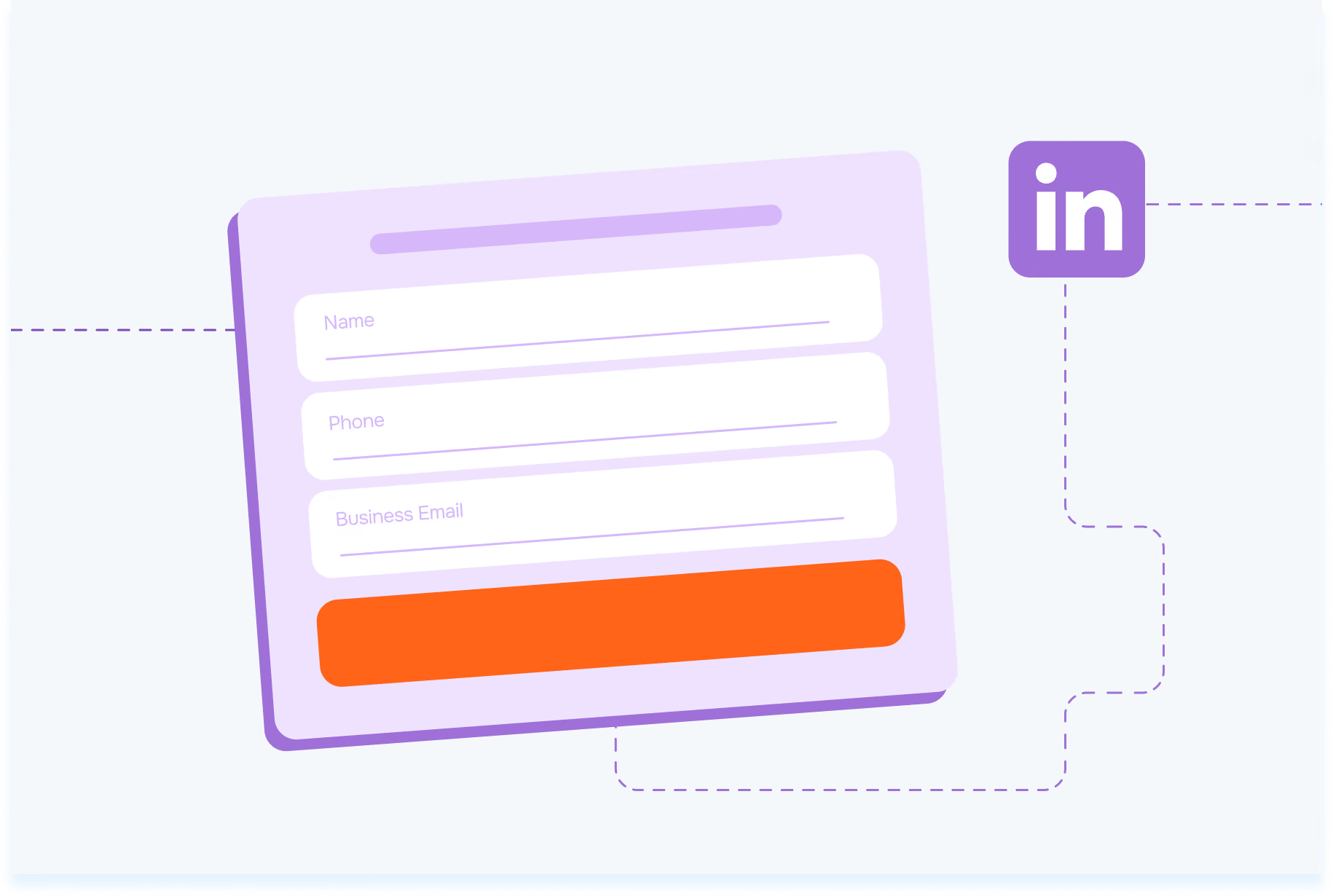
To solve this problem, Facebook offers Lead Ads, an ad format that allows users to submit their contact information without leaving the platform. The form opens directly within the app and is automatically filled with data from the user's profile, including their name, email address, and phone number. With one click, you get a lead.
This is particularly valuable for SaaS companies, as the average conversion rate for Lead Ads is 12.54%, compared to 10% for standard ads with a landing page. For brands working with a digital marketing services provider, that efficiency gap is often one of the clearest reasons to test the format seriously. Additionally, the cost of acquiring a lead on Facebook is on average three times lower than on LinkedIn.
In this article, we’ll look at seven real-world Facebook Lead Ads examples from SaaS and tech companies. We’ll break down what they’re doing, why it works, and how to adapt these strategies to your product.
What Are Facebook Lead Ads (And Why They Work for SaaS)
Facebook Lead Ads, also known as Meta Lead Ads, are ads with a built-in form (Instant Form). In practice, that Facebook lead generation form is what removes the extra step between attention and submission. When a user clicks on an ad, the form opens directly within Facebook or Instagram, so they don’t need to visit a website.
Here's how it works:
- A user sees an ad in their feed
- They click the CTA button (“Download,” “Sign Up,” or “Learn More”)
- A form opens with their profile information already filled in
- They confirm the information and click “Submit.
- You receive a lead
Why this works for SaaS:
- Minimal friction, especially on mobile devices
- Data is automatically sent to your CRM via integrations such as HubSpot, Salesforce, and Zapier
- You can add custom questions to qualify leads
- Works on all placements: Feed, Stories, Messenger, and Reels. That flexibility matters because many best practices in Facebook ads depend on matching the offer and creative to the placement.
1. HubSpot – Turning Educational Content Into High-Intent Leads

Offer Type: Free Guide / Educational Resource
HubSpot's Role:
HubSpot uses Lead Ads to distribute practical content directly relevant to marketers' goals. In this example, the offer is phrased as specifically as possible: "Your Free Guide to Instagram for Business." Users immediately understand that that they’ll receive structured content on a specific platform.
The headline, "Stop thumbs right in their tracks," acts as an attention hook. It aims to stop the scroll and grab attention. Meanwhile, the main value is revealed in the text above: "Strategies for Instagram that drive serious results." This highlights the practical nature of the material.
The visual isn't overloaded with product or UI details. This is one reason HubSpot often appears in strong Facebook ads examples for educational lead capture. Instead, it uses a real-life scenario. This lowers the perception barrier, making the offer feel less like marketing.
The "Download free" call to action (CTA) leads to a classic form with basic fields: name, email, and company. After submitting the form, the user receives the guide, and the company gets a qualified lead who has already shown interest in the specific topic.
Why it works:
- The offer solves a specific problem
- Framing it in terms of the result enhances the value of the content
- The low barrier to entry makes downloading a natural next step
- The visual reinforces the sense of practical application
- The lead goes straight into the CRM and can be processed through the email funnel
Lesson: This is a strong lead generation Facebook ad example because the content is tied to a single channel and a clearly defined use case. Lead Ads perform better when the content is tied to a single channel or objective. The more specific the use case, the more likely users are to submit their information. Present educational content as a tool that can be used immediately after download.
2. Asana – Positioning Task Management as a Revenue Driver

Offer Type: Free Trial / Product Sign-Up
What Asana Does:
In this advertisement, the company avoids directly addressing people’s pain points. Instead, Asana communicates its value through results. The pun-filled headline, "Don't sell your plans short," has a specific meaning: The problem isn't deadlines, but rather that teams aren't executing their plans at the business level.
The context of the result is provided immediately under the headline: "Increase revenue." This positions the product as part of a system that helps teams and businesses achieve specific goals. The visual reinforces this idea by showing a set of initiatives (global launch, operations timeline, and network management) integrated into a single workflow instead of abstract tasks. The text above the creative further solidifies this positioning: "Connect work to goals, collaborate across teams, and increase efficiency."
The CTA, "Try Asana for free today," leads to a typical product-led flow with quick entry into the product. For SaaS teams trying to generate leads on Facebook without adding extra friction, that directness matters. The form is minimal to avoid unnecessary friction at the first touchpoint.
Why it works:
- The focus shifts from operational pain to business results
- A single, clear outcome simplifies and strengthens the message
- The visual shows how different tasks connect into a unified system
- The message links the product to business results, not tasks
- A low barrier to entry accelerates the transition to first use
Lesson: Among example Facebook Lead Ads built for product-led growth, this one shows how outcome-driven messaging can do more than feature-heavy positioning. In B2B SaaS, it isn't always necessary to sell by highlighting pain points. When the product is mature and the category is well understood, communicating through outcomes is more effective. A single, clearly defined outcome tied to a business metric can be more effective than a list of problems and features.
3. ActiveCampaign – Using Risk Reversal to Remove Purchase Anxiety

Offer Type: Free Trial
What ActiveCampaign Does:
ActiveCampaign uses Facebook Lead Ads with a direct product offer and strong risk reversal. Among lead generation ads Facebook examples, this one stands out because it removes hesitation before the user even reaches the form. Rather than explaining the product's features or providing educational content, the advertisement addresses the main barrier: the fear of wasting money.
The key message, "30-day money-back guarantee," is centered in the visual and takes up most of the screen. The phrase "But you won't need it" reinforces confidence and serves as subtle social proof.
The ad copy reiterates this message, encouraging users to try the product risk-free and see results within 30 days. The "Get started" call to action (CTA) leads to a quick sign-up process without unnecessary steps.
The form that opens upon clicking the CTA requests a contact email, company name, and industry. These three fields allow ActiveCampaign to segment the lead even before the first email is sent.
Why it works:
- Strong risk reversal lowers the main barrier to entry for a SaaS product
- One focus and one message, without feature overload
- The visual is built around the value proposition, not the interface
- A confident tone ("You won't need it") builds trust
- The direct CTA aligns with the user's stage and doesn't require a long warm-up
Lesson: Industry data and benchmarks are among the highest-converting lead magnet formats for B2B SaaS. People want to know how they stack up against the competition. Give them that, and they’ll give you their email.
4. Monday.com – Communicating Value Through Visual Simplification

Offer Type: Free Trial / Product Sign-Up
What Monday.com Does:
The company builds its Lead Ads around a value proposition that is as simple and universal as possible. This creative encapsulates the idea in a single visual metaphor: "work" as a chaotic, overwhelming process and "simplified" as the result of using the product. Rather than showing an interface or case studies, it illustrates a transformation—from chaos to control.
The text above the ad provides social proof without overwhelming the viewer: "225K+ customers use Monday.com." This isn't the main focus but supports the core idea. Even without reading the description, the key message remains as simple and easy to read as possible.
The CTA, "Start your free account today," leads to product registration. This makes the ad feel less like a content play and more like a streamlined Facebook lead generation campaign built for fast product entry. Unlike content-based offers, there is no intermediate step here; the user goes straight to onboarding. The ad sells the user experience itself.
The form is minimalist, focusing on the essentials: email address and basic information needed to create an account. It is also a useful reminder for teams asking how to optimize Facebook ads without overcomplicating the first conversion step. Monday.com deliberately avoids overwhelming users with questions, striving to minimize friction at the entry point.
Why it works:
- A clear message with no need to read between the lines
- A visual metaphor that simplifies understanding of the product without explanations
- Social proof that builds trust without overwhelming the creative
- A direct transition to the product that shortens the path from click to first experience
- A minimal form that increases the number of sign-ups
5. Mailchimp – Driving Conversions With Performance-Led Messaging

Offer Type: Product Sign-up / Demo-Led Lead Generation
What Mailchimp Does:
Mailchimp focuses its communications on specific, measurable results rather than training or content. The central message—"Up to 97% increase in click rate with both email and SMS"—immediately highlights the benefit that users will receive.
Additional text reinforces this approach: "Drive sales and higher revenue" and "Here's proof." Users get the sense that the result has already been confirmed. This is a significant shift from classic educational offers, where value is first delivered through content.
The visual supports the use case. It shows a real example of an SMS message with a personalized offer and promo code alongside an e-commerce product. This links the platform to the use case of customer communication that leads to a purchase.
The "Sign up" call to action (CTA) leads to a more targeted lead generation process. The form asks for the user's name, work email, phone number, and company. This is not mass lead collection but rather an attempt to identify a high-potential audience and pass it on to the sales department.
Here's why it works:
- It sets expectations for the result with a specific number
- The message is built around revenue, not product features
- The visual shows a real-world use case, not an abstract interface
- The combination of email and SMS reinforces the perception of an omnichannel solution
- The expanded form allows you to immediately qualify the lead and pass it on to sales
Lesson: This is one of the best Facebook Lead Ads examples for showing how performance proof can carry the entire offer when the product is closely tied to revenue. When a product directly impacts revenue, it’s better to sell based on metrics than content. That becomes even more important when Facebook ads cost is rising and every lead needs a clearer path to revenue. A single, strong, performance-driven message, backed by proof, can be more effective than an educational lead magnet. In such campaigns, the form serves as a screening tool rather than a means to maximize lead volume.
6. Salesforce – Capturing High-Intent Leads Through Event-Led Offers
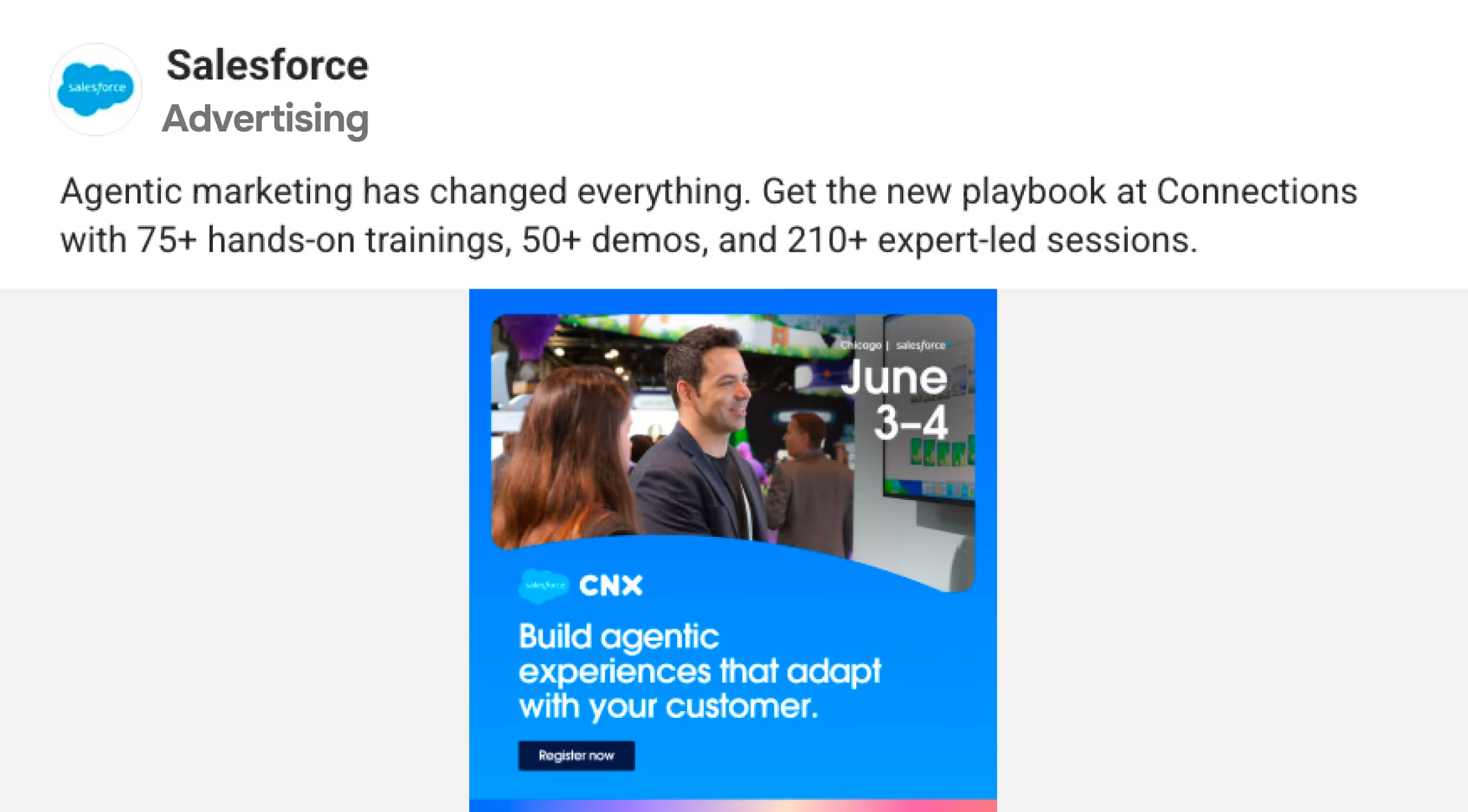
Offer Type: Registration for an Offline Event / Conference
What Salesforce Does:
In this example, Salesforce uses Lead Ads to promote its flagship event, Dreamforce. For teams evaluating Facebook Lead Ads for B2B, this is a useful reminder that not every high-intent offer has to be a demo or a download. The advertisement immediately sets the context: "Agentic marketing has changed everything," followed by specific details such as hands-on training, 50+ demos, and 210+ expert sessions. These concrete details demonstrate serious intentions rather than playing on emotions.
The offer is reinforced through pricing and savings. Users see "Save $400 on your CNX pass" and the final price of $499, which lowers resistance immediately and adds a sense of urgency. Unlike classic Lead Ads with content, here the user understands what they’re signing up for and what they’ll ultimately receive.
The visual supports the message. Rather than charts or an interface, it shows a real scene from the event with participants and demo zones. The date and location are also highlighted to put the user in planning mode.
Forms in such campaigns typically include name, work email, company, and job title. This filters for an audience that is truly ready to invest time and money in attending.
Why it works:
- The offer is tied to real-world experience, not theoretical content
- Specific numbers regarding sessions and demos reinforce the sense of scale
- The price and discount create a sense of a good deal
- The visual reduces abstraction and shows what participation looks like
- The form filters out casual leads and retains an audience with high intent
Lesson: This format presents a well-structured experience with a clear agenda, statistics, and a financial incentive to sign up.
7. Notion – Packaging Product Value Into a High-Perceived Offer

Offer Type: Free Trial / Extended Product Access
Notion's Role:
Notion's ad attracts new users with a limited-time offer. For teams building Facebook Lead Ads for SaaS, this is a strong example of how qualification can be tightened without making the value proposition feel weaker. The ad combines two key value propositions: collaboration and AI automation. The headline, "Smart Collaboration Meets AI Automation," immediately conveys the product's value proposition, while the offer, "Free 3-Month Trial with Full AI Access," makes the value proposition concrete and lowers the barrier to entry.
An additional layer of the offer reinforces the perceived value: users see not just free access but also an offer with tangible monetary value: "Get up to $12,000 of FREE Notion." This offer is ideal for companies that need an AI-powered work tool without any upfront costs.
Visually, the ad serves the same purpose. Rather than showing the Notion interface, it highlights different roles within a team, such as editor, agent, notetaker, and researcher, and positions the user at the center of this system. This quickly conveys that the product solves multiple tasks and supports a variety of work functions centered around individuals or teams.
The form is noticeably more rigorous than classic low-friction Lead Ads. In addition to an email address, Notion asks for company size, website, name, country, work email, and company name. For mass lead generation, this is a fairly high barrier, but it is justified here because the offer is aimed at startups that potentially meet the program’s criteria.
Why it works:
- The offer is directly tied to the product rather than intermediate content
- The value proposition is clearly defined and features a trial period with full access to the AI
- The monetary equivalent reinforces the perception of value and makes the offer more visually impactful
- The creative showcases a team-based use case rather than a single feature
- The extended form helps filter out irrelevant leads and collect qualification data
Lesson: This is the kind of structure often seen in high converting Facebook Lead Ads, where the offer is product-led, time-bound, and clearly tied to perceived value. In this case, a time-limited offer with clear benefits and value converts best.
What Every High-Performing Lead Ad Gets Right (5 Patterns Worth Using)
After analyzing seven case studies, we identified five principles that consistently work across companies:
- A specific offer, not an abstract proposition. Each ad offers one clear thing, such as a template, a certificate, or a spot in a webinar
- A minimal number of fields. The most effective forms contain two to three fields. If qualification is needed, one additional question is added, but no more
- Visuals show the product in action. Screenshots of the interface, dashboards with real data, and ready-made templates all reduce uncertainty and help users mentally apply the product
- One pain point–one ad. No one tries to reach the entire audience with a single ad. Different segments have different pain points and offers
- Follow-up starts immediately. A lead loses value without instant follow-up. In many funnels, that follow-up works even better when paired with Facebook retargeting ads that reinforce the same offer after submission. All companies integrate Lead Ads with their CRM systems and launch an automated email sequence within the first few minutes
Each case is tied to a specific stage of the funnel. That is also what makes these campaigns useful as Facebook lead generation ads ideas rather than just creative references. Content-based offers work when they solve a problem immediately. Product-led offers convert when their value is immediately apparent. Performance-based messages resonate when the product directly impacts revenue. Event and high-ticket offers no longer require volume; rather, they require quality leads.
FAQs
What are Facebook Lead Ads and how do they work?

What is a good conversion rate for Facebook Lead Ads?
How much does it cost to generate a lead on Facebook?
What type of offer works best for Facebook Lead Ads?
How can I improve the quality of leads from Facebook Lead Ads?

.png)
