

Display Advertising Best Practices for 2026: Full Guide

February 23, 2026

It's easy to think that Display ads are less effective than Search or performance-social ads if you evaluate them in the same way. However, this is not the case. Display ads' main role in 2026 will be to shape and strengthen demand before users form queries in search engines. In short, search captures existing demand, while display advertising shapes and strengthens it.
The problem of banner blindness remains relevant. Users rarely click on banners, if they pay any attention to them at all. However, well-thought-out creativity and competent display settings increase brand awareness and allow you to better understand your target audience's needs. This is particularly important for SaaS companies, whose potential customers rarely make impulsive decisions.
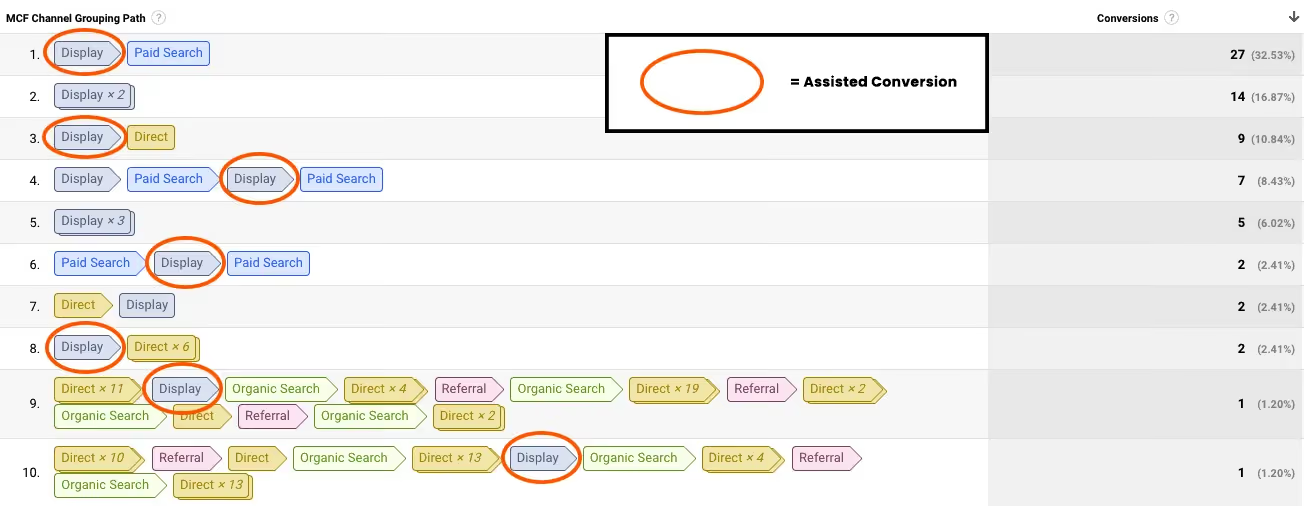
In the funnel, display advertising works as a channel for accumulating influence. Display increases the share of branded searches, brings users back after their first visit, and maintains interest in the product. Some of this effect is not reflected in last-click reports but is reflected in the speed of movement through the funnel and the volume of the pipeline.
Therefore, the question for 2026 is not whether display works, but how to build a Display advertising strategy that fits into the media mix and supports business growth.
Key Takeaways: What Matters in Display Advertising in 2026
- Display does not replace Search. It builds demand earlier in the funnel and increases branded queries that later convert into pipeline
- Most of Display’s impact is invisible in last-click reports because it works through assisted conversions, branded search lift, and faster deal progression
- In a cookieless environment, first-party data becomes the main optimization signal. Without CRM and value-based events, algorithms optimize for cheap leads instead of revenue
- Campaign structure now has more impact on results than manual bid control because automation works inside the architecture you build
- Mixing cold audiences and retargeting in one campaign usually shrinks the top of the funnel as the system shifts budget toward faster-converting segments
- Optimizing only for lead volume often reduces pipeline quality because the platform starts targeting users who submit forms but rarely reach the SQL stage
- Display expands the top and mid-funnel, while Search and retargeting convert that demand into qualified pipeline
- In Display, users have no active purchase intent. The banner must communicate value within one second, or the impression has no measurable effect
- Placement cleanup and format testing often reduce cost per SQL faster than constant changes to targeting or bidding
The New Reality of Display: Cookieless Data and AI Automation
Before discussing best practices, it is important to understand the environment in which they operate. Many display advertising approaches that were effective a few years ago are now either less effective or completely ineffective. The problem is not with the channel itself but with the fact that the rules of the game have changed.
Two factors will have the strongest influence on display strategy in 2026: the disappearance of the persistent cookie model and widespread automation through AI. The first factor has reduced the number of user signals received. The second factor has made automated bidding strategies the norm, rendering manual control less advantageous.
Failing to take these two shifts into account can cause even a technically well-configured campaign to produce poor results. Let's take a closer look at how the display advertising landscape has changed.
Cookieless Reality and Why It Matters
Until 2017, third-party cookies allowed users to be tracked across websites, build large audiences, and apply aggressive retargeting. In 2018, everything began to change. Safari and Firefox began blocking third-party cookies by default. In 2020, Google announced Chrome's transition to Privacy Sandbox and the gradual phase-out of third-party tracking. This led to three global changes:
- Remarketing reaches fewer people. The platform cannot always recognize users on different websites, so some visitors fall out of retargeting
- Lookalike audiences are built on less data. This reduces the accuracy of reaching the desired audience and makes the result less predictable
- Cross-site tracking becomes less transparent. It is more difficult to track the entire user journey from the first banner impression to conversion on another domain, so Display attribution becomes less accurate
First-party data has now become a valuable asset. It refers to data that a company independently collects and does not depend on third-party identifiers.
Examples include:
- Website behavior
- Subscriptions
- CRM
- Trial users
- Current customers
In the Google ecosystem, the use of first-party segments, such as Customer Match, increases conversion by an average of 10% and ROAS by 15% compared to campaigns without proprietary data.
Therefore, any digital Display advertising implementation in 2026 starts with data infrastructure and clear Display advertising best practices around segmentation and signal quality. Without the proper analytics setup, user segmentation by funnel stage, and CRM synchronization with advertising platforms, the platform will not receive signals that can be used to optimize the campaign.
Following the change in data sources, contextual targeting has returned as well. It is now important not only which user will see the banner but also where they will see it. For example, a Semrush banner would be appropriate on a page dedicated to marketing. Relevance arises from the context of the page, not from tracking specific users.
A cookieless reality does not remove display from the media mix. It simply makes display advertising more dependent on its own data and more sensitive to the quality of segmentation and campaign structure.
AI in Display Advertising – It’s Everywhere
The second key driver changing the reality of display ads is ubiquitous automation. As previously mentioned, large advertising platforms already use machine learning systems to manage bids, budget allocation, and creative combinations. Manual optimization is no longer the main source of advantage.
Google Display, for example, uses responsive ads. Advertisers only need to upload a few headlines, descriptions, and images, and the system automatically combines and optimizes them.
This changes the logic of campaign management. Whereas the result previously depended largely on manual bidding and micro-control, structure now plays a key role. The platform optimizes within the framework set by the marketer.
If a campaign is built without clearly dividing audiences, the algorithm will optimize average metrics.
Combining cold traffic and retargeting in one campaign will prevent the system from correctly matching the message to the user's intent.
If existing customers are not excluded, the budget will be spent on an audience that does not generate new value.
Using the same creative at all stages of the funnel will prevent the algorithm from distributing impressions correctly.
It's no secret that AI is a great help with operational tasks, but it only works within existing structures. For example, if an advertising strategy is flawed, automation will not fix it. Therefore, the key factors for effectiveness (and the core best practices for Display ads) in 2026 will be:
- Correct audience segmentation
- Separation of funnel stages
- Transmission of high-quality signals (events, conversion value)
- Logical campaign architecture
Automation strengthens the system, but the system itself must be built correctly. However, the system itself must be built correctly.
Where Display Fits In Modern Marketing Ecosystem
Our experience shows that display advertising rarely exists on its own. More often than not, it is a supporting type of advertising that works within a media mix alongside Search, Paid Social, CTV, and sometimes Retail Media. This structure becomes clearer when you look at how different Google Ads campaign types are mapped to specific funnel stages. However, Display is often viewed as an alternative to, or even a competitor of, all of the above channels. In reality, however, it serves completely different purposes.
Display advertising occupies an intermediate position in this system. It is cheaper to scale than social or LinkedIn in the B2B segment and more flexible than CTV. At the same time, it is not limited to hot demand, unlike Search.
How Display Compares to Other Digital Channels
To clarify, here is an illustration of the main types of Display advertisement compared to other campaign formats.
Understanding the differences between each type is important. Display is often removed from the strategy when Search starts to show good results. However, Search does not create demand, it only serves it. If the volume of search queries does not grow, Search will sooner or later face limitations. Display helps expand the top of the funnel and increase demand. Therefore, it is incorrect to expect the same direct CPA metrics from Display as from Search. The channel has a different function, and typical Google Display ads cost benchmarks reflect this difference between reach-oriented and intent-driven traffic. The channel has a different function.
The correct media mix logic looks like this:
- Display generates interest and increases awareness
- Search captures the generated demand
- Retargeting through Display and Social brings users back
- CTV or Video strengthen the brand when scaling
As a result, Display is not an alternative to Search, but an intermediate layer between awareness and conversion.
How to Build High-Performance Display Campaigns in 2026
Now that we have discussed the current drivers and ecosystem of Display, we can move on to the main topic and outline a Display advertising strategy 2026. To do this, we will describe each stage of creating a suitable architecture that will bring real benefits to the business.
Data Foundation – Organize Your Audiences First
When we simplify display ads to their basic logic, it all comes down to who will see your ad and at what stage of the funnel. Conversion signals, which algorithms later adapt, help with this.
This is evident even in basic metrics. For example, the average CTR is 0.46% in Display and 3.17% in Search. These values demonstrate that the level of intent for these channels is inherently different. In such an environment, optimization based solely on the number of applications leads to an overrepresentation of cheap but weak leads. This is why more and more campaigns are switching to optimization based on conversion value, revenue, or qualified leads.
Optimizing the system based on the number of forms submitted causes it to find audiences that submit requests more often, but who rarely reach the SQL stage and close deals. This is a common issue in Display advertising for SaaS, where lead quality matters more than raw volume. Although CPL decreases in reports, the volume of the actual pipeline does not grow.
This is why more and more campaigns are switching to optimization based on conversion value, revenue, qualified leads, or CRM events. Without these signals, the platform simply doesn't understand which users generate business results, so it scales the volume of leads rather than sales.
The second key component of the data foundation is intent-based segmentation. Since up to 95% of users do not convert on their first visit, retargeting can increase conversions by 150-200%, especially through remarketing Display ads built around intent-based segments. When cold and highly intent audiences are combined in one campaign, the system automatically allocates more of the budget to retargeting because it yields faster conversions. Consequently, the reach of new users decreases, and the top of the funnel narrows.
In our experience, modern display architecture should be built in the following order:
- First, value signals and CRM data
- Second, segmentation by intent
- Finally, targeting and creative
Otherwise, the algorithm scales the volume of leads, not sales.
Structure Your Channel Mix Around the Funnel
The placement platform is just as important as data architecture and targeted advertising. Depending on your goals and marketing strategy, each product type requires a specific channel.
Video Display: When You Need to Create Demand
Video is used at the top of the funnel when your audience isn't actively searching for a product yet. Review our SaaS video ads examples to see how the messaging differs at this stage. This is common for complex B2B solutions, new product categories, and entering different markets. In these scenarios, banners can increase reach, but they cannot explain the product's value.
According to the Interactive Advertising Bureau (IAB), digital video remains one of the main drivers of growth in the advertising market. This shift is reflected in companies' budgets, which are allocating more funds to formats that are effective in the early stages of the funnel.
In practice, video is used when brand demand is low. This channel helps explain the product and increase search traffic. Furthermore, video is no longer exclusively for companies with large budgets.
GDN and the Open Web: Scaling Your Warm Audience
If you have an existing audience interested in your product and need to increase warm traffic, classic display networks are the most effective solution. There is no better alternative to the Display Network, whose sites reach over 90% of internet users worldwide, according to Google.
This makes the open web the primary tool for:
- Retargeting
- Lookalike audiences
- Scaling mid-funnel campaigns
GDN will not bring cheap leads, but it will increase the volume of the pipeline. See our Google Display ads examples for structure ideas and formats.
DSP: When Control Is Important, Not Just Reach
DSPs (demand-side platforms), such as The Trade Desk and Google Display & Video 360 (DV360), are not connected initially, but rather when network inventory begins to stagnate. This occurs when a campaign reaches a frequency cap or starts receiving too many low-quality placements.
According to the IAB, programmatic revenues grew 18% in 2024, reaching $134.8 billion and reflecting the growing demand for managed buying.
DSPs are most effective when:
- access to premium sites is needed
- frequency control is required across the entire funnel
- brand safety and placement transparency are important
LinkedIn: Accurate Targeting of Roles and Accounts
LinkedIn remains the primary channel for targeting roles, industries, and companies. According to the platform, it has over 65 million decision-makers, and four out of five users influence business decisions. This is particularly important for B2B SaaS companies.
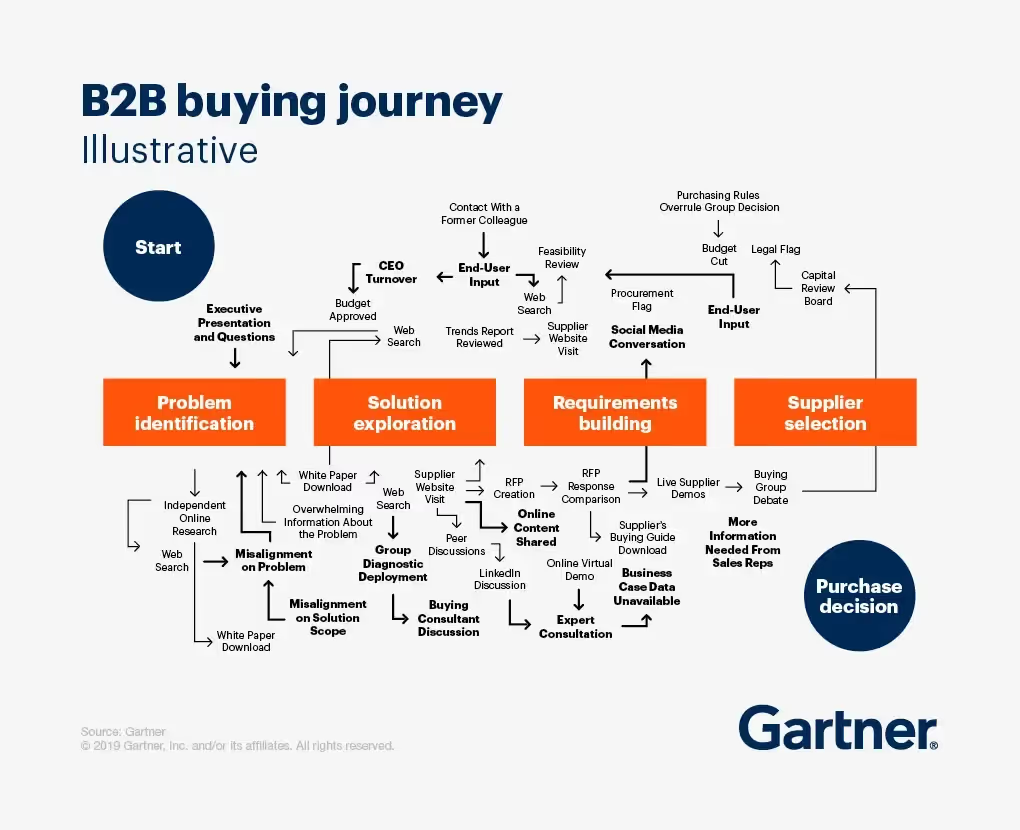
Using this channel is justified when:
- The product is sold to specific roles
- The audience is narrow
- The transaction cost is high
In these cases, targeting the right roles accurately is more important than achieving a low CPM.
Microsoft Advertising: for Scaling Your B2B Audience
Microsoft Advertising is often used as a more scalable addition to LinkedIn. Through its ecosystem, Microsoft claims to reach over one billion users. The key difference between Microsoft Advertising and other display networks is its use of professional signals from LinkedIn. This enables you to target by industry, company, and role at a lower cost per contact than LinkedIn itself.
This channel is ideal for:
- You need a broader B2B audience than LinkedIn offers
- When the balance between accuracy and cost per contact is important
- Your campaign works in conjunction with search demand
Microsoft Advertising enables you to expand your B2B audience reach without a significant increase in CPM while maintaining accurate segmentation based on professional criteria.
Match the Message and CTA to the Buyer’s Intent
Every year, creative requirements become more demanding. Users grew tired of banners 15 years ago, so you have to fight for their attention. In Display, the text inside the banner is more important than it seems. The user has no intention to buy, no context, and often no time not only to read but even to view the banner. The creative should be such that it explains the value and offers a clear solution in a fraction of a second. B2B banners should not say too much; short formulations with a specific message show the best results.
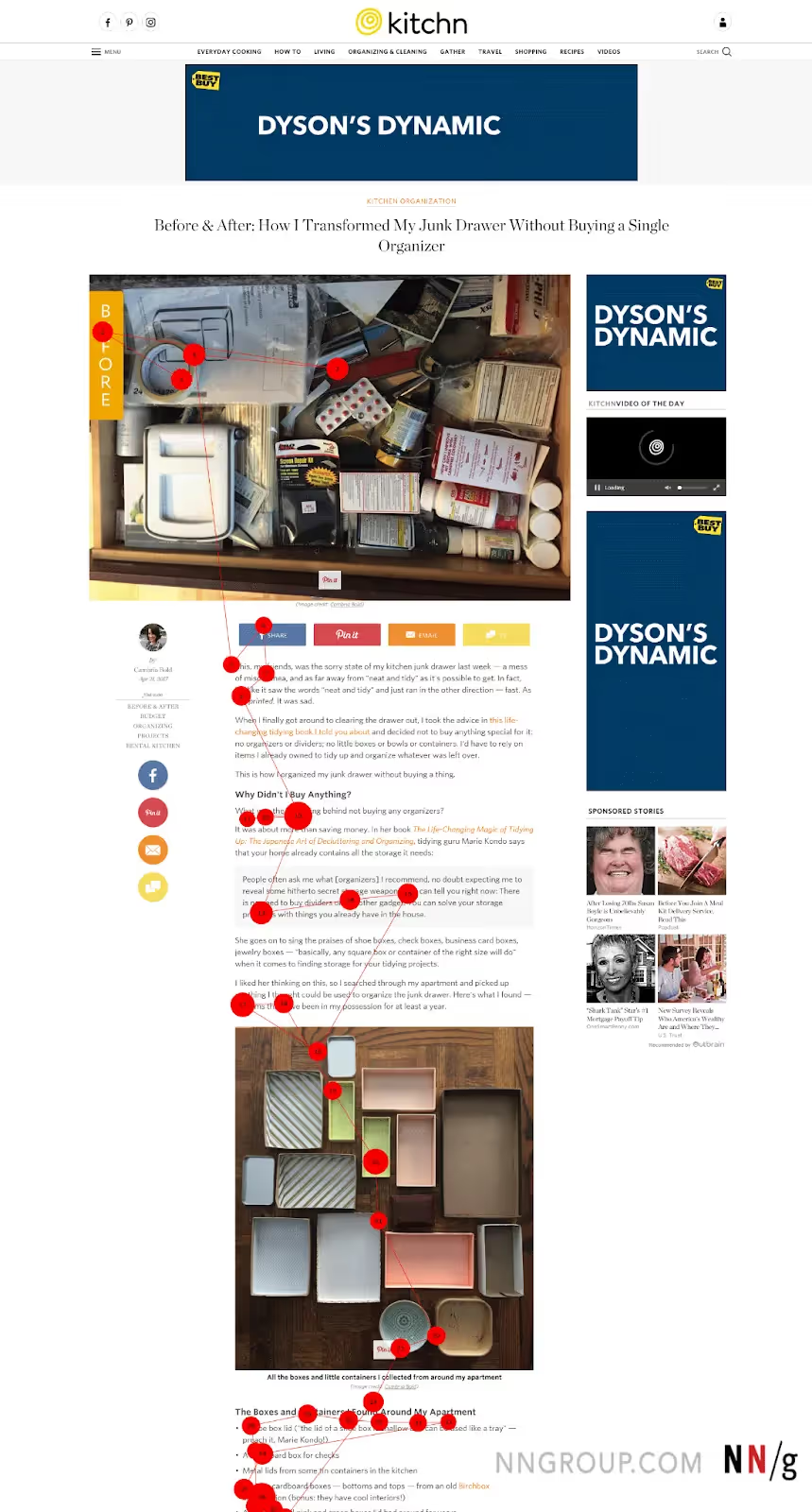
One banner – one result
Rather than describing features or integrations, the creative should immediately convey the problem it solves.
Bad:
- "All-in-one marketing automation with advanced analytics and integrations"
Better:
- "See your pipeline growth in one dashboard"
Short, value-focused teasers are more effective because the display of contact occurs outside the context of a purchase. Users visit the site for personal reasons.
CTA should match the level of intent
Ideally, the CTA button in Display would take into account the user's position in the funnel.
Using an aggressive CTA with a cold audience may result in a normal CTR, but conversions into deals will be low.
Meaning and clarity are more important than creativity
In display copywriting, there is a simple rule: the user should understand the meaning of the banner within one second.
Therefore:
- A specific result is better than an abstract promise
- A direct CTA is better than a metaphorical one
- A short sentence is better than a long one
Bad:
- "Take your marketing to the next level"
Better:
- "Increase qualified leads by 30%"
- CTA: "Get the benchmark"
Specifics increase trust
Numbers and measurable results increase the likelihood of a click if they are credible and related to a real case study.
For example:
- “Cut reporting time by 40%”
- “Used by 1,200 B2B teams”
- “Reduce CAC in 90 days”
Note: Any figures in the advertisement must be supported by case studies or research. After clicking through, users should not encounter different values. Unrealistic promises reduce trust and worsen conversion at subsequent stages.
Make Your Creatives Clear, Focused, and Recognizable
The visual accompaniment in display ads should perform the same function as text. Namely, they should quickly explain what they are about and whether they are worth paying attention to. Overloaded banners are less effective, unless you are advertising Adobe, Visme or Canva. The image and text should complement each other.
One visual center instead of an overloaded composition
A banner should have one main element, such as a product, result, number, or short thesis. This is one of the core banner ad design best practices in display. When a design contains a logo, interface, icons, illustrations, and text blocks, users do not know where to look. The rule is simple: If the main meaning of the banner cannot be understood in one second, then it is overloaded.
Effective formats:
- Large headline + simple background
- Product interface with a highlighted result area
- One character or object with a short thesis
Readability on mobile devices
Most display traffic comes from mobile devices. According to Statista, mobile devices account for about two-thirds of global web traffic.
This directly affects creative requirements:
- Text must be readable on a small screen
- Small interface details should not be key elements
- Important words should occupy the central part of the banner
If a banner only looks good on a desktop, it loses most of its effectiveness.
Visual consistency throughout the campaign
When the creative elements of a campaign appear to belong to different brands, the campaign becomes less memorable, and the frequency of contact ceases to increase brand recognition.
A minimum set of consistent elements is necessary:
- One main background or accent color
- Identical style of illustrations or photos
- Repeating headline format
This creates an accumulation effect: Users begin to recognize the brand by its visual pattern rather than its logo.
Use of animation and video
Animation and HTML5 banners can increase attention to creative, but only if the movement emphasizes or complements the main message.
Problems arise when:
- Animation distracts from the text
- Several movements occur simultaneously on the banner
- The user does not understand what exactly is being offered to them
Animation should draw the eye to the key message or CTA, not just enliven the banner.
Fix Placement Waste Before Scaling the Campaign
Even with normal targeting, part of the Display budget goes to sites that generate clicks but do not generate leads. Therefore, after launching a campaign, it is always necessary to check where exactly the ad is displayed and what actually works. This is one of the reasons companies often work with best Google Ads agencies that focus on placement cleanup and pipeline metrics rather than just CTR.
The working logic is simple. The campaign is first launched with automatic site selection. The algorithm tests different sites and applications and collects data. After a few weeks, it becomes clear which placements generate conversions and which ones only consume the budget. After that:
- Places with expenses and no conversions are excluded
- Sources with results are kept and scaled up
This is one of the fastest algorithms that lowers the cost of a lead without changing the targeting or creative.
Formats should be tested using the same logic. The same message is launched in different formats: static banner, HTML5, video. It is important that the targeting and budget are the same, otherwise the comparison is meaningless.
The decision should be based on the cost per lead or transaction, not on the CTR. In B2B campaigns, it often turns out that the format with a lower CTR gives cheaper SQL.
The main principle is to first collect data on a wide range of platforms and formats, then keep only those that actually bring results. Everything else will be a source of unnecessary expenses.
Test Different Ad Variations and Measure What Actually Improves Results
In addition to testing formats, you also need to conduct A/B testing of creatives. Many teams rely on a specialized SaaS performance marketing agency to structure these experiments around pipeline metrics. This will help you understand which elements actually improve results, rather than just collecting clicks. It is always better to start with data analysis, based on which you can choose a goal:
- Reduce the cost per lead
- Increase conversions
- Improve the quality of applications, etc.
A clear goal helps you choose the right evaluation metric. In Display, this is usually not CTR, but conversion cost. A competent Google Ads management company usually structures these tests around SQL or revenue, not just CTR. According to WordStream, the average CTR for banner ads is about 0.46%, which indicates a high percentage of accidental clicks and low audience intent.
Test one variable at a time. Only one element should change in each test:
- Headline
- Image
- CTA
- Main value proposition
If you change the image and text at the same time, it is impossible to understand what exactly influenced the result.
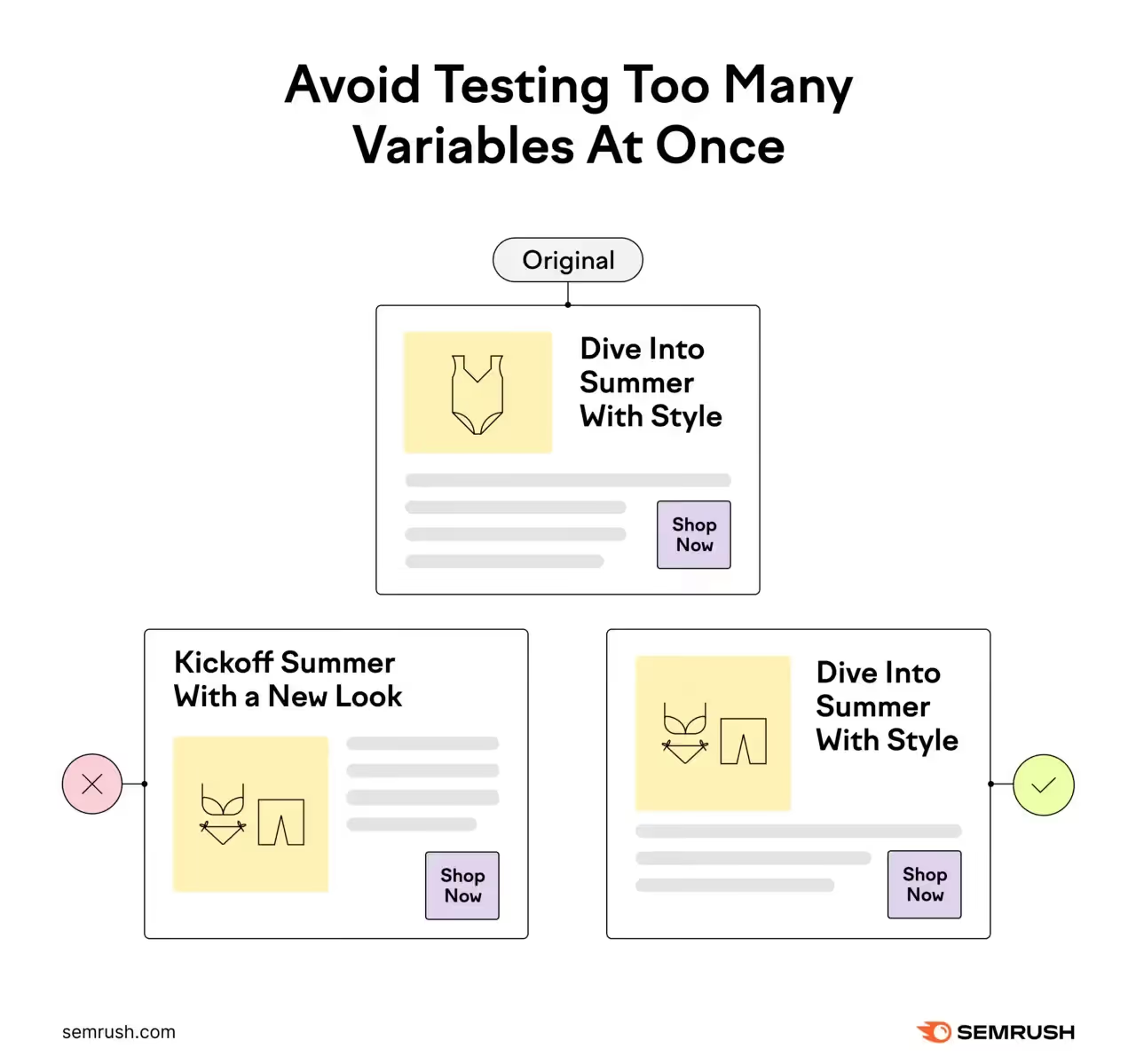
Testing decisions cannot be made after just a few conversions. As long as the difference in lead or conversion cost is small, it may be random and not reflect the actual effectiveness of the option. Only with a sufficient amount of data can you conclude which option really works better. This approach usually defines the best Display ads strategy for B2B in practice.
FAQs
The key metrics should relate to the pipeline. SQL cost, impact on branded queries, assisted conversions, and funnel velocity. CTR and CPL alone do not indicate whether a campaign is attracting real buyers or merely generating inexpensive leads.

With data. First, value signals and events are transferred from the CRM. Then, segmentation is built based on intent. Only after that are targeting and creative elements configured.
Display advertising shows real results not after the first leads are generated, but rather when a sufficient number of contacts with the brand have accumulated. This is evident in specific signals: the number of branded search queries increases, users return to the site after their first visit, and leads reach the SQL stage faster. In B2B, this is usually visible at the pipeline level rather than at the initial conversion level.
No, because the channels have different functions. Search works with high-level demand, while Display works with low- and medium-level intent. Therefore, a direct comparison based on CPA or conversion rate would be inaccurate.
Retargeting leads to faster conversions. The algorithm redistributes the budget in its favor because it sees faster conversions. Although leads are retained in reports, the influx of new audiences decreases. Over time, the top of the funnel does not grow and the pipeline begins to stagnate.



.avif)

.png)