

B2B SaaS Paid Ads Shakeup: What to Know for 2026

December 22, 2025

2025 threw a wrench into how we've been doing paid advertising for years.
AI didn't just show up to search results—it basically commandeered the front row. Meta's automation got smarter (and way more mysterious). And if you thought B2B buying cycles were long before? They just stretched even further.
If you're running paid campaigns the same way you did in 2025, you're probably burning budget without even realizing it.
At Aimers, we manage over $30M in ad spend for B2B SaaS companies. Throughout 2025, we watched the ground shift beneath our feet. These weren't small tweaks; they were fundamental changes that forced us to rethink strategies we'd relied on for years.
So instead of giving you another boring "trends for 2026" post, we asked two of our senior PPC specialists to tell you what actually happened. Layla Abilova (our Growth Leader) and Konstantin Bogdanovich (PPC Manager) have been in the trenches managing campaigns while everything changed around them.
What you're about to read isn't theory—it's what we learned managing millions in ad spend while Google's AI Overview launched, Meta rolled out Andromeda, and B2B decision-makers took their sweet time to convert.

Google AI Overview Pushed Everything Down
The biggest shake-up for classic PPC in 2025 was the introduction of Google AI Overview.
AI blocks took over the top of the page, pushing organic results down—and often moving ads even lower. This changed CTR patterns and traffic distribution almost overnight. Imagine watching your top ad position (the one you paid premium CPCs for) suddenly buried below a wall of AI-generated content.
For many advertisers, this meant:
- lower click-through rates even on top ad positions,
- higher CPCs in competitive industries,
- the need to create content that gets “picked up” by AI Overview, not just optimize ads,
- a growing importance of brand strength and user intent.
By 2026, ignoring AI Overview in your PPC strategy simply won't work. Advertisers will need to blend PPC with SEO, content, and subject-matter expertise to appear in AI-generated answers.
ChatGPT and Perplexity Became Real Traffic Sources
In 2025, GA4 dashboards started filling up with traffic from chat.openai.com, Perplexity.ai, and other AI platforms. Most marketing teams noticed it around Q2, when their "direct traffic" numbers started looking weirdly inflated.
If tracking isn't set up correctly, traffic from these systems gets lumped into three categories: direct, referral, or the dreaded "not set."
This leads to messy attribution. You might think you're getting all this amazing direct traffic—when really, it's ChatGPT sending people your way. And without proper tracking, you're essentially flying blind. Some of our clients didn't catch this until Q3, which meant months of skewed data and misallocated budget. Honestly, it's like trying to navigate with a broken compass.
In 2026, AI agents will play an even bigger role in user journeys, and clean analytics will become non-negotiable.
Meta Andromeda Took Automation to Another Level
In 2025, Meta rolled out a major update—Andromeda. It's a new layer of AI optimization that strengthened automatic audience creation, conversion probability predictions, creative adaptation for individual segments, and the overall behavior of Advantage+ (which now runs on even more closed ML models).
This pushes manual control to the background. Old habits like micro-segmented audiences and heavy testing simply stopped delivering the same value. PPC managers who spent years perfecting audience layering suddenly found their carefully crafted segments underperforming simple Advantage+ campaigns.
Here's the thing: Andromeda reinforced the "black box" direction—where the decisive factors are creative quality (your ads matter more than your targeting now), volume of data, strong first-party signals, and stable, long optimization cycles.
Translation: your ad creative matters more than your targeting now. And if you're constantly tinkering with campaigns, you're probably hurting performance more than helping it. The algorithm needs time to learn—like, weeks, not days.
B2B Decision Cycles Got Longer (Way Longer)
In 2025, the B2B sector saw the longest decision cycles in recent years. The main drivers? Economic uncertainty, rising competition, stricter budget oversight from finance teams, and higher expectations to prove real product value.
What used to take 60 days now takes 90 or 120. And that changes everything about how you plan campaigns, budget for CAC, and measure success.
Companies that invested in upper-funnel activities ended up with stronger SQL and opportunity metrics. They weren't just capturing demand; they were creating it. Videos showcasing product value. Detailed case studies. Educational content addressing buyer objections.
In 2026, this won't be optional anymore. You can't just wait for someone to Google your category and hope they click your ad—that person might not exist anymore (or at least, not in the volume you need).

AI Max for Search Campaigns (Proceed with Caution)
Introduction of AI Max in Google Ads was an important update in the PPC world in 2025. Google, along with its sales team, actively encourages converting standard Search campaigns into AI Max search campaigns. These include Text Customization and Final URL Expansion—the first modifies your ad texts; the second changes landing pages.
After using AI Max with many projects, we strongly recommend testing it gradually. Monitor not just overall campaign performance, but also search terms closely. Pay close attention to the impressions AI Max generates—often they include overly broad queries, which can lead to efficiency losses, especially in narrow B2B niches.
We've seen AI Max send traffic for "project management" when the client only wanted "project management for construction teams." Small difference in the query, huge difference in conversion rate. And when your average sale is $50K ARR? Those wasted clicks add up fast. You know what I mean?
Given that AI Max is still labeled as beta, there's hope Google will improve its effectiveness. But until then, treat it like any beta feature: useful in some contexts, dangerous in others.

PMax Finally Opened Up
Search campaigns remain foundational. But in the current era of search transformation, the importance of campaigns that go beyond simple Google Search is growing. So let's talk about Performance Max campaigns.
Google has been improving its favorite child since 2021 (how quickly time flies!), and it achieved a lot in 2025. The ability to add negative keyword lists at the PMax campaign level—using this is extremely important. Device targeting allows you to finally exclude non-converting mobile traffic. Now you can exclude Age and Gender; a separate checkbox for "Customer acquisition: optimizing for new customer acquisition" has appeared.
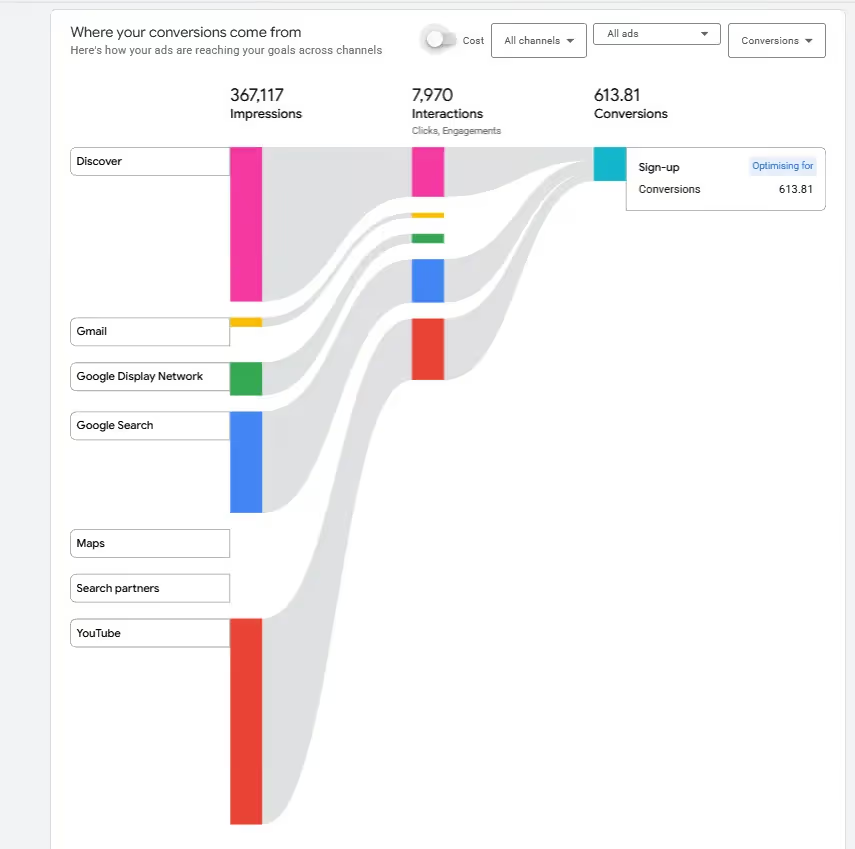
Last but not least: Channel performance insights, which display reports with spend, impressions, clicks, and conversions segmented by placements within your PMax campaign.
You can actually see where your money's going now—Search, Display, YouTube, Discovery. Before these updates, managing PMax felt like throwing money into a machine and hoping something good came out the other end. Now? You can actually make informed decisions.
Informational Keywords Took a Hit (But Commercial Intent Still Works)
Given the use of AI tools that easily answer general questions, people are reading fewer informational blogs; instead, they're reading concise summaries generated by AI tools. Why click through to read a 2,000-word guide when ChatGPT can summarize it in 30 seconds?
Now, getting clicks for informational, TOFU queries is much harder. And this is one reason why the influence of banner campaigns like Pmax and Demand Gen is growing: they capture users' attention not at the moment of searching.
However, once people have gathered information and are ready to buy—when they use Google search looking for a product or service—your campaigns must be fully armed and ready to capture that customer. The shift is pretty clear: awareness happens elsewhere now (AI tools, social, video), but conversion still happens in search.

What You Actually Need to Do About All This
Let's break down what this means for your 2026 strategy.
- Stop Treating PPC Like It's Separate from Everything Else
AI Overview and ChatGPT referrals mean you can't think about paid ads in isolation anymore. Companies that combine paid acquisition with strong content that AI tools pick up? They're going to outperform those running ads alone.
- Get Your Analytics Sorted Before You Spend Another Dollar
If you can't properly track traffic from ChatGPT, Perplexity, and other AI platforms, you're making decisions based on incomplete data. Take a weekend. Fix your GA4 setup. Add custom channel groupings. Future you will thank present you.
- Let Automation Do Its Thing (But Stay Strategic)
Meta Andromeda and Google's AI Max show where platforms are headed. Fighting automation wastes time. Instead, focus on creative strategy, conversion optimization, and making sure your tracking feeds quality data to the algorithms.
- Build Your Upper-Funnel Before Your Bottom-Funnel Tanks
Waiting until your bottom-funnel performance falls apart to start demand generation? That's too late. Start warming audiences now with video content, case studies, and educational materials. Think of upper-funnel as preventive maintenance—you don't wait until your car breaks down to change the oil.
- Test New Features Like You'd Test Anything Else
Don't blindly adopt new features just because Google recommends them. Test systematically. Monitor closely. And be ready to roll back if efficiency drops.
- Put Your Budget Where Intent Actually Lives
With informational keywords losing effectiveness, concentrate spend on keywords where users are actively looking to buy. If someone's Googling "best [your category] for [their use case]"? That's your moment.
- Actually Use the PMax Data Google Finally Gave You
With Google providing more visibility into PMax performance by channel, you need to actually use that data. We've seen accounts where 80% of spend was going to Display (which converted at 0.2%) while Search was starved for budget. That's fixable now—but only if you look at the data.
So What Does 2026 Look Like?
2025 taught us something important. The paid advertising landscape can fundamentally shift in ways that make last year's playbook obsolete. The companies that succeeded weren't the ones with the biggest budgets—they were the ones that adapted fastest.
For 2026, expect these trends to accelerate. AI will play an even bigger role in search results. Automation will continue reducing manual controls while demanding better creative and first-party data. B2B decision cycles will likely stay long, making demand generation increasingly critical.
The winners in 2026? They'll be B2B SaaS companies that treat paid advertising as part of a broader demand creation system rather than a standalone lead generation tactic. That means tighter integration between PPC, content, product marketing, and sales.
The landscape changed dramatically in 2026. But change creates opportunity for those willing to adapt faster than their competitors.
FAQs
No. Search campaigns remain foundational, especially for high-intent keywords and branded searches. For most B2B SaaS companies, we recommend running both—using Search for targeted queries and PMax for broader demand capture.

Update your GA4 configuration to properly categorize these sources. Add chat.openai.com, perplexity.ai to your channel grouping definitions. Create a custom channel group for "AI Referrals." Takes maybe an hour to set up, saves months of confused data analysis.
Not necessarily pushing back, but definitely testing carefully. Enable AI Max on a small percentage of campaigns first. Monitor search term reports closely. Many advertisers found it worked well for certain campaign types but not others.
Based on 2025 data, assume 4-6 months for most B2B SaaS products, potentially longer for enterprise sales. Budget accordingly—the cost of acquiring a customer now includes 4-6 months of engagement, not just the final conversion.
Stop treating paid ads as a standalone lead generation channel. Integrate your PPC strategy with content creation, demand generation, and sales enablement. The advertisers who win will use paid ads to amplify great content, warm audiences over time, and guide prospects through extended buying journeys.

.avif)

.png)