
SaaS Product Marketing: Position, Launch, and Grow


A SaaS platform can have strong features, clean UX, and a capable sales team, yet still struggle to grow. The reason is often not the software itself. It is the gap between what the solution does and how clearly the market understands why it matters.
That is the gap PMM is built to close.
SaaS product marketing helps software companies define positioning, shape messaging, plan launches, support sales, improve adoption, and connect product value with measurable business outcomes. It brings together product, go-to-market, sales, and customer success, ensuring that the right customers understand the right value at every stage of the journey.
In practice, this discipline turns capabilities into reasons to buy, reasons to try, reasons to stay, and reasons to expand.
What Is SaaS Product Marketing?
SaaS product marketing is the strategy and execution behind how software is positioned, launched, adopted, and grown. It explains who the product is for, what problem it solves, why it is different, and how customers can turn its capabilities into real business value.
Product Marketing Alliance defines product marketing as the process of bringing a product to market and overseeing its ongoing success. Pragmatic Institute adds an important layer: product marketing also depends on market understanding, positioning, and clear communication of product value. For SaaS companies, this is not just launch ownership. It is the operating layer that keeps product value understandable across acquisition, activation, retention, and expansion.
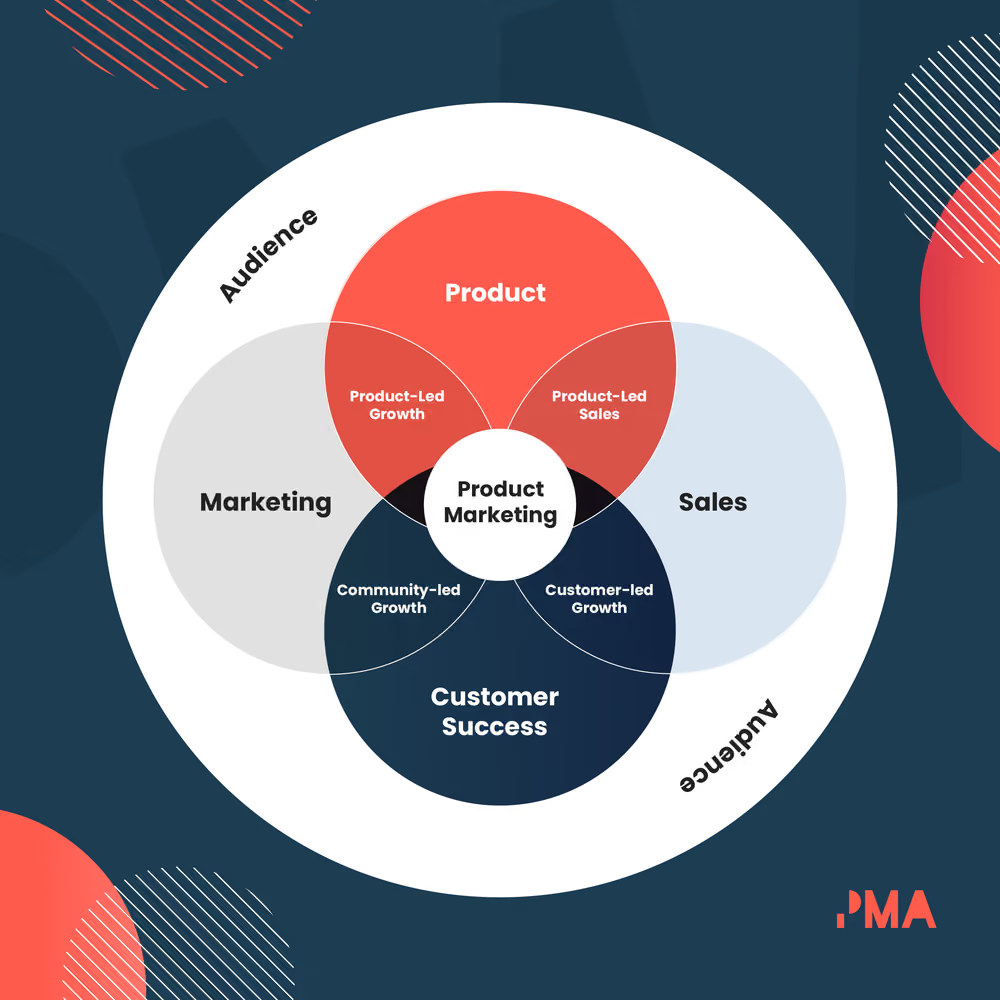
That makes product marketing for SaaS different from a one-time launch campaign. The work continues after the announcement. PMMs help shape positioning, website copy, onboarding flows, lifecycle campaigns, sales enablement, feature education, and expansion narratives. They make sure the product story stays consistent from the first ad click to the sales conversation, onboarding experience, renewal, and upsell motion.
For example, a project management platform should not only say it has dashboards, automations, and integrations. A strong SaaS product marketing strategy explains why those capabilities help a head of operations reduce manual reporting, improve team visibility, and make delivery more predictable. The feature list explains what exists. Product marketing explains why it matters.
How PMM Differs From General SaaS Marketing
SaaS marketing covers the broader system that attracts, converts, and retains customers. PMM focuses more tightly on market fit, value story, launch motion, and usage growth.
The two should work together, but they should not do the same job. PMM defines the product story: who the product is for, why it matters, how it is different, and what outcome it helps customers achieve. Demand generation, SEO, paid media, and lifecycle teams turn that story into traffic, pipeline, activation, and renewal. When this handoff is weak, campaigns may generate interest without creating preference, and sales may receive leads who still do not understand why the product is the right fit.
Product Marketing vs. Demand Generation
Demand generation creates and captures market interest. PMM makes sure that interest is attached to a clear value story.
That distinction matters because awareness alone does not create preference. If demand generation brings traffic to a page, PMM helps answer the questions that determine whether the visitor keeps evaluating: why this solution, for whom, against what alternatives, and for which business outcome?
This is also where product marketing connects to the wider go-to-market plan. Positioning should not sit in a separate messaging doc while campaigns, landing pages, paid acquisition, and sales conversations tell a different story. We've explored this idea in more detail in our guide to SaaS go-to-market strategy, where we explain how customer understanding, channel strategy, and revenue execution need to work as one system instead of separate marketing initiatives.
Product Marketing vs. Product Management
Product management owns what gets built and why it matters for the roadmap. PMM owns how the market understands that value.
Effective PMs and PMMs share customer research, competitive insights, usage data, win/loss feedback, and sales objections. Product management may identify a roadmap opportunity. PMM turns that opportunity into a market-facing narrative that buyers, users, sales teams, and customer success teams can use.
PMM should not simply “package” product decisions after the fact. It can feed market signal back into the roadmap by showing which value points customers miss, which competitor narratives are shaping the category, and which product capabilities need stronger commercial context before they can drive adoption or revenue.
Product Marketing vs. Customer Success
Customer success helps customers achieve outcomes after purchase. PMM supports that work by clarifying value, improving onboarding messaging, promoting relevant features, and building campaigns that increase usage.
For SaaS, this connection matters because the launch is not the finish line. A feature that users do not understand or adopt does not create much business value. PMM helps turn release communication into adoption support: what changed, why it matters, who should use it, and how it helps customers get more value from the product.
How to Build SaaS Product Positioning and Messaging
Positioning is where SaaS product marketing becomes practical. It turns customer research, product capabilities, competitive context, and business value into a clear market story: who the product is for, what problem it solves, why it is different, and what outcome the buyer can expect.
This matters because B2B buyers rarely move through a simple, linear journey. Gartner describes the B2B buying process as a set of recurring jobs, from problem identification and solution exploration to requirements building and supplier selection. Strong positioning helps buyers make sense of the product during that self-directed evaluation, before they ever speak with sales.
The goal is not to make the product sound impressive. The goal is to make the right buyer understand value faster than competing solutions can explain theirs.
Defining the Ideal Customer Profile and Buyer Personas
Start with the ideal customer profile. For SaaS, an effective ICP goes beyond company size or industry. It should include firmographics, use cases, pain intensity, team maturity, current technology stack, buying process, expected contract value, and expansion potential.
Then define buyer personas and user personas separately. The buyer may be a VP of Marketing, CFO, or Head of Operations, while the daily user may be a specialist, manager, analyst, or customer-facing employee. PMM needs both perspectives because software has to be easy to justify during the buying process and easy to adopt after purchase.
Turning Product Features Into Business Value
Feature-led messaging usually sounds like this: "AI dashboard, automated reports, native integrations."
Value-led messaging sounds different: "See which campaigns generate qualified pipeline without rebuilding reports every week."
The difference matters because buyers rarely purchase software for its feature list alone. They invest in faster decisions, less manual work, cleaner attribution, lower acquisition costs, stronger adoption, and more predictable business outcomes.
One useful way to build messaging is to move every feature through a simple translation:
Instead of describing what the product includes, explain what changes for the customer after using it.
The same logic applies to marketing technology. A tool is only valuable when it changes the way a team works: reducing manual effort, improving decisions, increasing ROI, or making revenue impact easier to prove. We've covered this in more detail in our guide to SaaS marketing tools, where we show how software value should be tied to measurable business outcomes, not just feature depth.
Differentiating the Product in a Competitive Market
Most SaaS categories are crowded, which makes differentiation one of product marketing's most important responsibilities. That differentiation may come from audience focus, workflow depth, speed to value, integrations, implementation experience, data quality, pricing model, compliance, or measurable business outcomes.
A useful positioning test is simple: if you removed the logo from your homepage, would a buyer still understand why your product is different? If the answer is no, the messaging probably needs sharper contrast.
Strong differentiation also requires continuous validation. As markets evolve, positioning should evolve with them. A good example is our work with an AI SaaS company, where we tested messaging hypotheses, page structure, and calls to action through A/B experiments. The strongest result delivered a 241% conversion uplift, showing why positioning should be treated as a testable growth lever, not a one-time messaging exercise.
What a SaaS Product Marketing Plan Should Include
A SaaS product marketing plan should connect positioning to execution. It should not be a launch checklist only. It should explain how the offer will reach the right customers, convert demand, support sales, drive activation, and improve retention.
The plan should also make trade-offs clear:
- Not every segment needs the same message
- Not every release needs a full launch
- Not every channel deserves budget at the same stage
Strong PMM planning helps the team decide where to focus, what to test first, and how to turn the product story into a repeatable go-to-market motion.
Go-to-Market Strategy and Channel Selection
Your go-to-market strategy should define the audience, offer, channels, conversion path, and sales motion. A PLG motion might rely on SEO, comparison pages, free trial flows, email onboarding, and retargeting. Enterprise software may need ABM, LinkedIn Ads, webinars, sales enablement, and personalized landing pages.
Channel selection should follow the customer journey, not internal preferences. We've covered this in more detail in our guide to SaaS marketing plans, where we explain why teams need to align strategy, budget, channels, and execution before choosing tactics. Otherwise, the company may end up with active campaigns that are well-run but disconnected from how buyers actually evaluate the product.
For paid acquisition, PMMs should work closely with teams managing SaaS PPC, Google Ads, and paid social. Otherwise, campaigns may drive clicks with messaging that does not match the product's real value. We've also explored this in our guide to paid acquisition for B2B SaaS, where we show how paid channels work best when positioning, offer, funnel stage, and revenue goals move together.
Product Launch and Feature Release Planning
A SaaS launch plan should include target segments, launch tier, message hierarchy, website updates, sales enablement, lifecycle emails, onboarding changes, paid media support, customer success notes, and post-launch measurement.
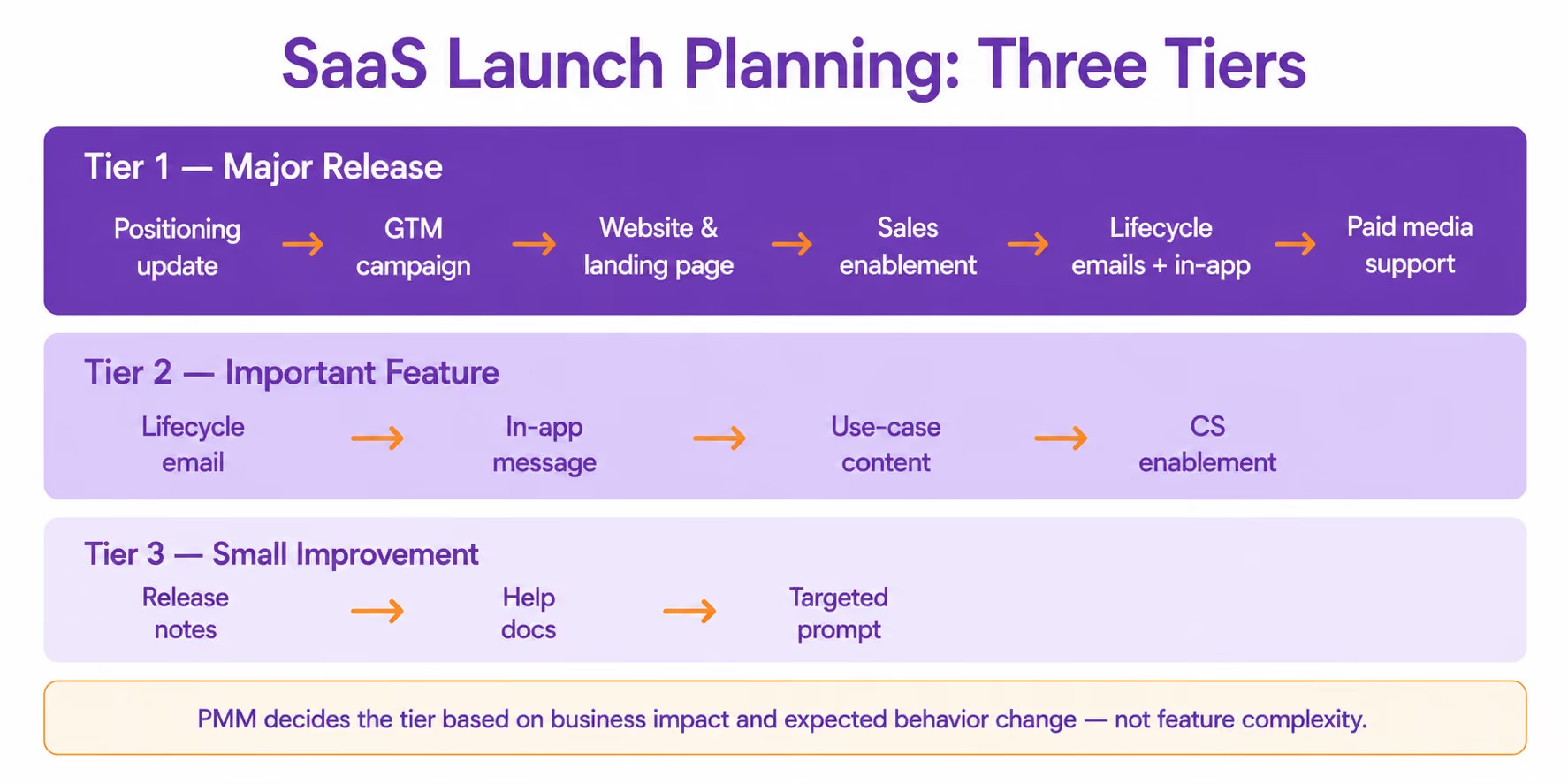
Not every release deserves the same launch motion. A major product module may need a full campaign, sales enablement, website updates, and paid support. An important feature may need lifecycle emails, in-app messaging, use-case content, and customer success enablement. A smaller workflow improvement may only need release notes, help docs, and targeted prompts.
PMM decides the level of effort based on business impact and user value. Every launch should define the audience that needs to care, the value the update creates, and the behavior it is meant to change after release. This keeps launch planning focused on outcomes, not announcement volume.
Sales Enablement and Customer-Facing Assets
Sales enablement turns positioning into usable material for the revenue team. This can include one-pagers, objection handling, competitor battlecards, demo narratives, ROI calculators, case study angles, and talk tracks.
Good enablement does not overwhelm sales with more documents. It helps the team explain value clearly, answer objections, and connect product capabilities to business outcomes. Strong assets are built around the buying conversation: the cost of inaction, the reason to change now, the product's advantage, and the proof needed to trust the decision.
How PMM Supports Acquisition, Activation, and Adoption
PMM should not stop once the offer is launched. In SaaS, growth depends on whether the right customers understand, try, use, and expand the product. A strong product story needs to carry through every stage, from the first website visit to the first value moment and long-term adoption.
Free Trial, Freemium, and Product-Led Growth Journeys
For free trial and freemium motions, PMM helps define the path from signup to first value. That includes the homepage promise, trial CTA, onboarding screens, activation emails, guided tours, upgrade prompts, and the product cues that help users understand what to do next.
The question is not only “How do we get more signups?” It is “How do we help the right users reach the value moment quickly?”
This is especially important in product-led motions. OpenView defines product-led growth as an end user-focused model where the product drives acquisition, conversion, and expansion. In practice, that means the first product experience has to prove value before a buyer speaks with sales.
A good example is our work with Originality.AI, where improving landing page clarity, motivation, and relevance helped increase sign-up conversion by 47% on the homepage and 148% on the Plagiarism Checker landing page. The lesson is practical: landing page messaging sets the expectation that onboarding then has to fulfill. If the pre-signup promise is unclear, the product has to work harder to prove value after signup.

Onboarding, Activation, and Feature Usage
Activation happens when a user completes the action that shows meaningful early value. Habit formation begins when that action becomes part of the user's workflow.
PMM supports activation and adoption by clarifying what to do next, why it matters, and which outcome the user should expect. This can include onboarding copy, lifecycle emails, in-app messages, release notes, use case pages, and help center content. The work is not just educational. It reduces the gap between what the product can do and what users actually adopt.
Feature education also needs focus. Pendo's product benchmarks show that only 6.4% of features drive 80% of product clicks, and even best-in-class products reach 15.6% feature adoption. For PMM, this is a useful reminder: adoption does not happen just because a feature exists. Users need to understand which features matter, when to use them, and how they connect to value.
If the software needs a stronger post-click experience, onboarding pages, or conversion paths, we can help turn product messaging into clearer user journeys through landing page design and CRO. The goal is not just to improve page performance, but to help users move from interest to action with less friction.
Lifecycle Campaigns for Retention and Expansion
Lifecycle campaigns help customers discover more value over time. PMM can support campaigns for feature education, use case expansion, plan upgrades, seat expansion, reactivation, and renewal support.
This is where marketing tactics should evolve with the company's stage. Early SaaS teams need first customers. Scaling teams need repeatable activation, retention, and expansion. As the product matures, PMM helps keep the value story current by showing users which workflows to adopt next, why deeper usage matters, and how expanded product use supports better outcomes.
How to Measure PMM Success
SaaS product marketing should be measured across acquisition, activation, adoption, retention, and revenue. MQLs alone are not enough because they stop at interest. They do not show whether the value story helps customers activate, adopt the product, stay, or expand.
PMM should also work with analytics and RevOps to connect campaign data with product usage and revenue outcomes. A launch that drives signups but no activation is not a successful SaaS product marketing strategy. Likewise, a campaign with lower lead volume but higher trial activation, stronger adoption, and better expansion potential may create significantly more business value over time.
The most useful PMM metrics rarely tell the full story on their own. They become meaningful when viewed together. High signup volume with low activation may point to weak positioning or onboarding. Strong adoption with low expansion may indicate that customers see value but not enough differentiation between plans. Looking at the full customer journey helps teams identify where product marketing is creating momentum and where it needs refinement.
That is why PMM should be evaluated across the entire customer lifecycle rather than through campaign metrics alone. Looking at acquisition without activation, or retention without adoption, makes it difficult to understand whether product marketing is actually helping customers realize value.
We've explored this challenge across many SaaS engagements. Connecting marketing, product, and revenue data creates a much clearer picture of PMM performance than looking at campaign or product metrics in isolation. Without that connection, teams may optimize individual dashboards while missing the broader growth story.
.avif)
Turn Product Clarity Into Growth
SaaS product marketing is where product value becomes market clarity. It helps teams translate capabilities into positioning, messaging, launch plans, sales enablement, adoption campaigns, and measurable growth.
The strongest PMM work does not start with channels or launch tactics. It starts with the harder questions: who the software is for, what problem matters most, why the solution is different, how buyers evaluate it, and how users experience value after signup or purchase.
That clarity influences every stage of growth. In practice, it helps teams:
- Improve acquisition by making the value proposition easier to understand;
- Increase activation by setting the right expectations before users enter the product;
- Strengthen adoption by reinforcing product value throughout the customer journey;
- Support retention and expansion by giving customers more reasons to stay, upgrade, and deepen product usage.
Just as importantly, it helps marketing, sales, product, and customer success work from the same story instead of creating different versions of the offer at every handoff.
If your product creates value but that value is difficult for buyers to recognize, PMM is often the missing layer between product development and sustainable growth. At Aimers, we help SaaS and tech companies turn positioning into measurable business outcomes by connecting messaging, paid acquisition, landing pages, CRO, and analytics into one coordinated growth system.
FAQs
What is SaaS product marketing?

What should a SaaS product marketing strategy include?
How is product marketing for SaaS different from demand generation?
What metrics matter most for PMM?
What is the difference between a SaaS product marketing plan and a SaaS launch plan?