

Digital Marketing for Tech Companies: Revenue-First Guide

August 3, 2026
Most tech companies do not have a digital marketing problem. They have a prioritization problem.
It is easy to launch campaigns, publish content, run retargeting, report on clicks, and still miss the outcome that matters: qualified pipeline that can turn into revenue at an acceptable CAC and payback period.
That is why digital marketing for technology companies should not be managed as a channel checklist. It should be managed as a revenue system. The real work is deciding which audience to pursue, which channels fit the sales motion, which conversion paths remove friction, and which metrics prove that marketing is creating pipeline quality, not just activity.
Direct answer: digital marketing for tech companies works best when it is built around ICP clarity, channel fit, conversion quality, and measurement that connects campaigns to CRM stages, qualified opportunities, closed-won revenue, ARR, CAC, and payback. Channels matter, but they only work when the system around them is strong.
Key Takeaways
- Tech companies should optimize for qualified pipeline and revenue efficiency, not only traffic, leads, clicks, or engagement
- The right channel mix depends on GTM motion, company stage, ICP, ACV, sales cycle length, conversion path maturity, and measurement quality
- Paid search captures existing demand, LinkedIn Ads can reach specific buying committees, SEO builds compounding demand capture, and retargeting keeps high-fit accounts engaged through longer buying cycles
- Landing pages, CRO, and analytics are not support functions. They decide whether media spend compounds, leaks, or gets misread in platform dashboards
- Strong reporting should connect campaigns to CRM stages, qualified opportunities, pipeline, closed-won revenue, CAC, and payback, not stop at form fills or platform conversions
- A strong strategy needs a 90-day operating plan: audit the system, test channel fit, improve conversion paths, clean measurement, and scale only what proves pipeline quality
Why the Old Channel-Checklist Model Fails
The old model starts with activity: launch Google Ads, post on LinkedIn, publish blog articles, turn on retargeting, and ask the team to increase leads. That can create motion. It does not necessarily create growth.
In B2B SaaS and tech, weak traffic is easy to buy and expensive to convert. A campaign can hit CPL goals while sending sales a queue of low-fit leads. A content program can grow organic sessions while missing buying intent. A LinkedIn campaign can reach the right job titles but send them to a generic page that does not match the problem in the ad.
The problem is that B2B buying is not a simple linear funnel. Gartner describes the B2B buying journey as nonlinear, with buyers moving through buying jobs such as problem identification, solution exploration, requirements building, supplier selection, validation, and consensus creation. That means digital marketing has to help buyers move through decisions, not just push more people into the top of the funnel.
This is why top-of-funnel reporting can be misleading. Traffic is not intent. Leads are not pipeline. MQL volume is not sales readiness. Even a good CAC number can hide a payback problem if the deals close slowly, churn early, or never expand.
A channel-checklist model usually breaks in predictable places:
- If the ICP is too broad, targeting gets noisy
- If the offer is vague, conversion rates underperform
- If the landing page is generic, message match breaks
- If analytics are incomplete, the team scales what looks good instead of what produces revenue
- If sales feedback is not part of optimization, marketing keeps buying the same quality problem
The same applies to content and SEO. In marketing for technology companies, publishing more pages does not help if the content does not answer a real buyer question or support a real decision. Google’s helpful content guidance emphasizes original, people-first content that gives readers enough information to achieve their goal. For tech companies, that means content should support buyer education, comparison, validation, and conversion, not just keyword coverage.
The Revenue-First Digital Marketing Framework
At Aimers, we frame digital marketing for technology companies around four connected layers: ICP, channel fit, conversion path, and measurement. If one layer is weak, the system leaks.
Use this framework as a diagnostic sequence, not a static planning template. If Google Ads looks expensive, the problem may be the ICP, not the bid. If LinkedIn CPL looks high, the issue may be offer fit or sales follow-up, not the platform. If SEO traffic grows without pipeline, the gap may be intent mapping, conversion path, or measurement.
%20(1).avif)
The point is to find where the system leaks before scaling more activity.
1. ICP: Start With Fit, Not Reach
For tech companies, the best audience is rarely “all SaaS companies” or “all IT leaders.” This is especially true for IT companies, where implementation complexity and security requirements often narrow the viable ICP. Useful ICP work is more specific. The team needs to know which accounts are easiest to convert, most likely to retain, and valuable enough to support the acquisition cost.
Useful segmentation dimensions include:
- company size and growth stage
- ACV band and expected payback period
- sales motion: self-serve, PLG, sales-led, enterprise, or hybrid
- buyer role and buying committee complexity
- use case and urgency of the problem
- existing tool stack or integration needs
- region, compliance needs, and implementation complexity
This work improves more than targeting. It shapes ad copy, landing page proof, content briefs, demo routing, sales qualification, and negative audience rules. The goal is not only to attract the right people. It is also to make the wrong-fit audience opt out earlier.
That matters because poor-fit demand is expensive even when the click is cheap. If a campaign attracts users who cannot buy, cannot implement, or cannot justify the ACV, the marketing team is not generating pipeline. It is creating work for sales.
2. Channel Fit: Choose Based on Sales Motion
Different GTM motions need different digital marketing systems. For software companies, the channel mix should follow how the product is bought, activated, and expanded. A PLG tool with a short path to activation should not be marketed the same way as an enterprise platform with a six-month buying cycle.
For B2B teams, LinkedIn can be useful because its ad platform supports professional targeting such as job title, company, industry, seniority, company size, and matched audiences. That makes it useful when the audience is narrow and the team needs to reach specific roles or buying committees, not just broad interest groups.
The practical question is not “Which channel is best?” It is “Which channel fits this sales motion, buyer stage, and next step?”
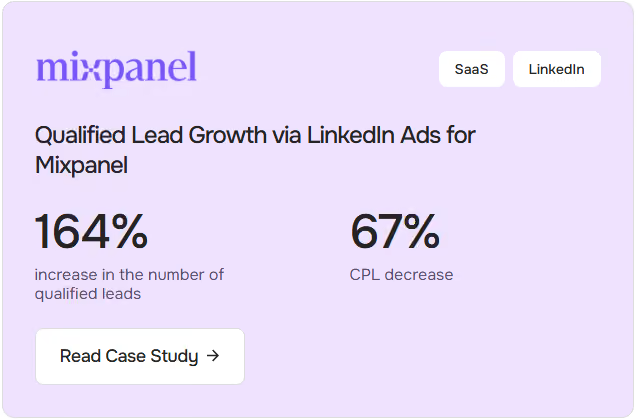
For example, in our work with Mixpanel, LinkedIn Ads became useful because the goal was not cheap traffic. The goal was qualified reach and acquisition efficiency for an analytics SaaS audience. By restructuring paid acquisition and improving campaign relevance, Aimers helped increase qualified leads by 164% while decreasing CPL by 67%.
3. Conversion Path: Fix the Post-Click System
Many tech companies try to solve a conversion problem by buying more traffic. That usually amplifies the leak. If the campaign targets the right audience but the landing page is vague, slow, unsupported by proof, or disconnected from the ad promise, media performance will stay capped.
A strong conversion path answers five questions quickly:
- Is this page clearly for me?
- Does it describe the problem I came with?
- Can I understand the offer without decoding product jargon?
- Do I trust this company enough to take the next step?
- Is the next step appropriate for my level of intent?
This is where landing page design and conversion rate optimization become part of revenue strategy, not just design polish.
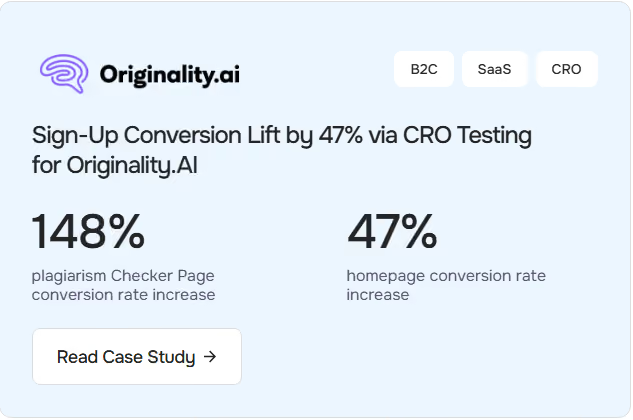
A good example is our work with Originality.AI, where the problem was not simply traffic volume. The landing pages needed clearer messaging, stronger structure, and better conversion logic for paid and organic visitors. After CRO testing and landing page optimization, the Plagiarism Checker page increased sign-up conversion by 148%, while the homepage increased sign-up conversion by 47%.
The takeaway is simple: post-click quality decides whether channel spend compounds or leaks. Better media buying cannot fully compensate for a page that does not match the visitor’s intent, problem, and readiness to act.
4. Measurement: Build Reports for Decisions
Good reporting should help the team decide where to invest, where to cut, and where to investigate. If the dashboard cannot connect spend to sales outcomes, the company may be managing activity rather than growth.
For paid acquisition, this usually means building a feedback loop between ad platforms and CRM stages. Google supports offline conversion imports and enhanced conversions for leads, which allow advertisers to send later funnel data back into Google Ads instead of optimizing only for the first form fill.
This matters because not all conversions should carry the same weight. For IT companies, a high-fit conversion should also reflect technical compatibility, deployment requirements, and procurement readiness. A student downloading a template, a small company outside the ICP, a high-fit demo request, and a sales-qualified opportunity are not the same business outcome.
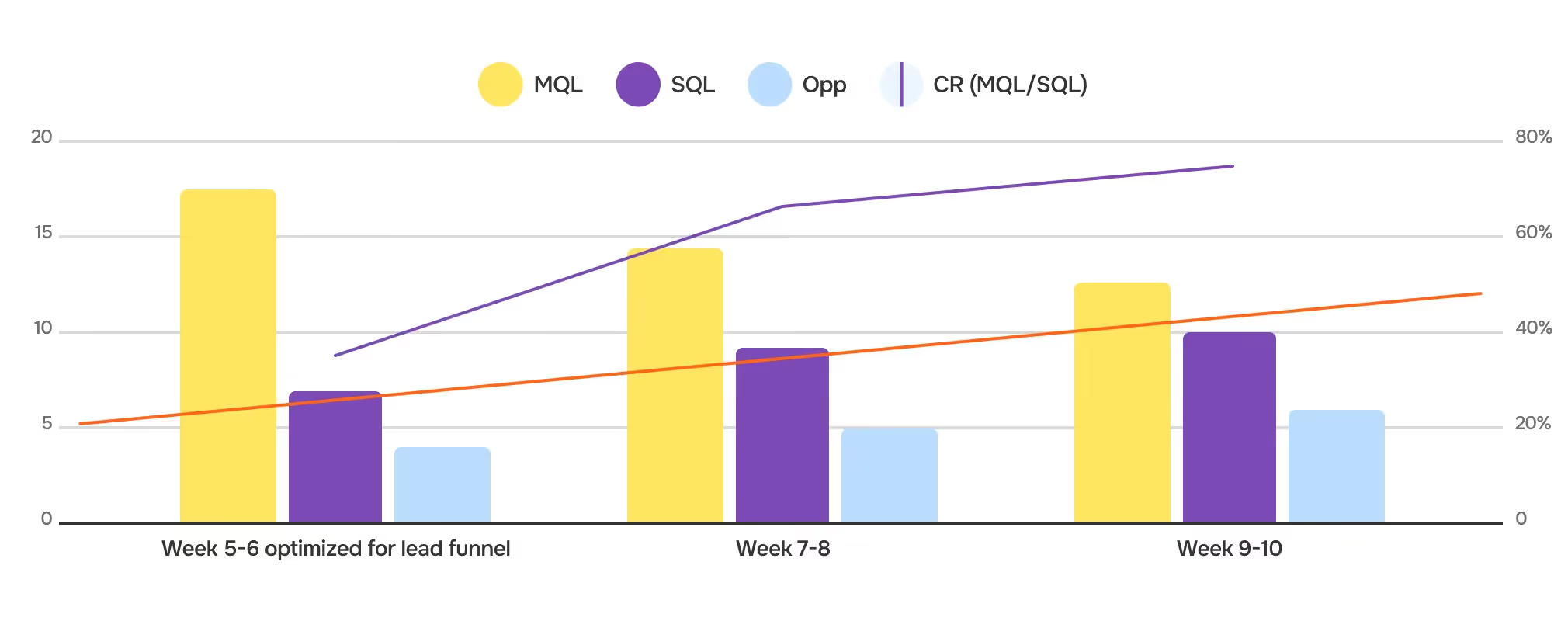
Aimers saw this clearly in our work with Cloudvisor. Their Performance Max campaign was generating low-intent and spammy leads because the system was optimizing toward surface-level form submissions. We mapped the full funnel from form submission to MQL, SQL, Opportunity, and Closed-Won, then integrated key HubSpot conversion events into Google Ads. As a result, Cloudvisor increased its MQL-to-SQL conversion rate by 130.3% and grew Opportunity volume by 50%.
If tracking is fragmented, start with an analytics review or PPC audit before increasing budget. Scaling spend before fixing measurement usually scales confusion.
How Channel Priorities Change by Company Stage
The best digital marketing strategy for a tech company changes as the business matures. The mistake is keeping the same channel mix because it worked at a previous stage.
Across the technology industry, company stage is not only about funding round. It is about how clearly the company understands its ICP, how repeatable the sales motion is, how mature the conversion path is, and whether reporting can connect spend to pipeline and revenue. A Seed company with strong product-led activation may be ready for focused paid search tests. A Series A company with weak CRM hygiene may still need measurement cleanup before scaling media spend.
The practical point is not to “graduate” from one channel to another. Paid search, LinkedIn, SEO, retargeting, and CRO can all matter at different stages. What changes is the job each channel needs to do.
Early-stage teams should use digital marketing to learn which messages, segments, and offers show real demand. Growth-stage teams should use it to prove repeatability and improve conversion quality. Scale-up and mature SaaS teams should use it to improve CAC payback, contribution margin, retention, and expansion.
If a channel worked last year, that is useful history, not a budget strategy. The better question is whether the channel still matches the company’s current ICP, GTM motion, sales cycle, and measurement maturity.
For a broader planning framework, we’ve covered the difference between a SaaS marketing plan and a SaaS marketing strategy in more detail.
Which Channels Usually Matter Most
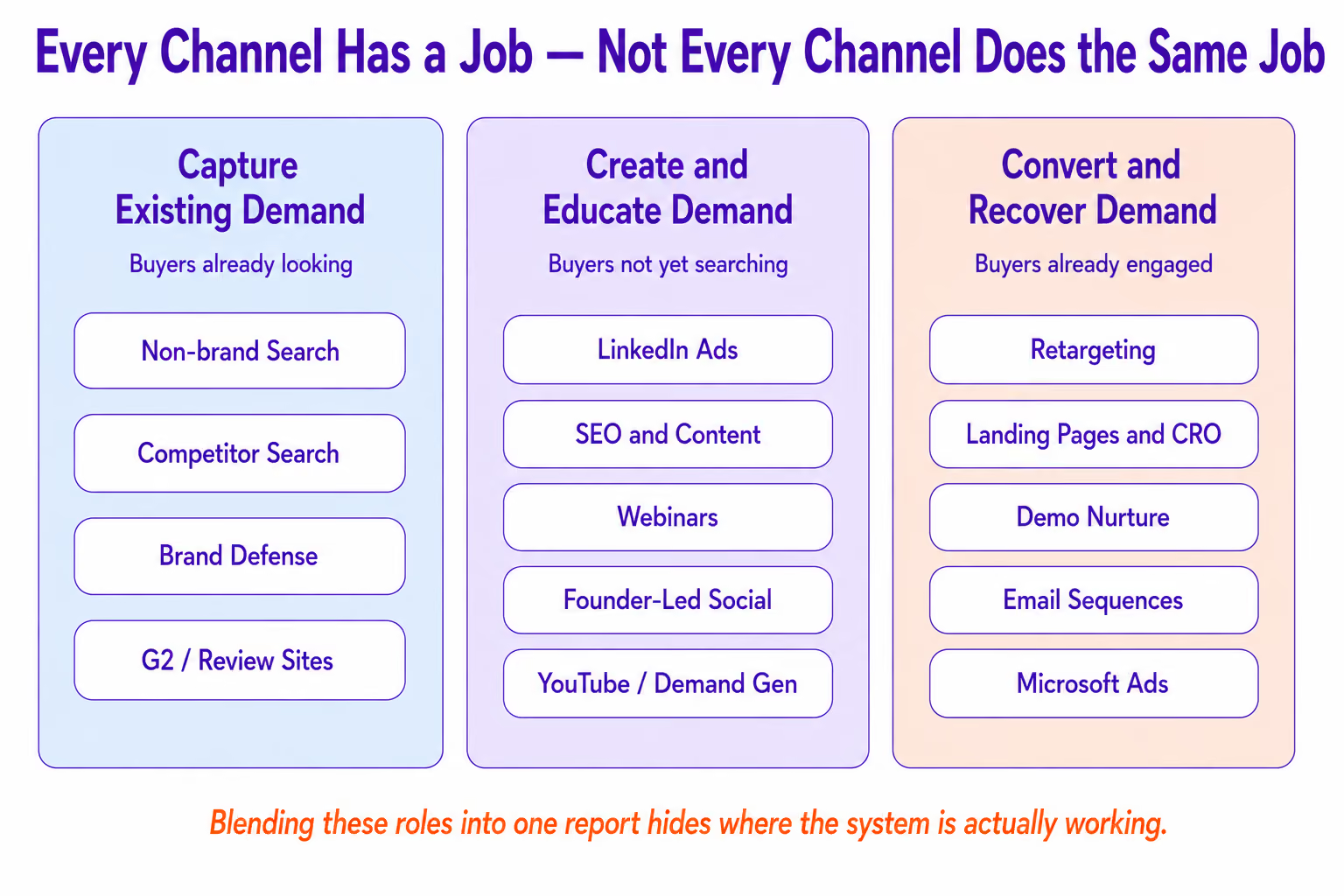
In marketing for technology companies, there is no universal channel stack. But there are predictable roles that each channel can play inside a revenue-first system.
The question is not “Which channel should we use?” It is “What job should this channel do, and how will we know whether it is creating qualified demand?”
Paid Search
Paid search is often the cleanest place to capture existing demand because the user is already expressing a problem, category, competitor, or solution intent. It works best when the company has clear problem-aware searches, a landing page that matches the query, and tracking that separates lead volume from pipeline quality.
For software companies, paid search is usually strongest when:
- The category already has search demand
- Buyers describe the problem in searchable language
- The offer matches the level of intent
- Brand and non-brand campaigns are measured separately
- CRM data shows which keywords and campaigns produce qualified opportunities
The risk is treating paid search as one blended channel. Brand search, non-brand category search, competitor search, and retargeting do not measure the same thing. If they are blended together, the account may look efficient while true acquisition is underperforming.
For teams that need stronger campaign structure, offer testing, and conversion governance, our Google Ads management work focuses on connecting paid search to qualified pipeline, not just platform conversions.
LinkedIn Ads and Paid Social
LinkedIn Ads and paid social are often better for persona reach, demand creation, retargeting, ABM-style campaigns, and education. They can be powerful when the audience is narrow and the offer is specific. They can become expensive quickly when the team targets broad personas with generic assets.
LinkedIn is especially useful when the buying committee matters. Its targeting options include professional attributes such as job title, company, industry, seniority, company size, and matched audiences, which makes it useful for reaching specific roles inside high-fit accounts.
The main mistake is judging LinkedIn by the same standards as high-intent search. Search captures existing demand. LinkedIn often creates, educates, or accelerates demand inside the right accounts. Its impact may appear first in awareness and account engagement before it reaches pipeline. That means the front-end CPL can look worse even when pipeline quality is stronger.
Paid social outside LinkedIn usually plays a different role. For many B2B SaaS and tech companies, Meta, Reddit, or other paid social channels are better suited for retargeting, creative testing, webinar promotion, founder-led content, and lower-cost message validation before moving the strongest angles into higher-intent or higher-cost channels.
When the channel fits the audience and sales motion, our LinkedIn Ads and paid social work helps B2B teams reach the right people with offers that match their buying stage.
SEO and Content
SEO matters when the company can map search intent to real buying problems. The goal is not to publish more articles. The goal is to own the questions, comparisons, and use cases that high-fit buyers search before they talk to sales.
For tech companies, strong SEO usually includes:
- Problem-aware content that maps to pains and use cases
- Solution-aware content that explains categories and approaches
- Comparison content that helps buyers evaluate alternatives
- Integration and use-case pages that capture specific demand
- Case studies and proof pages that support conversion
- Refreshes of existing pages that have traffic but weak conversion
Google’s helpful content guidance supports the same direction: content should be original, useful, and created to help people achieve their goal, not just to cover keywords. For tech companies, that means content should answer real buyer questions and support the path from education to evaluation.
If the company is building an organic engine, the content strategy should support pipeline, not only rankings. We’ve covered this in more detail in our guide to B2B SaaS content strategy.
Retargeting and Nurture
Retargeting and nurture rarely create demand on their own. Their job is to recover and compound value from other channels. In longer buying cycles, they help keep high-fit accounts engaged until the buying committee is ready to move.
The key is segmentation. A pricing-page visitor should not receive the same follow-up as someone who read a top-of-funnel guide. A demo no-show should not be treated like a first-time blog reader. A comparison-page visitor may need proof, while a product-page visitor may need a clearer next step.
Good retargeting usually separates audiences by intent level:
- Pricing, demo, and contact visitors;
- Comparison and alternative-page visitors;
- Product and feature-page visitors;
- Webinar and content-engaged audiences;
- Abandoned trial or signup flows;
- Target accounts that engaged but did not convert.
The goal is not to chase every visitor around the internet. The goal is to keep relevant buyers moving toward the next useful action.
Landing Pages, CRO, and Analytics
Landing pages, CRO, and analytics are not channels, but they often decide whether channels work.
If the post-click experience is weak, paid media gets blamed for a conversion problem. If analytics are weak, the team cannot tell whether the problem is targeting, offer, page, qualification, or sales follow-up. If CRO is missing, the company may keep buying traffic into a path that was never built to convert.
A revenue-first program treats landing pages, CRO, and analytics as the operating system for acquisition:
- landing pages turn channel intent into a clear next step;
- CRO identifies where visitors hesitate, drop, or choose the wrong path;
- analytics connects campaigns to qualified opportunities, CAC, payback, and revenue quality.
That is why landing page design, conversion rate optimization, and analytics should be planned alongside channel strategy, not after the media budget is already spent.
A 90-Day Revenue-First Action Plan
.avif)
A practical plan should improve the system before it increases spend. The first 90 days should not be used to scale every channel at once. They should answer three questions: what is leaking, what can be proven, and what deserves more budget?
Move budget toward campaigns with stronger qualified opportunity signals, pause weak segments, expand winning content and offers, document channel roles, build pipeline reporting, and create a weekly optimization cadence around CRM and revenue data.
The company can connect channel decisions to pipeline quality, CAC direction, and revenue potential.
For paid acquisition, the “fix and test” phase should also include better conversion feedback. Google’s offline conversion imports allow teams to send later funnel events back into Google Ads, so campaigns are not optimized only around the first form fill.
The point of the first 90 days is not to prove that every channel can work. It is to find the few parts of the system that deserve more investment.
Sometimes the answer is more budget for non-brand search because it produces qualified opportunities. Sometimes it is cutting a LinkedIn audience that looks good in-platform but never becomes sales-accepted. And sometimes the best growth move is not more spend at all, but rebuilding landing pages or fixing analytics because the team cannot yet trust the numbers.
If tracking is fragmented, the first step should be an analytics review or PPC audit before budget increases.
Common Mistakes Tech Companies Make
Most digital marketing mistakes in tech do not look dramatic at first. The campaigns run, dashboards update, leads come in, and the team has activity to report. The problem is that the wrong system can look busy while quietly weakening pipeline quality.
%20(1).avif)
1. Optimizing for lead volume before lead quality
A flood of low-fit leads creates noise for sales and hides weak economics. The campaign may hit its CPL target, but if those leads do not become sales-accepted opportunities, the team is buying activity rather than demand.
This is especially risky in B2B SaaS, where lead quality depends on ICP fit, buying readiness, ACV potential, sales cycle length, and the buyer’s ability to implement the product. We’ve covered this distinction in more detail in our guide to B2B SaaS lead generation strategies.
2. Launching channels without a clear ICP
If everyone is the target, targeting, copy, landing pages, and reporting all get weaker. Google Ads starts matching broad intent. LinkedIn audiences get too wide. SEO briefs chase traffic instead of buyer questions. Landing pages speak to a category instead of a specific pain.
A clear ICP does not only improve targeting. It also helps the team decide which audiences to exclude, which proof to show, which offers to test, and which leads sales should prioritize.
3. Scaling spend before fixing conversion
More budget amplifies whatever is already happening. If the conversion path is strong, more budget can accelerate learning and pipeline. If the conversion path is weak, more budget usually scales the leak.
Before increasing spend, the team should know where visitors drop, which offers convert, which landing pages match intent, and which conversions become qualified opportunities. This is where landing page design and conversion rate optimization become part of acquisition strategy, not just page polish.
4. Using one landing page for too many intents
A comparison query, a pain-point query, and an executive LinkedIn click need different context.
Someone searching for an alternative to a competitor may need comparison proof. Someone clicking from LinkedIn may need a clearer explanation of the problem and why it matters. Someone visiting a pricing page may need implementation, security, ROI, or procurement reassurance.
When every visitor lands on the same generic page, message match breaks. The campaign may still get clicks, but the page does not give each buyer enough confidence to take the next step.
5. Reporting only on platform metrics
Google Ads and LinkedIn can show conversions while the CRM tells a different story about opportunity quality. Platform dashboards are useful, but they are not enough for revenue-first decisions.
The team needs to connect campaigns to lifecycle stages, qualified opportunities, pipeline, closed-won revenue, CAC, and payback. For paid acquisition, Google’s offline conversion imports can help send later funnel conversion data back into Google Ads, so optimization is not based only on the first form fill.
6. Blending brand, non-brand, and retargeting into one performance number
A blended Google Ads report can make performance look better than it really is. Brand campaigns often capture demand the company already created. Non-brand campaigns test real acquisition. Competitor campaigns test displacement. Retargeting helps recover and accelerate existing demand.
If these are reported together, the team may over-credit paid media for brand demand and underinvest in the campaigns that create new pipeline.
7. Treating content as a publishing quota
Publishing more articles does not automatically create organic growth. For software companies, SEO works when content maps to real buyer questions, use cases, integrations, comparisons, and decision points.
Google’s helpful content guidance emphasizes original, useful content created for people, not content made mainly to attract search traffic. For tech companies, that means SEO should support buyer education and conversion, not just keyword coverage.
8. Treating an agency as a strategy substitute
A strong partner can sharpen execution and decision-making, but the company still needs a real offer, market insight, sales alignment, and access to revenue data.
The right agency should not simply “run ads.” It should help the team decide what to run, why it matters, how the post-click path should work, and how success will be measured. But it cannot replace product-market insight, customer knowledge, or internal sales feedback.
The Real Job of Digital Marketing in Tech
Digital marketing for tech companies is not about being everywhere. It is about building a system that reliably creates qualified demand, converts that demand into pipeline, and improves the economics of growth.
In the technology industry, the companies that win are not always the ones with the largest budgets. They are the ones with the clearest ICP, strongest message match, best conversion paths, and most disciplined measurement.
That is the real job: connect audience, channel, offer, landing page, CRM data, and sales feedback into one operating system. When those pieces work together, marketing stops being a collection of campaigns and starts becoming a repeatable revenue function.
Aimers helps B2B SaaS and tech companies build that kind of system across paid search, paid social, landing pages, CRO, analytics, and pipeline-focused reporting.
If your team needs help finding the right channel mix, improving conversion paths, and connecting marketing activity to qualified pipeline, we can help you turn digital marketing from channel activity into revenue-first growth.
FAQs
Digital marketing for tech companies should create qualified pipeline and improve revenue efficiency, not just generate traffic, clicks, or leads. The best programs connect campaigns to qualified opportunities, closed-won deals, ARR, CAC, and payback.

There is no universal channel mix. Paid search, LinkedIn Ads, SEO, retargeting, landing pages, CRO, and analytics are common building blocks, but the right mix depends on ICP, GTM motion, ACV, sales cycle length, company stage, and conversion path maturity.
Use Google Ads when search intent is clear and buyers are already looking for a problem, category, competitor, or solution. Use LinkedIn Ads when the team needs to reach specific roles, companies, seniority levels, or buying committees. In many B2B SaaS programs, the channels work best together: Google captures existing demand, while LinkedIn helps reach and educate high-fit accounts.
Landing pages are where traffic becomes pipeline or drops off. Strong pages improve message match, reduce uncertainty, show relevant proof, and guide the visitor to the right next step. If the landing page does not match the ad, search query, buyer role, or level of intent, more traffic will usually amplify the leak.
Tracking is directionally strong when the team can connect campaigns to CRM stages, qualified opportunities, pipeline, closed-won revenue, CAC, and payback. If reporting stops at clicks, leads, form fills, or platform conversions, it is usually not enough for revenue-first decision-making.

.png)