

HealthTech Marketing Strategies: A B2B Playbook for Health Technology Companies

September 16, 2026

In our work with HealthTech and healthcare software companies, the hardest growth problem is rarely a lack of traffic. More often, different stakeholders are evaluating different risks while marketing still speaks to them as if they were one buyer. A clinician may need workflow evidence, IT wants integration and security detail, finance wants a defensible business case, and procurement may enter late with a different set of requirements.
That complexity is measurable. In Aimers’ HealthTech work, buying decisions commonly involve 4–8 stakeholders. Broader B2B research from 6sense puts the average buying cycle at 10.1 months, with buyers first contacting sellers only 61% of the way through the journey.
A strong HealthTech marketing strategy therefore has to connect intent capture, stakeholder-specific proof, conversion, and measurement around qualified pipeline.
Why HealthTech Marketing Requires a Different B2B Playbook
HealthTech marketing has to reduce business, clinical, technical, and implementation risk before it can efficiently create pipeline. That makes it different from a broad Healthcare marketing strategy, which can include patient acquisition, provider reputation, or community outreach. B2B healthcare technology companies usually sell into organizations where several functions participate in evaluation and implementation.
For marketers, the implication is simple: more traffic is not automatically useful traffic. A provider-facing SaaS company gains little from broad healthcare queries if the visitors are patients or local clinics looking for services rather than software buyers.
Trust, Compliance, and Proof
HealthTech buyers need enough evidence to justify evaluation, not just enough interest to click an ad. Strong messaging defines the use case, audience, environment, and measurable outcome, then supports that promise with customer results, validation, security information, implementation detail, or peer proof.
Compliance awareness also belongs in campaign execution. HIPAA does not apply to every health technology company in the same way; HHS guidance focuses on covered entities and business associates and warns regulated organizations to assess whether tracking technologies can receive protected health information. FDA oversight is similarly product-specific and depends in part on intended use and whether a software function meets the definition of a medical device.
Marketing does not need to act as legal counsel. It does need a repeatable process for checking claims, forms, targeting, tracking, and supporting evidence before a campaign scales.
Integration and Long Evaluation Cycles
For provider-facing HealthTech, interoperability is part of the value proposition. In 2024, 91% of U.S. hospitals integrated third-party technology into their EHR for at least one clinical purpose, but only 52% reported doing so through standards-based APIs. That makes “seamless integration” a weak claim on its own; technical buyers want to know what connects, which standards are supported, what implementation requires from the buyer and vendor, and who owns the work.
.avif)
The first measurable conversion is also rarely the commercial outcome. A demo may lead to technical validation, clinical review, security assessment, a pilot, procurement, and internal approval. Effective B2B healthcare marketing therefore has to connect acquisition with downstream progression, not optimize only for clicks, form fills, or cheap demos.
Mapping the HealthTech Buying Committee: Who Decides and What They Need
HealthTech purchases are cross-functional decisions, so one message rarely works for the entire buying committee. In Aimers’ HealthTech work, deals commonly involve 4–8 decision-makers. KLAS research similarly emphasizes alignment across IT, clinical, operational, and financial leaders.
The practical task is to identify what each stakeholder must validate before the opportunity can move forward.
%20(1).avif)
The clinical champion deserves special attention because the same person may evaluate the product and then advocate for it internally. Marketing should give that champion reusable proof rather than forcing them to translate a generic sales deck for finance, IT, or procurement. For B2B2C HealthTech, patients and caregivers add another audience layer, but they are usually better treated separately from the enterprise buying committee.
HealthTech Marketing Strategy by Business Model
The right HealthTech marketing strategy depends on the risk buyers need to resolve before they can move forward. The same channel can work across several categories, but the proof required to convert demand differs.
Healthcare AI illustrates why the bottleneck matters. AMA’s 2026 survey found that 72% of physicians reported incorporating at least one AI use case into practice, up from 48% in 2024 and 38% in 2023.
%20(1).png)
Growing adoption does not remove buyer scrutiny. Earlier AMA research found that data privacy assurances and EHR integration remained important adoption requirements. In the 2024 survey, 87% cited data privacy assurances and 84% cited EHR integration as attributes needed to advance physician adoption. For healthcare AI companies, the marketing challenge is therefore less about proving that AI exists and more about making validation, workflow fit, privacy, oversight, and implementation credible.
HealthTech Marketing Strategies That Drive Pipeline
The strongest marketing strategies for Healthcare technology companies follow buyer intent and deal friction, not a fixed channel list. Search captures active demand; LinkedIn and ABM can reach narrow committees; expert content reduces evaluation risk; partners, events, and nurture help complex opportunities keep moving.
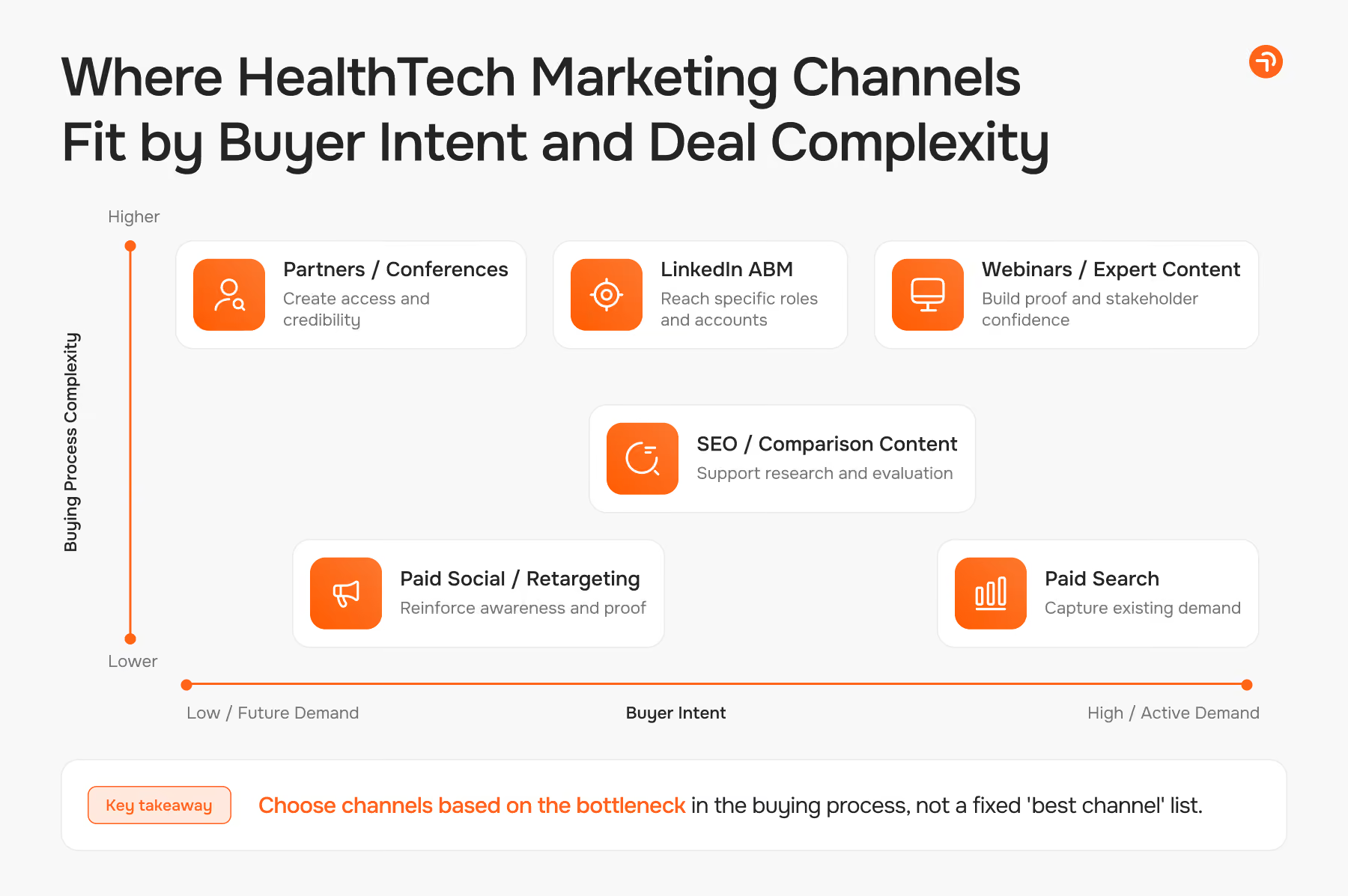
HealthTech channels solve different jobs depending on buyer intent and buying-process complexity. Paid search captures active demand, while ABM, expert content, partners, and events become more important as evaluation involves more stakeholders and longer cycles.
Evidence Content, SEO, and AI Search
HealthTech content should answer commercial evaluation questions instead of simply keeping the blog active. Prioritize clinical or operational evidence, integration and implementation guides, ROI content, security explainers, customer proof, comparisons, and category education that a buyer can use internally.
SEO should focus on problem-aware, solution-aware, comparison, integration, implementation, and compliance-related searches. Review sites also matter where the category is represented: G2’s 2025 research found that 56% of enterprise buyers cite software review sites and 55% cite AI search among their top research sources.
AI search does not require a separate technical playbook. Google states that the same SEO fundamentals apply to AI Overviews and AI Mode, with no special schema or additional technical requirements. For HealthTech, citation-worthy content usually overlaps with what buyers already need:
- Clear methodology.
- Expert input.
- Original data.
- Precise claims
- And implementation detail.
Teams extending this into broader AI digital marketing can also review Aimers’ dedicated practice.
Paid Search and Competitor Conquesting
Paid search deserves early budget when category demand exists and commercial intent can be separated from patient-facing or irrelevant traffic. Structure campaigns around category and solution terms, high-intent problems, integration queries, competitor alternatives, branded demand, and strong negatives.
Competitor conquesting works only when the landing experience gives buyers a concrete reason to evaluate another vendor. Sending an expensive competitor query to a generic homepage wastes intent. Use comparison messaging, an alternative page, or proof that answers a specific switching question.
Healthcare policy also affects targeting. Google classifies personal health content as a sensitive-interest category and prohibits advertiser-curated audiences for that content, while a 2025 policy clarification excludes content directed to healthcare professionals acting in their professional capacity from the Health sensitive-interest category. B2B healthcare advertising and patient-condition targeting should not be treated as the same media problem.
LinkedIn ABM and KOL Engagement
LinkedIn becomes more useful as the audience narrows and account value rises. Role, seniority, company, and industry targeting can reach clinical, technical, operational, and economic stakeholders with different proof.
Healthcare creative needs specificity. LinkedIn reported a 41% year-over-year increase in health-related conversations; its research also found that 64% of healthcare audiences value brands that present themselves honestly, while only 27% value traditional health advertising.
%20(1).avif)
Aimers saw that principle with mdeg, a MedTech B2B SaaS company. We narrowed targeting, excluded weak-fit seniorities, optimized by GEO and job title, and made creative more specific to devices, compliance, infrastructure, and use cases. The resulting LinkedIn program reached 730% ROAS, with LinkedIn-generated leads converting into profitable deals.
%20(1).avif)
KOL or expert-led content can extend the same approach when the expert adds real clinical or technical credibility. Effective KOL content makes the evidence more useful and trustworthy to the buyer; it should not function as a celebrity endorsement.
Partners, Events, Webinars, and Nurture
Partner marketing matters when another organization already has credibility or distribution with the buyer. EHR vendors, implementation partners, consultants, benefits brokers, device manufacturers, associations, and resellers can support joint webinars, integration content, referrals, marketplace listings, or co-selling.
Conferences should have a commercial job before the booth is booked: named-account meetings, partner development, KOL interviews, product validation conversations, content capture, or post-event nurture. LinkedIn’s B2B Institute similarly argues that events can function as reach multipliers and content engines, not only as lead-generation moments.
Email and webinars then help maintain momentum between buying events. Segment nurture around what the stakeholder still needs to validate:
- Clinical evidence.
- Integration.
- Economic proof.
- Implementation, or internal enablement.
A webinar should answer a real evaluation question rather than repeat the product demo.
Paid Social and Retargeting
Paid social is most useful for education, repeated exposure, creative testing, event promotion, and B2B2C acquisition rather than as a universal direct-response engine for enterprise HealthTech. Retargeting can reinforce customer proof, implementation assets, comparisons, and webinars.
DentalSave shows how creative can affect performance. Across a broader Aimers creative and PPC program, conversions grew 32% on Google and 56% on Meta, while CPC fell 20% on Google and 34% on Meta; Meta CPA fell 35%. These were broader program results, not the effect of one isolated asset, but they show why audience-specific messaging and faster creative feedback loops matter.
When Broad Awareness Is Worth the Spend
Broad awareness earns budget when the company needs category familiarity before demand capture can work efficiently, such as a new market, new category, or major account-based push. If high-intent demand already exists and qualified buyers are dropping after the click, proof, conversion, targeting, or sales progression usually deserves attention before adding reach.
Content Marketing for HealthTech: Build the Proof Layer
HealthTech content should function as a proof system, not a publishing calendar. Start with one question: what does this stakeholder still need to believe before the opportunity can move forward?
%20(1).png)
Case studies should show the baseline problem, what changed, the measurable result, and the conditions or timeframe behind it. ROI tools should expose assumptions such as implementation cost, adoption, time to value, recurring cost, and expected financial impact instead of manufacturing a bigger headline number. KLAS reports that healthcare CFOs increasingly expect multiyear financial modeling and visibility into total costs.
Internal champions also need content they can reuse: a one-page economic summary for finance, security material for IT, a workflow diagram for clinicians, and an implementation timeline for operations. Edelman and LinkedIn’s 2025 research found that more than 40% of B2B deals stall because of misalignment inside the buying group. A focused content library is more useful when it covers the questions that otherwise slow evaluation.
Turning Trust Into Conversion: HealthTech Landing Pages and CRO
HealthTech conversion improves when the page reduces uncertainty at the same moment it asks the buyer to act. In Aimers’ analysis of 200+ SaaS landing pages, 73% had at least three serious conversion blockers, and fixing them produced an average 127% increase in conversion rate across the analyzed work. The dataset is broader than HealthTech, but the CRO lesson is relevant: acquisition efficiency depends on what happens after the click.
A strong page should align the headline with the ad or query, make the audience and use case explicit, surface customer or validation proof near key CTAs, explain privacy or integration details where they affect evaluation, and ask only for information needed at that stage.
Forms deserve special scrutiny. For HIPAA-regulated entities, HHS warns that tracking technologies can receive PHI in some website and app contexts and that a standard cookie banner does not, by itself, constitute valid HIPAA authorization. That does not make every HealthTech lead form a HIPAA issue, but teams should understand what data is collected and which tools receive it.
CTA clarity matters too. Aimers tested DentalSave’s homepage CTA “Start Saving” against “See Plans.”
%20(1).avif)
%20(1).avif)
The more concrete option increased CTR by 221% and target conversions by 13%. The result came from clarity, not a universally better CTA: the next step became easier to understand.
%20(1).avif)
Use CRO diagnostically. If traffic is weak, fix targeting. If qualified visitors engage but do not convert, investigate message match, proof, offer, CTA, or form friction. If conversions rise but SQL quality does not, look at the audience or qualification logic before buying more traffic.
A 90-Day HealthTech Marketing Roadmap
The first 90 days should establish a reliable path from buyer intent to qualified pipeline, not force every channel to scale at once. Three months may be too short to prove full revenue impact in complex HealthTech sales, but it is enough to clean up measurement, expose funnel bottlenecks, and identify what deserves more investment.
The sequence matters. Scaling before the measurement and qualification system is reliable can make weak demand look successful. By Day 90, the team should have a clean baseline, a clearer view of pipeline quality, and enough evidence to make the next budget decision with less guesswork.
Measuring HealthTech Marketing Across Long Sales Cycles
HealthTech marketing should be measured by how efficiently qualified buyers progress toward pipeline and revenue. Channel metrics remain useful diagnostics, but a low CPL is not a win if those leads never become SQLs, pilots, opportunities, or customers.
Long buying journeys make that distinction important. 6sense’s 2025 study of nearly 4,000 B2B buyers found an average buying cycle of 10.1 months, with buyers first contacting sellers 61% of the way through the journey. LinkedIn also notes that B2B sales cycles often extend beyond 200 days and buying committees average 6–10 people.
Measure Progression, Not Just Lead Volume
Stage conversion often reveals more than lead volume. If Campaign A generates 100 leads at $100 CPL but only 5 SQLs, its cost per SQL is $2,000. If Campaign B generates 50 leads at $150 CPL and 15 SQLs, cost per SQL is $500. The second campaign can justify a higher CPL because downstream economics are stronger.
Track meaningful transitions such as Lead → MQL → SQL → Opportunity → Closed-Won, adding pilots, clinical reviews, or technical evaluations only when they represent real buying progress. Disqualification reasons should also feed targeting decisions.
Connect CRM Outcomes Back to Acquisition
Paid platforms optimize toward the signals they receive. Aimers saw this with Cloudvisor: after mapping form submission through MQL, SQL, Opportunity, and Closed-Won and integrating downstream HubSpot events into Google Ads, MQL-to-SQL conversion increased by 130.3% and Opportunity volume grew by 50% within four weeks of full-funnel implementation.
Cloudvisor is not a HealthTech benchmark, but the mechanism is relevant. For HealthTech, the downstream signal may be an accepted SQL, qualified demo, pilot approval, opportunity, or another stage that consistently predicts revenue.
Use Attribution to Support Decisions
Sourced and influenced pipeline answer different questions. Sourced pipeline shows opportunities marketing is credited with originating; influenced pipeline shows where marketing touched an opportunity during the journey. Report them separately so marketing neither overstates what it created nor hides its role in long-cycle evaluation.
No attribution model can observe every conference conversation, peer recommendation, internal discussion, or anonymous research session. LinkedIn reported in 2025 that only 28% of marketers describe their attribution strategies as “very successful.” Use first-touch, last-touch, multi-touch or data-driven views, CRM campaign influence, and pipeline cohorts as different lenses instead of pretending one model reconstructs the sale perfectly.
Match the Reporting Window to the Decision
Use weekly reporting for search terms, spend, CPC, conversion rate, lead quality, and tracking issues; monthly reporting for MQL-to-SQL, cost per SQL, demo quality, and opportunities; and quarterly reviews for pipeline, win rate, CAC, payback, revenue contribution, and budget reallocation.
LinkedIn and YouGov found that 87% of B2B marketers struggle to measure long-term campaign impact even as 66% are expected to justify marketing spend at least monthly. The response is to define leading indicators that correlate with pipeline and keep validating them as revenue data matures.
Building a HealthTech Marketing Engine That Generates More Predictable Pipeline
A more predictable HealthTech pipeline comes from connecting buyer insight, proof, acquisition, conversion, and CRM feedback into one operating system.
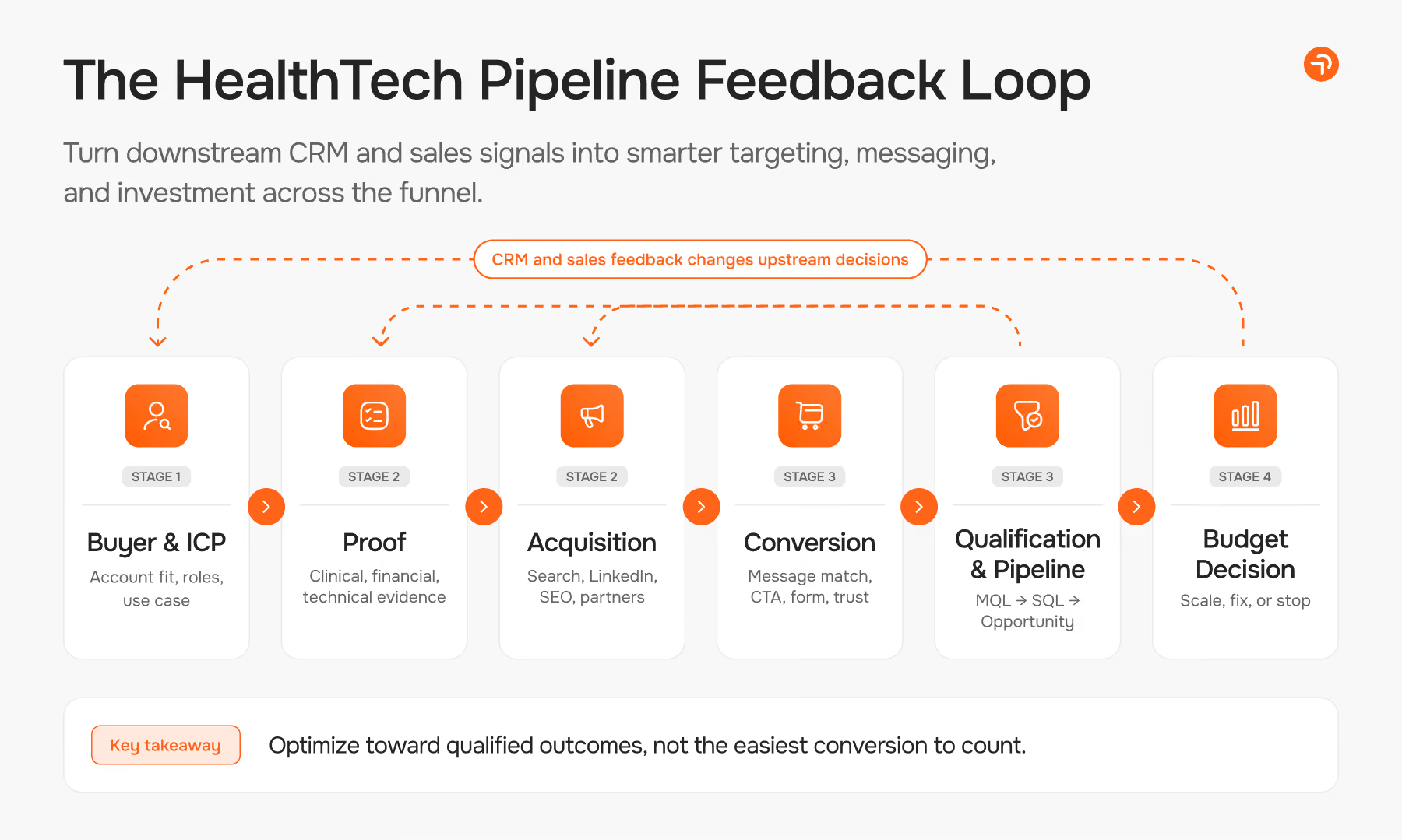
Before increasing spend, identify the constraint closest to pipeline.
- Low qualified traffic: improve demand capture, targeting, account coverage, SEO, or partner distribution.
- Strong traffic but weak conversion: investigate message match, proof, offer, CTA, and form friction.
- Healthy conversion but weak SQL quality: tighten audience selection and qualification.
- Good SQL volume but weak opportunity progression: address stakeholder proof, sales enablement, implementation, pricing, or procurement friction.
- Healthy pipeline but limited scale: expand channels and audiences already producing qualified outcomes.
Marketing and sales also need the same definition of quality: ICP fit, relevant roles, use-case fit, disqualification reasons, accepted sales conversations, opportunity criteria, and which CRM stages feed back to ad platforms. Every performance review should end with a decision about what to scale, fix, test, or stop.
Teams deciding whether to build this capability in-house or with an external partner can use Aimers’ comparison of the best performance marketing agencies to evaluate specialist expertise against broader agency models. The core test is whether a partner can connect paid media, CRO, CRM outcomes, and pipeline instead of optimizing channels in isolation.
Turn Your HealthTech Marketing Strategy Into Qualified Pipeline
Strong HealthTech marketing makes it easier for the right buyer to evaluate, trust, and justify the product. If qualified buyers are not reaching the funnel, improve demand capture and targeting. If they arrive but do not convert, look at message match, proof, and the next step. If leads convert but rarely become opportunities, use CRM and sales feedback to find where quality or stakeholder alignment breaks down.
Aimers is a SaaS marketing company with a dedicated HealthTech practice across paid search, LinkedIn Ads, CRO, landing pages, and analytics. If your acquisition program generates activity without enough qualified pipeline, our HealthTech digital marketing agency can help identify where the funnel is losing value and build the next stage around measurable commercial outcomes.
In practice, the strongest marketing strategies for Healthcare technology companies make buyer progression, proof, and pipeline economics the basis for the next growth decision.
FAQs
No. Healthcare marketing is the broader category and can include patient acquisition, provider reputation, community outreach, and public health communication. HealthTech marketing usually supports the sale or adoption of software, digital health platforms, medical technology, and related solutions across providers, payers, employers, and B2B2C models.

A HealthTech marketing strategy connects the right buyers, proof, channels, conversion paths, and measurement around qualified pipeline. A strong Healthcare marketing strategy for technology companies should also account for clinical credibility, privacy and compliance requirements, technical fit, and multi-stakeholder evaluation.
There is no single best channel. Paid search is strongest when buyers already search for the category or problem; LinkedIn and ABM become more useful for narrow buying committees and high-value accounts; SEO, partners, events, webinars, and retargeting support longer research and evaluation cycles.
Use specific, supportable claims and preserve the context behind the evidence. Show what the product does, for whom, under what conditions, and what proof supports the result. Privacy, security, clinical, regulatory, and compliance claims should be reviewed against the rules that actually apply to the product and organization.
Prioritize MQL-to-SQL, sales acceptance, cost per SQL, opportunity creation, sourced and influenced pipeline, CAC, payback, ROAS, and revenue contribution. CTR, CPC, and landing-page CVR remain useful diagnostic metrics, but they should not become the final score.



.png)


