
What AI Mode and AI Overviews Mean for Your B2B PPC Budget


AI search has created a budget problem before it has created a clean reporting view. Google is adding ads inside AI Overviews and testing formats in AI Mode, yet advertisers still cannot isolate those placements as separate budget lines or reporting segments. A blanket Search cut would therefore be premature.
Our recommendation is to protect high-intent campaigns, reduce informational spend only when pipeline data supports the decision, and expose 5–15% of media spend to a controlled AI Max experiment when CRM signals are reliable. If the account still optimizes mainly toward raw form fills, keep the test at 0–5% or fix measurement first.
At Aimers, we see the same pressure from both sides: sales wants better leads, while finance wants a defensible answer about where the next dollar should go. This guide turns the current platform limits into a practical budget, testing, and measurement framework.
The Short Answer How AI Search Should Change Your B2B PPC Budget
Treat AI search as an allocation and measurement problem inside the existing media mix. The safest sequence is to protect proven demand, test expansion within a visible budget, remove spend that fails to create commercial value, and scale only when qualified pipeline improves.
The 5–15% range is an Aimers planning recommendation, not a Google benchmark. It applies to media spend only. Agency fees, creative, analytics implementation, CRM work, and landing-page development remain outside the allocation unless the company deliberately combines them.
For AI Mode PPC and AI Overviews PPC planning, the controllable question is how much of the B2B PPC budget can be exposed to automated discovery without weakening proven demand capture.
AI Overviews AI Mode and AI Max
AI Overviews and AI Mode change the buyer’s search experience; AI Max changes how an advertiser’s existing Search campaigns match queries, adapt creative, and select landing pages. Combining all three under one “AI campaign” label leads to poor budget decisions.
AI Overviews and AI Mode can use query fan-out, which runs related searches across subtopics before composing an answer. A cloud-cost query might expand into FinOps processes, tools, implementation, vendors, and pricing within one interaction. Google Search Central confirms the mechanism. Advertisers therefore need relevant pages, clear campaign roles, and signals that separate research from buying intent.
What Google Lets Advertisers Control
The current control boundary is clear: advertisers can govern campaign inputs and risk, but they cannot buy or report on an AI-generated placement as a separate channel.
Google reports ads shown within AI Overviews as Top Ads. Existing Search, Shopping, and Performance Max campaigns can be eligible, but advertisers cannot target only those placements, opt out, or view them as a separate reporting segment. As of October 2026, ads within AI Overviews are available in English on mobile and desktop in 12 countries, with sensitive verticals such as finance and healthcare excluded. Google Ads Help should be checked again on the publication date because availability continues to change.
Google AI Mode ads are also still developing. Google is testing Conversational Discovery ads and Highlighted Answers, so these formats should not yet be treated as stable inventory with an independent forecast. Google’s May 2026 announcement describes them as tests.
.jpeg)
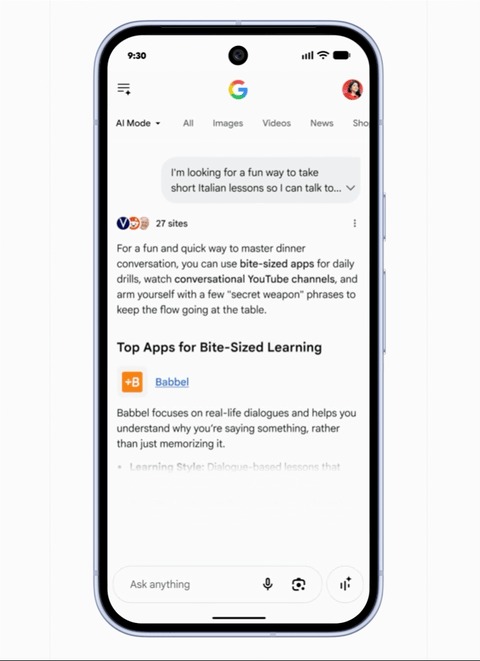
AI Max offers useful diagnostics, including expanded-match totals, search terms with headline and URL combinations, generated assets, and landing pages selected through Final URL expansion. It still does not identify whether an impression appeared in a conventional SERP, beside an AI Overview, or inside another AI response. Google’s AI Max reporting documentation also warns that filtering only by the AI Max match type excludes “Other search terms,” so the report cannot reconcile every impression or dollar.
What Has Actually Changed for B2B Paid Search
AI search is changing the shape of demand more than the commercial role of paid Search. Buyers can ask longer questions and reach a more informed position before visiting a vendor. The effect on traffic varies sharply by intent, which makes account-level query and pipeline data more useful than channel-wide predictions.
Google reports that AI Overviews increased Search usage by more than 10% for the query types that trigger them in the US and India, while commercial query volume was also increasing. These are Google internal findings, not independent B2B benchmarks, but they show why fewer clicks do not automatically mean less demand.
Third-party research captures the other side. Pew Research Center analyzed 68,879 searches from 900 US adults. Users clicked a traditional result in 8% of visits with an AI summary, compared with 15% without one; links cited inside the summary received a click in 1% of visits. The study measured general search behavior, not B2B paid media or qualified pipeline.
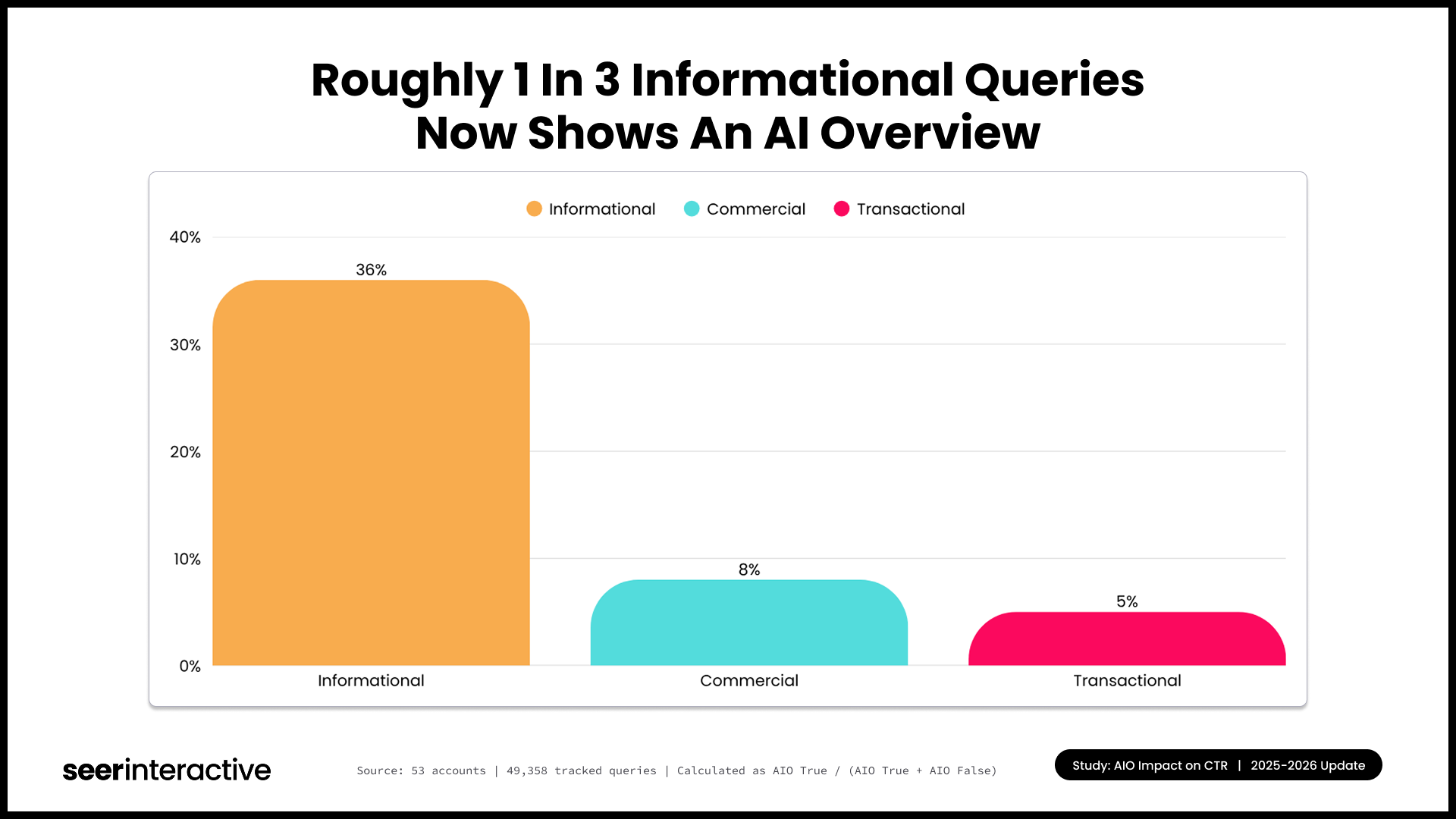
Seer Interactive’s April 2026 analysis covered 53 brands, 5.47 million queries, 2.43 billion organic impressions, and 296.9 million paid impressions. AI Overviews appeared on 36% of informational queries, compared with 8% of commercial queries and 5% of transactional queries. Paid CTR on queries with an AI Overview moved from 14.6% in January 2025 to 16.2% in February 2026.
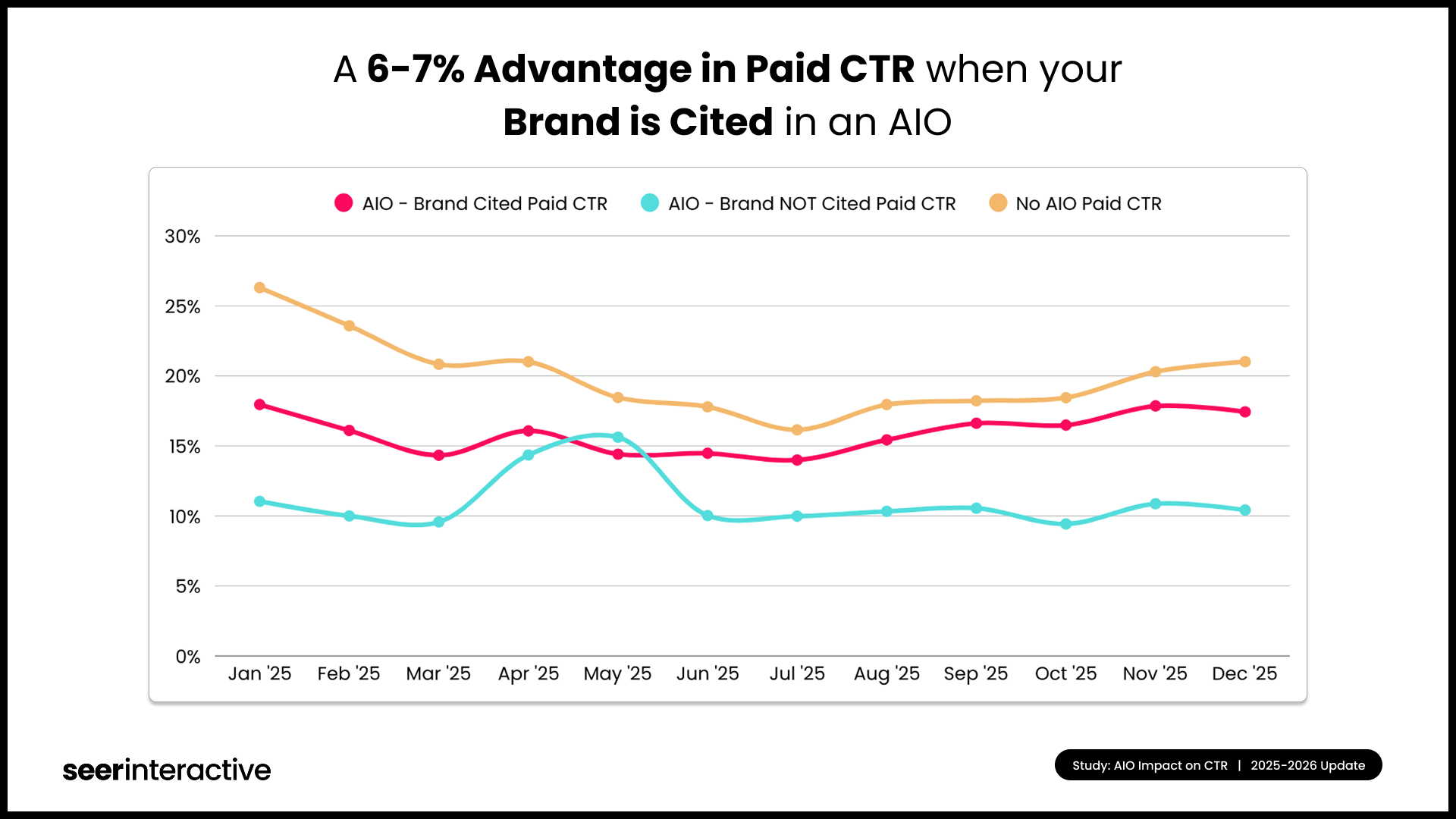
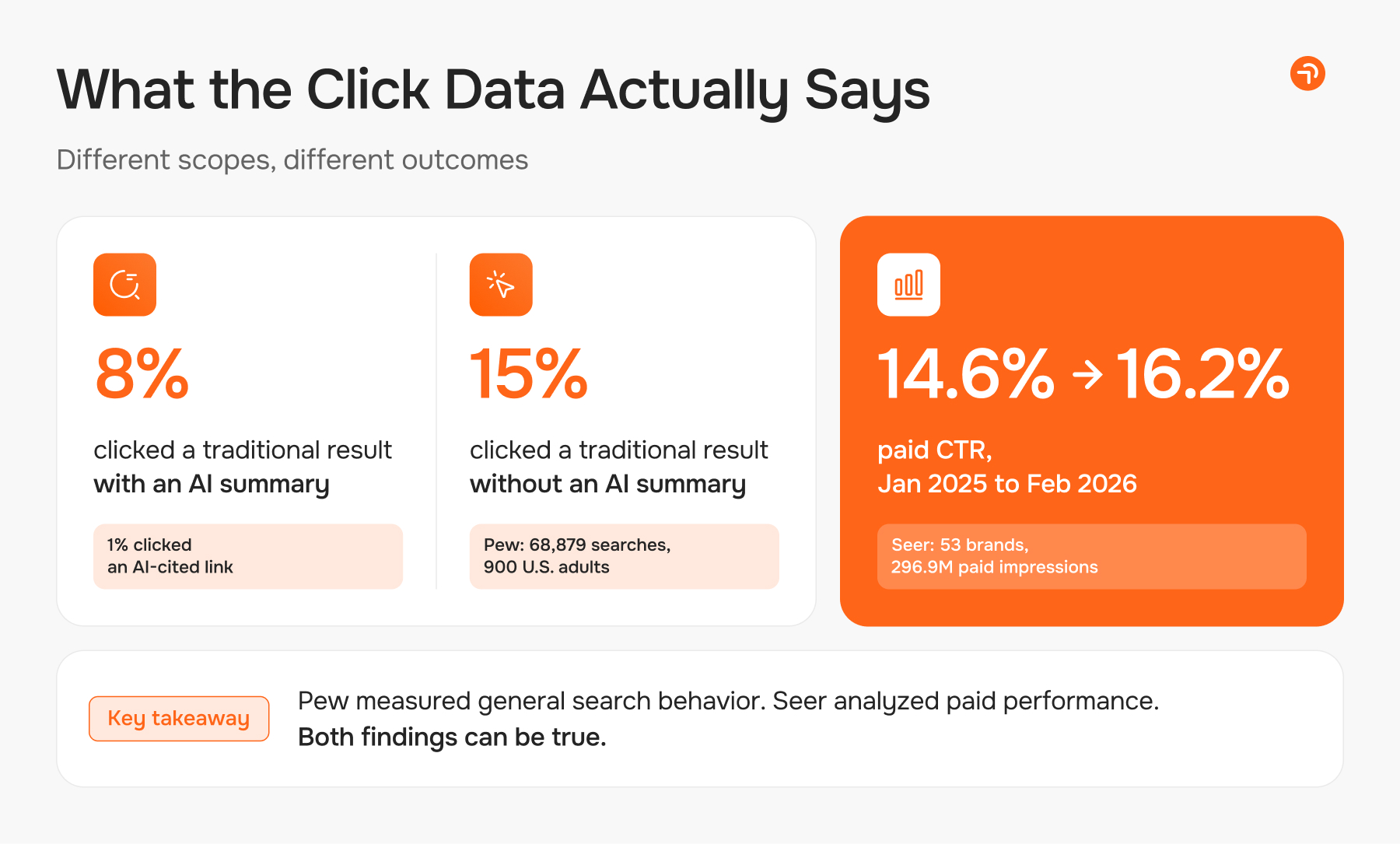
General search users clicked less often when AI summaries appeared, while paid CTR remained comparatively stable in Seer’s advertiser cohort. The scopes differ, so both findings can be true.
The two studies do not conflict. AI-generated answers can remove informational clicks while paid behavior remains more stable on the queries advertisers buy. Neither dataset provides a universal AI Overviews paid search CTR benchmark. A zero-click search PPC forecast built from general or organic behavior would overstate what the evidence can support.
Use three account patterns to guide the first response:
• If clicks fall while SQLs and opportunities remain stable, protect the campaign and avoid buying back low-value traffic merely to restore CTR.
• If clicks or form fills rise while stage progression falls, narrow the expansion and improve the conversion signals sent to Google.
• If commercial clicks, SQLs, and opportunities fall together, audit budget constraints, auction coverage, search terms, and landing-page relevance.
Our earlier analysis of B2B SaaS paid ads in 2026 covers the broader shift. For this budget decision, separate brand, category, use-case, comparison, competitor, problem-aware, and informational clusters, then trace each one into pipeline.
The B2B PPC Budget Framework for AI Search
Divide the media budget by commercial job: protect proven demand capture, fund controlled exploration, retain support for longer research cycles, and keep a reserve for evidence-based reallocation. General investment math still belongs in a broader planning exercise, so use our guide on how to calculate your SaaS PPC budget rather than repeating it here.
PPC Budget Allocation 2026 by Campaign Role
These are boundaries for individual buckets, not percentages to add at their maximums. They describe a starting framework for a B2B paid search budget, not a universal Google Ads budget for B2B.
Three Budget Scenarios
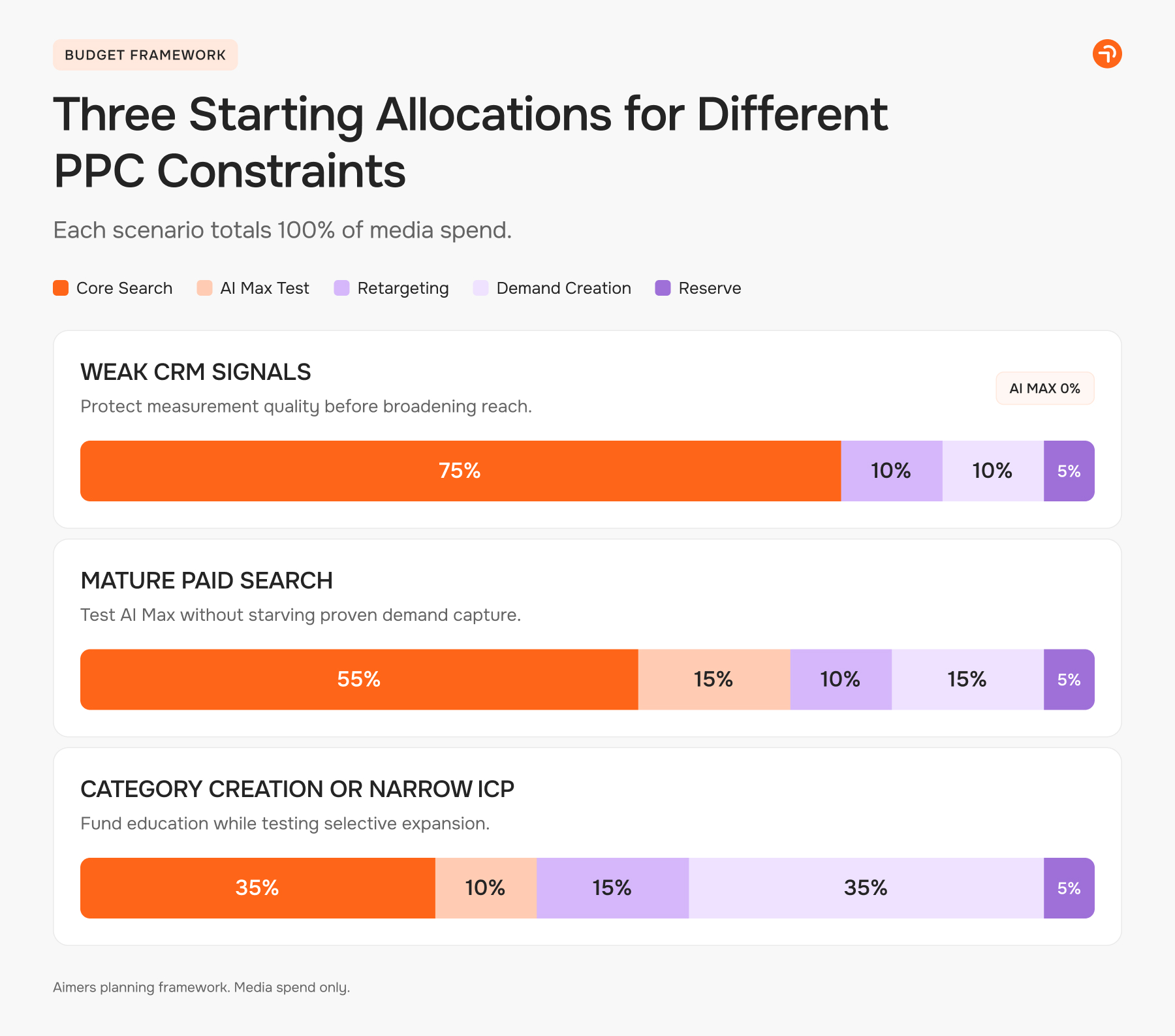
Scenario 1 prioritizes measurement. Keep the core protected and delay AI Max until the account can distinguish qualified demand from raw form volume. A limited 5% learning test is possible, but it must come from Core Search: 70% core plus 5% AI Max, with the other buckets unchanged.
Scenario 2 supports a meaningful test. Reliable SQL or opportunity data gives a 15% AI Max budget enough room to learn without making automation the account’s only source of incremental reach. Scale from incremental opportunities and pipeline, not from additional conversions at the same CPL.
Scenario 3 funds demand creation. A new category or very narrow ICP may not have enough commercial search volume to support the growth target. This mix deliberately sits outside the usual ranges: demand creation rises to 35%, while AI Max stays controlled because adjacent audiences can generate cheap but irrelevant leads.
The right scenario follows the bottleneck. Revisit the mix when measurement quality, sales capacity, qualified pipeline, or category maturity changes.
Budget Decisions by Query Type
Query clusters are often a better budget unit than campaign labels. One campaign may contain a valuable use-case cluster, a weak educational cluster, and an experimental long-tail cluster that require different actions. This matters because Seer’s 2026 data found much greater AI Overview exposure on informational queries than on commercial or transactional searches.
These actions are starting points. A generic informational cluster can earn investment when it reaches a strategic ICP or consistently influences opportunities. A category term can deserve a cut when it attracts students, job seekers, consumers, or companies that cannot buy.
Search terms must also be evaluated with the message and destination. A relevant query can still waste money when the ad is generic or Final URL expansion selects a page that does not address the use case.
How to Run an AI Max Test Without Sacrificing Core Performance
Run AI Max as a controlled incrementality test, not an account-wide switch. Google reports that non-retail advertisers activating AI Max typically see 14% more conversions or conversion value at a similar CPA or ROAS, based on Google internal 2025 data. That figure supports testing, but it is not a B2B pipeline forecast.
Confirm That the Account Is Ready
The account needs a stable baseline, enough conversion volume for comparison, relevant landing pages, agreed lead definitions, and CRM stages beyond the form fill. When those foundations are weak, keep total AI Max exposure at 0–5% or delay the test.
For advertisers researching broad match AI Overviews, the relationship is eligibility rather than guaranteed placement. Broad match and AI Max can help ads match complex queries, but neither guarantees that Google will show an AI Overview or place an ad inside it.
Use a Control and Trial
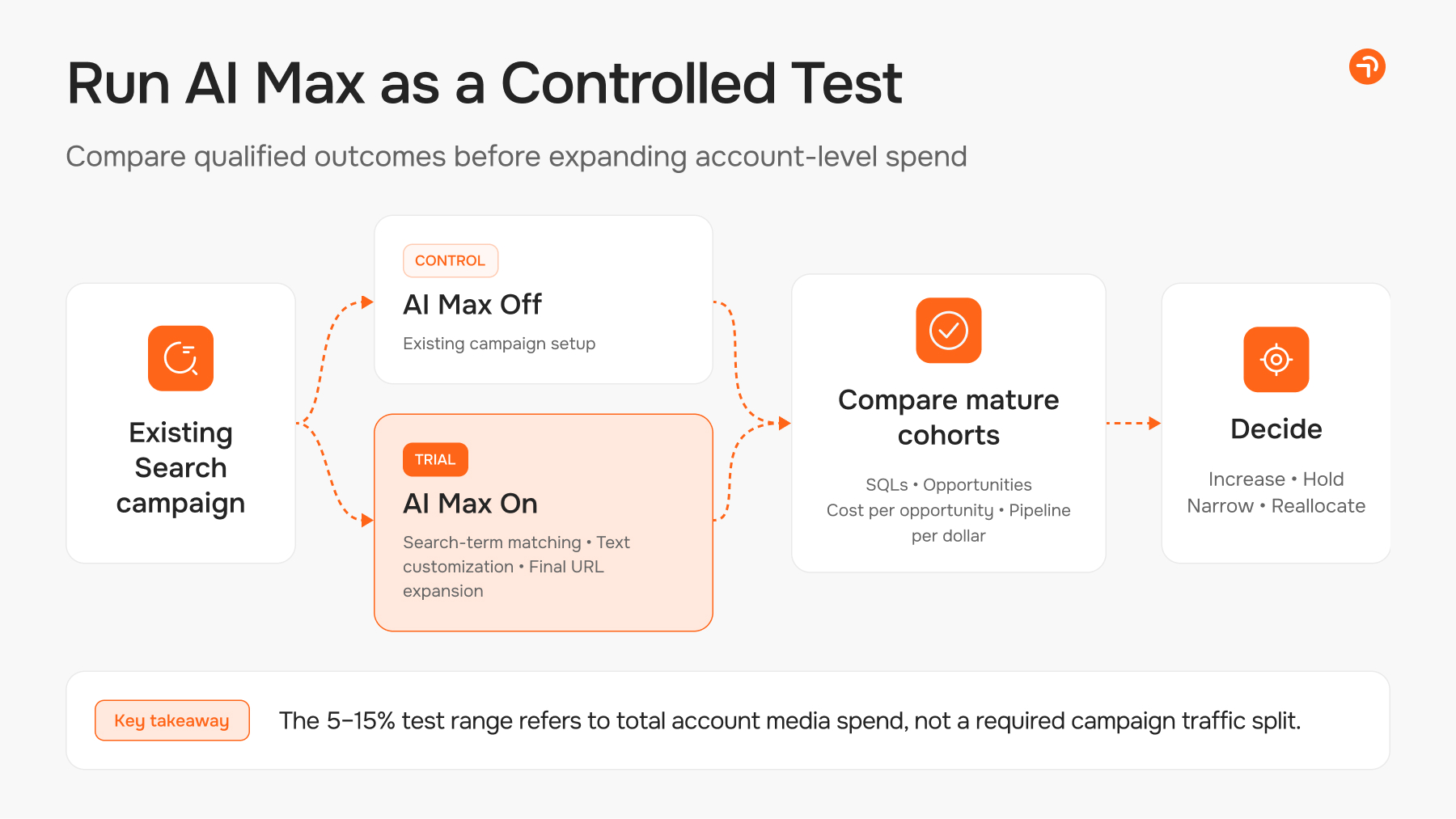
Google’s native AI Max experiment splits traffic and budget between control and trial arms inside an existing Search campaign. Before launch, document the campaign, dates, split, enabled features, business hypothesis, primary metric, and stop or scale conditions.
The 5–15% recommendation refers to total account media spend exposed to AI Max, not necessarily the traffic split inside the selected campaign. A larger share of one eligible campaign can still remain a modest share of the whole account.
Audit Queries Messages and Landing Pages
By default, an AI Max experiment can activate search-term matching, text customization, and Final URL expansion in the trial. Review brand settings, negative keywords, URL controls, generated assets, and the pages selected for each query.
In our work, AI Max matched a client selling project management for construction teams to the generic query “project management.” The language was related, but the commercial audiences were not. It is a useful reminder that semantic relevance and commercial relevance are not the same, and that first-party signals still have to guide the test.
Allow Enough Time for Pipeline Evidence
Google advises waiting at least two weeks after enabling AI Max before making changes so the system can learn. Its reporting guidance describes that as a ramp-up period, not a B2B commercial evaluation window.
Our usual evaluation window is 30–90 days, depending on conversion volume and the time needed for leads to reach SQL or opportunity. Scale when the trial increases total qualified outcomes at acceptable economics. Narrow or stop it when spend reaches the cap, ICP fit deteriorates, unsuitable pages keep appearing, or pipeline stays flat while platform conversions rise.
Measurement Matters More Than Placement Reporting
Since AI Overview placements cannot be segmented, B2B teams need to connect campaign and query data to CRM outcomes. The useful path is:
The offline conversion tracking B2B teams need should include clean conversion goals, retained click identifiers, deduplication, consistent CRM stages, and imports for qualified or converted leads. Google describes enhanced conversions for leads as an upgraded offline import that can combine hashed first-party data with click identifiers. Google unified enhanced-conversion settings in April 2026, and from June 15, 2026, uploads began moving toward the Data Manager API. Existing integrations should be checked before expanding spend.
A minimum measurement setup includes:
• Google tag and consent configuration verified across paid landing pages.
• GCLID and other available identifiers retained through the lead process.
• CRM imports for qualified lead, SQL, opportunity, and Closed-Won stages.
• Unique transaction IDs and deduplication between online and offline events.
• Conversion values based on business evidence rather than equal values for every form.
• A sales feedback loop for irrelevant queries, company sizes, geographies, and other qualification failures.
If paid traffic cannot be followed through the funnel, strengthen marketing analytics and attribution before giving automation more budget. Attribution does not need to reconstruct every hidden buyer interaction. It does need consistent identifiers, stage definitions, timestamps, and source data.
Our work with Cloudvisor shows how a better feedback loop changes optimization. The team mapped Form → MQL → SQL → Opportunity → Closed-Won and imported key HubSpot stages into Google Ads. Four weeks after full-funnel implementation, MQL-to-SQL conversion had increased 130.3% compared with the implementation week, while Opportunity volume grew 50%. These results came from a broader Performance Max measurement and optimization program, not from AI Max or an AI Overview placement alone.
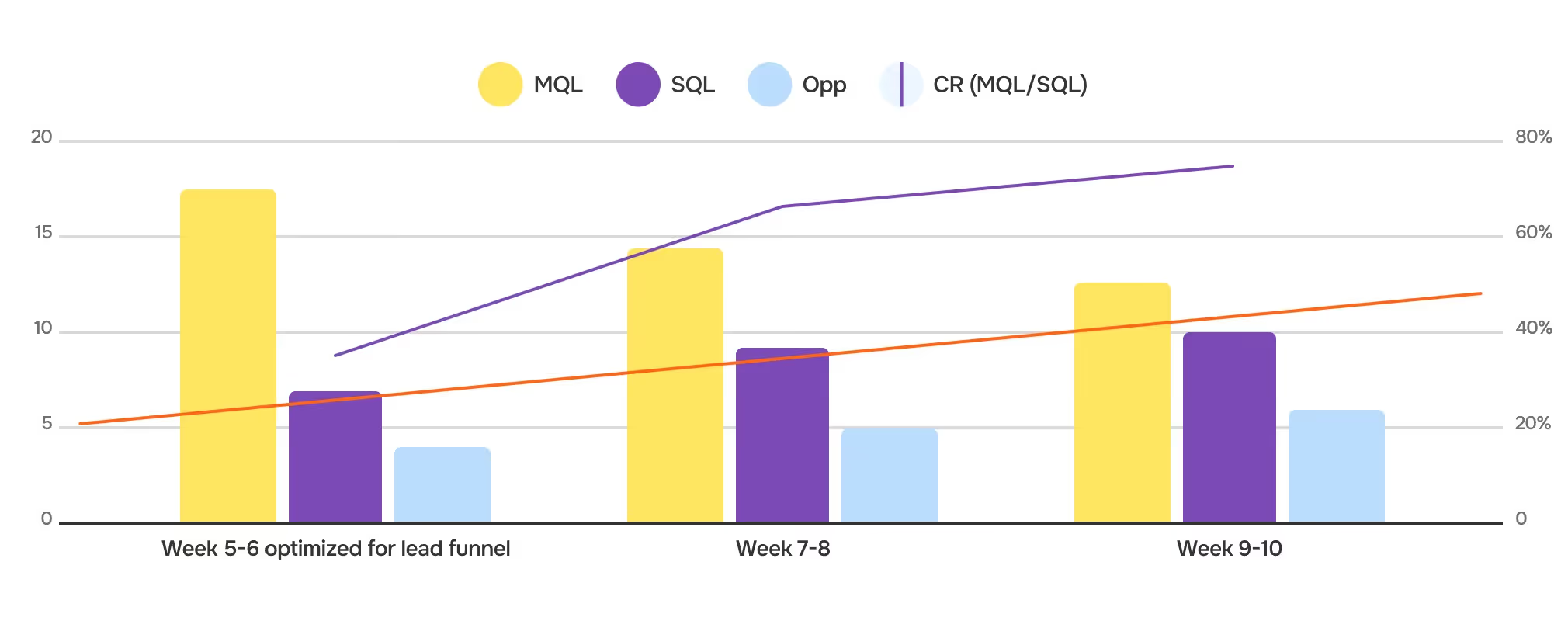
After Cloudvisor connected full-funnel CRM stages to campaign optimization, MQL-to-SQL conversion increased 130.3% and Opportunity volume grew 50% within four weeks. The results came from a broader Performance Max optimization program.
Landing-page quality remains part of the same economics. For Upper Hand, Aimers combined paid campaign optimization with technical analysis, behavioral research, and lead-form testing. Website conversion rate increased 345.34% in the first month, while cost per MQL across Google and Facebook fell by more than 50%. The result belonged to the broader paid and CRO program, but the practical lesson applies here: better targeting cannot compensate for a weak conversion path. Focused conversion rate optimization for SaaS can improve efficiency without requiring more traffic.
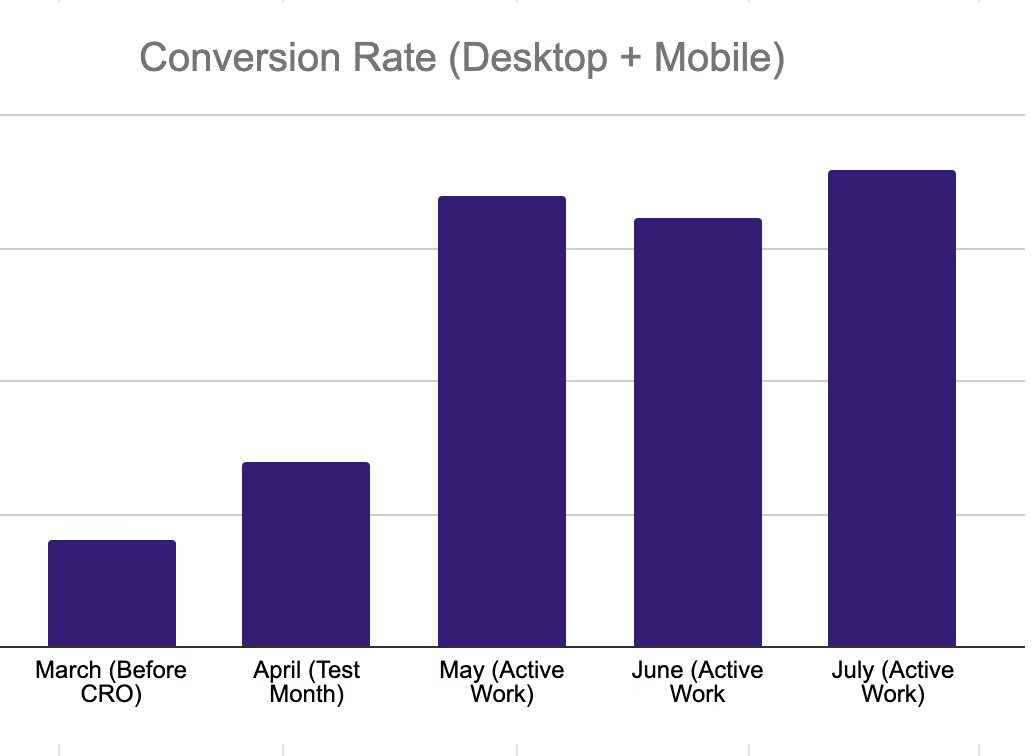
Upper Hand’s combined CRO and paid media program increased website conversion rate by 345.34% in the first month. The chart shows progression from the pre-CRO baseline through testing and active optimization.
Metrics That Should Decide the Budget
Sourced pipeline assigns creation credit to the channel that generated the opportunity. Influenced pipeline records a meaningful paid interaction with an opportunity that may have originated elsewhere. Define both rules before reporting them; otherwise the same opportunity can support incompatible budget stories.
Value-based bidding for leads becomes useful only when assigned values reflect actual stage progression, expected contract value, win rate, or margin. Google’s conversion value rules can adjust values using attributes such as geography, device, and audience, but the inputs should represent evidence rather than assumptions about who “should” be valuable.
When to Increase Hold Cut or Reallocate Spend
Budget changes should follow search-term quality, funnel progression, and marginal pipeline. CTR, CPC, and CPL are useful diagnostics, but none establishes the final business outcome alone.
Keep three guardrails. Do not invent a dedicated AI Overview budget, do not assume every Google announcement is available in every market, and do not scale from an aggregate CTR study or raw CPL. An AI Max budget earns expansion through qualified pipeline.
A 90 Day Action Plan
A 90-day plan creates a controlled budget decision. It does not promise that every opportunity will reach revenue within one quarter.
Days 1–30 Establish the Baseline
Confirm that qualified CRM outcomes return to Google Ads. Record brand and non-brand performance using SQL rate, opportunity creation, cost per opportunity, and pipeline per dollar. Select one stable campaign and define the hypothesis, protected budget, test allocation, and success criteria.
Days 31–60 Run the Test
Keep AI Max within the agreed account-level range. Monitor search-term relevance, brand cannibalization, landing-page selection, SQLs, and early opportunity progression. Do not scale because the trial generates more clicks or cheaper form fills.
Days 61–90 Make the Decision
Compare the trial with an equally mature control cohort. Increase, hold, narrow, or reallocate based on qualified opportunity economics, then document the result and the next budget assumption to test.
Make AI Search Earn Its Place in the Budget
AI search makes budget discipline more important. New surfaces and broader automation can create incremental reach, but the account still has to prove which spend produces the strongest pipeline.
Protect campaigns that already capture qualified demand, repair measurement gaps, and test expansion within a defined budget. Some companies will find profitable reach through AI Max; others will gain more from high-intent Search, retargeting, demand creation, or a better conversion path. The allocation should follow the commercial bottleneck.
At Aimers, we help B2B SaaS teams connect paid media decisions to the outcomes sales and finance care about. If you need to audit the current setup, protect proven demand capture, or test Google AI ads without giving automation a blank check, our SaaS PPC agency can build the measurement and campaign structure behind a more defensible budget.
FAQs
Do AI Overviews Reduce Paid Search Clicks

Can Advertisers Target Exclude or Report AI Overview Ads Separately
Do You Need AI Max to Advertise in AI Mode or AI Overviews
How Much of a B2B PPC Budget Should Go to AI Max Testing
How Should B2B Teams Measure AI Search PPC Performance