
Microsoft Ads vs Google Ads for B2B SaaS


In B2B SaaS, marketing effectiveness is not solely dependent on traffic volume. What's much more important are the overall contribution of advertising to the pipeline, the cost of SQL leads, and its impact on revenue. Nevertheless, companies often still choose a service based solely on reach. Consequently, Google Ads is considered the primary tool and Microsoft Ads is seen as a secondary channel.
However, despite its smaller volume, Microsoft Ads can provide better unit economics and a more relevant audience. According to WordStream, the average cost per click in Microsoft Ads is $1.54, which is 30-35% lower than in Google Ads for the same industries. Additionally, 66% of Microsoft Audience Network users are B2B decision-makers, which is crucial for SaaS products with long sales cycles.
We will present scenarios in which Microsoft Ads outperforms Google, despite its lower volume. We will examine four key use cases for B2B SaaS and demonstrate where and when lower volume brings higher value.
Executive Summary: Microsoft Ads vs Google Ads for B2B SaaS
- Microsoft Ads has the best ROI of all the PPC platforms in the B2B sector
- LinkedIn profile targeting significantly improves the quality of Microsoft Ads leads. This feature allows you to set up specific targeting, which is unavailable in Google Ads
- When scaling Google Ads, marginal CPL increases sharply
- When scaling Microsoft Ads, ROI growth remains stable
- Microsoft Ads brings in new leads rather than duplicating those already provided by Google Ads
- For the best results, use both platforms. Use Google Ads to capture the maximum volume of generated demand. Use Microsoft Ads to attract higher-quality B2B leads with better ROI and more stable economics when scaling up
Microsoft Ads vs Google Ads for B2B SaaS (2025 Performance Comparison)
Capturing High-Intent Demand
To create and develop a funnel, you need to understand your customers' needs. Specific requests in your field will be the primary driver. This is where it is important not only to advertise your SaaS product, but also to do it faster and cheaper than your competitors.
Google Ads: Maximum Traffic with an Overheated Auction
Google Ads is the hottest source of highly intentful traffic. However, it is also a highly competitive Google Ads auction. Statcounter estimates that Google leads over 91% of search visits worldwide. Bing has less than 4%.
Due to the high level of competition in this area, the cost per click for Google Ads for B2B commercial search queries tends to be above $8–$15. This is particularly apparent in mature industries, such as CRM, cybersecurity, and data platforms. Additionally, this type of ad is prone to auction dynamics and marginal cost-per-acquisition increases as the budget increases.
Microsoft Ads: Fewer clicks. More control.
Microsoft Ads provides access to the same category of queries in a different context. In desktop-heavy and enterprise-focused audience segments, Microsoft Search offers a cleaner search environment. There is less competition and less noise from B2C players and local aggregators.
Consequently, the cost per click for the same keywords in Microsoft Ads can be 30-40% lower, and the level of competition can be 2–3 times lower. The quality of traffic does not suffer. Microsoft users interact with sites more often on desktop, meaning they are more likely to submit an application or request a demo. In our case study for the B2B SaaS company Demio, adding Microsoft Ads as an additional channel allowed us to expand our audience reach at a lower cost.
High-Intent Search Performance Expectations
Reaching the Right Decision Makers
Unlike ecommerce, in B2B SaaS clicks that do not come from decision makers rarely convert into SQLs. This directly impacts CAC and overall pipeline quality.
Google offers interest-based targeting, activity-based audiences, and remarketing. However, the service does not have direct access to data on positions, companies, or industries. This complicates filtering audiences by ICP, especially for complex enterprise sales. While ABM strategies are possible in Google Ads, they require workarounds such as custom audiences, remarketing lists, and email database uploads.
When looking at Bing Ads vs Google Ads for SaaS, Microsoft Ads offers LinkedIn Profile Targeting, enabling advertisers to show ads for specific job titles, select companies and industries, and target by organization size.
This feature is available in Search and Audience Campaigns, including branded and competitive keywords. This is important for B2B, where a narrow funnel and high LTV require a focus on decision makers.
Decision-Maker Targeting Capabilities (Bing vs Google Ads)
Nurturing Demand in Long Sales Cycles
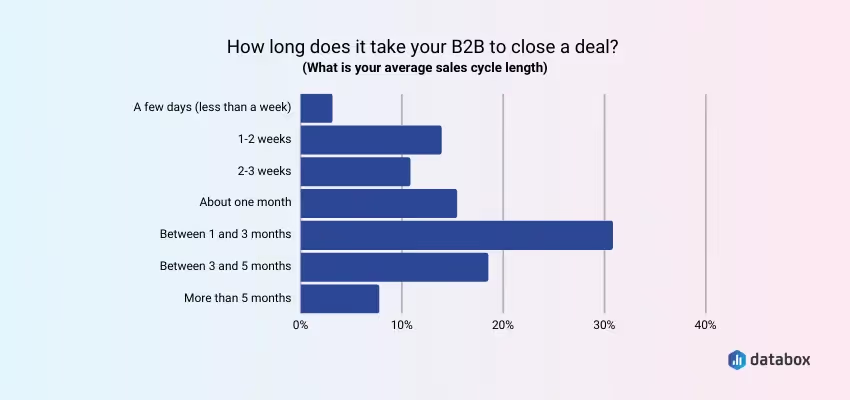
Unlike B2C, where conversion can happen instantly, B2B products require a lengthy consideration period. The average B2B sales cycle lasts more than two months. In the SaaS and enterprise sales segment, this period can stretch to four months or more. In such cases, it is important to not only capture traffic, but also retain the user's attention. Build trust in the product and encourage the next step.
Not all advertising platforms are equally effective at generating B2B leads, which becomes especially visible when comparing Google Ads vs Bing Ads lead quality. In Google Ads, remarketing primarily runs across the Display Network and YouTube, where ad placements often appear outside of a work context. For B2B audiences, this environment tends to feel intrusive and poorly aligned with decision-making moments, which often results in lower CTR and weaker brand perception.
Microsoft Ads takes a different approach through the Microsoft Audience Network (MSAN) and native ad formats. Ads are shown in environments such as Outlook, MSN, Edge, and Bing search results, where users are already in a work mindset. This makes remarketing feel more natural and increases the likelihood of bringing high quality B2B audiences back into the funnel.
Mid-Funnel and Remarketing Capabilities
Scaling Acquisition Without Breaking Unit Economics
An increase in the marketing budget does not always lead to proportional growth in results. This is particularly noticeable in B2B SaaS paid search comparison, where scaling Google Ads campaigns in competitive niches often drives CPC up while audience relevance declines. As a result, marginal CPL can deteriorate sharply.
In contrast, Microsoft Ads enables more sustainable scaling due to less auction pressure and other characteristics.
- Lower competition. Because there are fewer advertisers on Microsoft Ads, the average cost per click is 30-50% lower than on Google Ads, especially for non-branded and category queries
- Microsoft Ads also smoothly responds to budget growth. Unlike with Google, budget growth does not cause a sharp increase in CPC or a drop in ROI
- Incremental pipeline. Microsoft Ads can generate additional pipeline without competing with Google; rather, they complement it. This is especially true if the campaign is tailored to professional segments through LinkedIn Profile Targeting
A 2025 report compared Google and Microsoft Ads as paid search platforms for B2B SaaS under scaling conditions and revealed that:
- When the Google Ads budget increased by 40%, the cost per lead (CPL) rose by 23%, and the ROI fell by 17%
- A similar budget increase in Microsoft Ads resulted in a 6% increase in CPL and a stable ROI of 240-250%
These results are explained by the reduced level of auction pressure and the high desktop traffic share characteristic of B2B. We saw this firsthand when helping to develop a PPC strategy for ShipBob. In this case, connecting Microsoft Ads helped reduce CPL by 60% and increase qualified lead conversions by 2.5 times (a +148% increase).
Incremental Budget Efficiency: Bing Ads vs Google AdWords (B2B SaaS, 2025)
Ready to improve your B2B marketing performance?
It’s not always easy to pinpoint where a marketing campaign is falling short, especially when working across paid search platforms for B2B SaaS. This requires hands-on experience, which we have at Aimers. If you want to understand how to improve your SaaS ROI, you can get expert guidance from our team.
FAQs
At what budget level does Microsoft Ads begin to be worthwhile for B2B SaaS companies?

Will Microsoft Ads cannibalize Google Ads' traffic, or will they generate incremental demand?
How should Microsoft Ads be evaluated when last-click CPL appears to be worse than Google Ads'?
Why does lower volume sometimes lead to better unit economics in B2B SaaS?
In which areas does Google Ads outperform Microsoft Ads in the B2B SaaS sector?