
AI in B2B Marketing: Strategy, Implementation & ROI

April 22, 2026
It's no longer about whether companies should adopt artificial intelligence, it's about how fast they can do it without losing quality or strategic direction. In 2026, the gap between companies that use AI well and those that use it carelessly is already visible in conversion rates, pipeline velocity, and cost per acquisition.
According to HubSpot's 2026 State of Marketing research, 66% of marketing professionals globally now use AI not just for content drafts but for data analysis, audience segmentation, and full personalization workflows. Meanwhile, 98% of surveyed companies plan to maintain or expand their AI investment over the next 12 months.
For B2B companies specifically, the pressure is real. Sales cycles are longer, buying committees are larger, and content needs to work harder across every channel. That's undoubtedly why AI in B2B is growing so fast, it compresses timelines, improves targeting precision, and helps teams accomplish more with the same headcount.
This guide breaks down where AI delivers the most value, what a practical B2B marketing AI strategy looks like, and how to build the infrastructure that makes it all sustainable.
Where AI in B2B Marketing Creates the Most Impact
Not every part of the funnel benefits equally from AI adoption. The biggest wins tend to cluster around four areas: content production, lead scoring, personalization, and analytics. Here's how each plays out in real campaigns.
The pattern is consistent: AI tools for B2B marketing perform best when they're connected to real data and embedded into existing workflows, not bolted on as a separate layer after the fact.
AI for Content Marketing in B2B: Beyond the First Draft
AI for B2B content marketing has matured considerably over the past two years. What started as a shortcut for blog outlines has evolved into a full production accelerator, covering briefing, drafting, format adaptation, and even suggesting internal link structures.
The most effective teams are not using AI as the endpoint. They use it to handle repetitive, lower-creativity tasks so human strategists can focus on positioning, differentiation, and editorial judgment. The principle that guides good practice here: AI starts the execution, and expertise determines the direction.
For B2B specifically, AI content tools deliver the most value when used for:
- Producing variations of ad copy or landing page headlines for A/B testing
- Repurposing long-form assets (reports, webinars, case studies) into shorter formats
- Scaling account-specific content within ABM programs
- Drafting email sequences with personalized variables across a large contact base
- Generating meta descriptions, title tags, and structured FAQ content at volume
If you want a deeper look at how practitioners apply this in practice, our piece on how to use AI for your B2B marketing covers expert perspectives from six different teams across different B2B verticals.
B2B Marketing Automation with AI: What It Actually Looks Like
B2B marketing automation with AI is not just about scheduling emails or triggering simple workflows. The newer generation of platforms can interpret behavior, adjust messaging in real time, and prioritize accounts based on live intent signals, all without manual intervention.
These are the core automation layers where AI is making a measurable difference right now:
Email and nurture sequences. AI analyzes open rates, click patterns, and CRM data to determine the right send time, message frequency, and content variant for each contact. This goes well beyond basic drip campaigns.
Ad campaign optimization. AI ads automation tools adjust bids, rotate creative, and reallocate budget across channels faster than any manual process. For B2B advertisers running Google and LinkedIn in parallel, this kind of automation has become essential rather than optional.
Lead routing and scoring. Models trained on historical conversion data rank new leads in real time, flag high-intent accounts, and route them to the right sales rep based on territory, deal size, or product fit signals.
Conversational agents and chatbots. These handle first-touch qualification around the clock, capturing intent data that sales teams can act on during business hours.
The common thread across all of these: AI-driven marketing strategies require clean, connected data. Without reliable inputs from your CRM and analytics stack, the outputs will reflect those gaps.
AI for Lead Generation in B2B
AI for lead generation B2B typically breaks into two stages: identifying the right accounts and reaching them at the right moment.
On the discovery side, AI tools process large volumes of firmographic, technographic, and behavioral data to surface accounts that match your ICP and show active buying signals. This replaces manual list-building with a continuously updated, scored account list that reflects real market conditions.
On the engagement side, AI makes personalization scalable. Instead of sending the same message to 500 contacts, teams generate variations based on company size, industry vertical, job function, or recent digital behavior, all automatically and at speed.
Platforms like Clay, Apollo, and several AI-enriched CRM tools are now standard parts of the AI marketing for B2B companies. The teams that see real pipeline impact pair these tools with well-structured campaign architecture and clear attribution logic, not just volume.
AI Personalization in B2B Marketing
AI personalization in B2B marketing is where the technology creates compounding advantages over time. The more behavioral data a system processes, the more accurately it can adapt messaging, content sequencing, and timing to individual contacts or accounts.
In practice, personalization in B2B tends to look like this:
- Dynamic landing pages that adjust headlines and proof points based on the visitor's industry or company size
- Email copy that references a prospect's product category, tech stack, or recent content consumption
- Ad creative that adapts based on funnel stage, awareness messaging for new visitors, comparison content for those in evaluation mode
- On-site content recommendations that reflect a user's past behavior or stated interests
This level of personalization was possible before AI, but it was too slow and expensive to execute at any meaningful scale. AI changes the math significantly, particularly for companies managing large contact databases or running campaigns across multiple ICP segments simultaneously.
For a broader overview of what's available beyond the obvious tools, see our comparison of ChatGPT alternatives for marketers and how ChatGPT for B2B marketing has evolved into a much wider ecosystem.
AI in Account-Based Marketing (ABM)
AI in account-based marketing (ABM) deserves separate attention because ABM is fundamentally a data-intensive strategy. When you're running highly targeted programs for a specific list of companies, the accuracy of your targeting and the relevance of your content are the two variables that determine everything else.
These platforms support ABM across the full program lifecycle:
Account selection. Instead of relying on sales intuition alone, intelligent scoring models evaluate accounts based on fit, intent signals, and engagement history, helping teams prioritize which companies to pursue and when.
Content personalization at the account level. Rather than producing one case study or email template for a whole vertical, teams can generate account-specific versions of core assets with details adjusted to reflect the prospect's industry, challenges, or deal stage.
Engagement tracking across channels. Purpose-built tools monitor signals across paid, organic, email, and direct channels, then flag when a target account is showing elevated purchase intent so sales can act at the right moment.
Campaign coordination. Automation logic can sync messages across channels so that high-priority accounts experience consistent, sequenced outreach rather than fragmented, repetitive touchpoints.
ABM programs that incorporate AI typically reduce the time from initial engagement to pipeline entry. In competitive categories where speed to conversation matters, that's a real differentiator.
Building a B2B Marketing AI Strategy That Scales
Implementing AI in B2B marketing is not a one-time deployment. It's a staged process, and most companies go through a recognizable maturity arc regardless of their size or category.
To identify the right tools for each of these stages, our overview of the best AI tools for PPC and SaaS marketing covers both category leaders and niche options that are often overlooked.
Organizations that move through these stages fastest share consistent traits: leadership alignment, clear success metrics from the start, and a culture that treats AI as a capability to develop rather than a cost-saving measure to deploy once and ignore.
Common Barriers When Implementing AI in B2B Marketing
Even with strong intent, teams run into predictable obstacles. Understanding these barriers in advance makes the adoption process considerably smoother.
The HubSpot data supports this picture: 18% of surveyed companies have no AI policy at all, and another 26% restrict AI usage in ways that create friction without improving quality. Clear governance, not more tools, is usually the missing component in stalled adoption programs.
It's also worth noting that AI adoption is a human change management challenge as much as a technical one. Teams that invest in training and give employees space to experiment tend to see faster, more sustainable results than those that mandate adoption from the top down.
Measuring ROI from AI-Driven Marketing Strategies
Results from how to use AI in B2B marketing are measurable, but the right metrics need to be in place from the beginning. The most useful signals to track across the adoption journey include:
- Time saved per campaign cycle, specifically in content production, QA, and reporting
- Cost per qualified lead before and after AI tools were introduced to the workflow
- Conversion rates on AI-personalized assets compared to standard versions
- Pipeline velocity for accounts engaged through AI-supported nurture sequences
- Volume of usable leads generated per unit of outbound effort
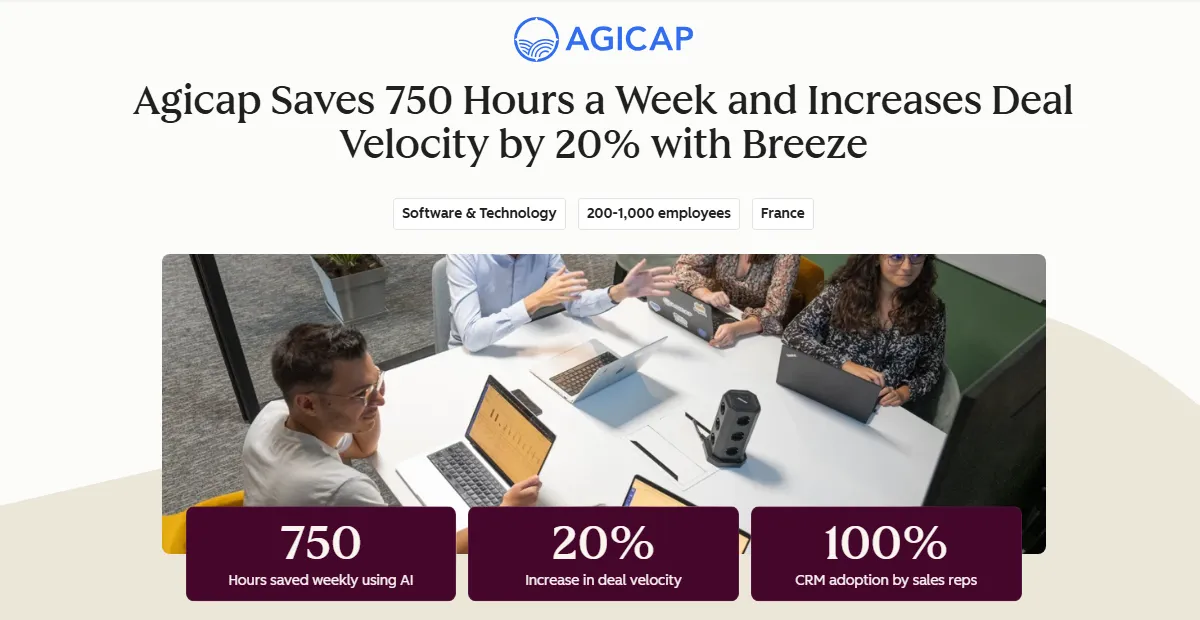
As a concrete example, Agicap saved 750 hours per week and shortened deal cycles by 20% after implementing an AI-supported marketing and sales workflow. Results at that level require architectural thinking and proper integration, not just a tool subscription.
Final Thoughts: AI in B2B Marketing Is a System, Not a Shortcut
Artificial intelligence in B2B marketing is no longer a future consideration. It's a present-day operational decision that compounds over time. Teams building real advantage right now are not necessarily using the most sophisticated tools, they're using available tools with better data, clearer processes, and a genuine investment in training their people.
The technology will keep improving. What separates high-performing marketing teams is the infrastructure and institutional knowledge they build around it. Start with a specific use case, measure the results honestly, then expand from there.
If you're looking for expert support in building out your AI-powered marketing stack, we regularly publish research and practical guides on this topic. A good starting point is our breakdown of the latest tools and approaches going beyond ChatGPT.
Want to improve PPC performance and pipeline efficiency with AI?
Aimers is a SaaS digital marketing agency that works with B2B companies to build scalable paid media and CRO strategies grounded in data and real expertise. We'd be happy to review your current setup and identify where AI can move the needle fastest. Get in touch to start the conversation.
FAQs
Where exactly does AI deliver the fastest results in B2B marketing?

Can AI replace B2B marketing teams?
What should we invest in first when implementing AI in B2B marketing?
How does AI improve B2B marketing ROI?
If we want AI to really work in our company, what should we invest in first?

February 2, 2026

February 3, 2026
.webp)