
LinkedIn Ads vs Facebook Ads: Which Wins for SaaS?


LinkedIn and Facebook are two fundamentally different advertising platforms. They have distinct targeting logic, different audiences, and produce varying results for SaaS businesses. LinkedIn is built on verified professional data and provides direct access to decision-makers. Facebook, on the other hand, relies on behavioral signals and offers a level of scale that LinkedIn cannot structurally provide with a narrow ICP.
Both platforms are effective for SaaS businesses, but they solve different problems. The choice between the two directly impacts pipeline quality, sales cycle length, and ultimately, CAC. The right decision depends on the business model, ACV, and the accuracy of the ICP definition.
At Aimers, we work with B2B SaaS companies on both platforms. In this article, we analyze each platform based on two key parameters: lead quality and scalability. This analysis uses the latest available data from 2025 and 2026.
The Core Difference: What You're Actually Paying For
At the structural level, LinkedIn vs Facebook ads is not just a channel comparison but a comparison of two different ways to qualify demand. Before comparing the metrics, it is worth clarifying how the two platforms differ structurally.
LinkedIn uses verified professional data. Users maintain their job title, industry, and company information because their profile directly affects professional visibility and career opportunities. As a result, you’ll find the following on LinkedIn:
- 65 million decision-makers
- 10 million C-level executives
- 4 out of 5 platform users are involved in making business decisions within their organizations
Facebook, on the other hand, operates on behavioral signals, such as interests, on-site actions, and lookalike audiences. Professional data is indirect and unverified here. The platform can assume that a user works in marketing but cannot verify their job title or company size.
One subtle point that is rarely mentioned when comparing these channels is important for B2B SaaS: LinkedIn allows you to target audiences based on the technologies in a company’s tech stack. For example, you can directly reach users at a company with a specific level of technological maturity and a budget for tools. Facebook does not offer this capability.
Cost Comparison: CPL, CPC, and CPM
The economics of advertising on LinkedIn vs Facebook only make sense when pricing is read in the context of audience quality and buying intent. Although platform selection is often reduced to metrics, those numbers only make sense in the context of each platform’s operating logic. CPC, CPM, and CPL on LinkedIn and Facebook reflect different fundamental factors, such as audience type, auction mechanism, and level of competition for ad inventory. Without this context, the numbers can create a false impression that one platform is simply cheaper than the other, which can distort the real picture and harm your company’s budget.
How Pricing Works on Each Platform
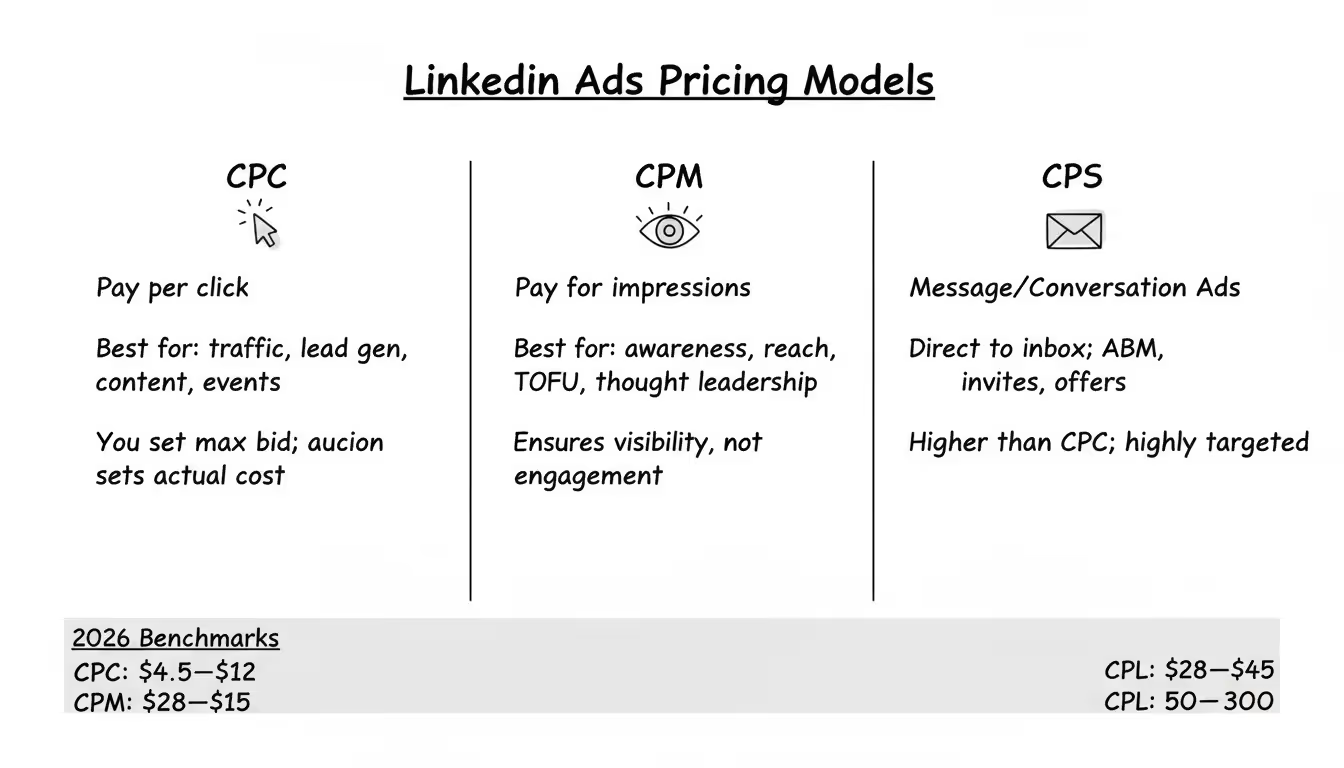
LinkedIn operates on three models:
- CPC – the primary model for lead generation and content campaigns
- CPM – for brand awareness and TOFU
- CPS – for Message and Conversation Ads, which are delivered directly to the inbox
The price is determined not by your bid, but by your closest competitor’s bid. You pay slightly more than they do to win the auction. At the same time, LinkedIn evaluates the quality of the ad as well as the bid. A high Ad Relevance Score can win the auction against a competitor with a higher bid.
Facebook primarily operates on CPC and CPM pricing, with delivery increasingly shaped by Advantage+ automation. The advertiser sets the campaign goal and budget, and the algorithm determines who to show the ad to, when, and at what price. Costs on Facebook depend directly on three factors:
- Competition for the audience
- Demand in a specific niche
- Ad quality
The higher the ad’s relevance and the stronger the landing-page experience, the lower CPM and CPC can be, because the algorithm favors ads that generate better user outcomes.
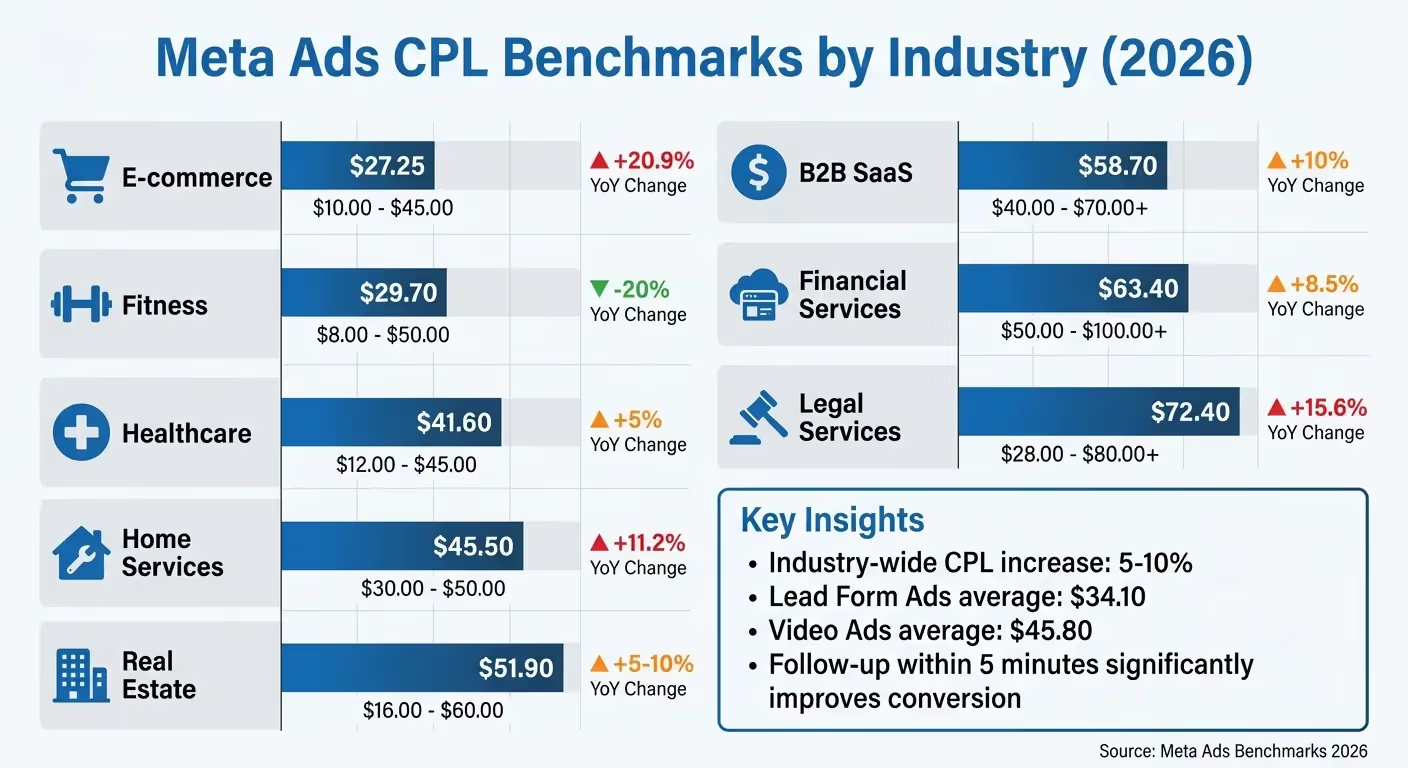
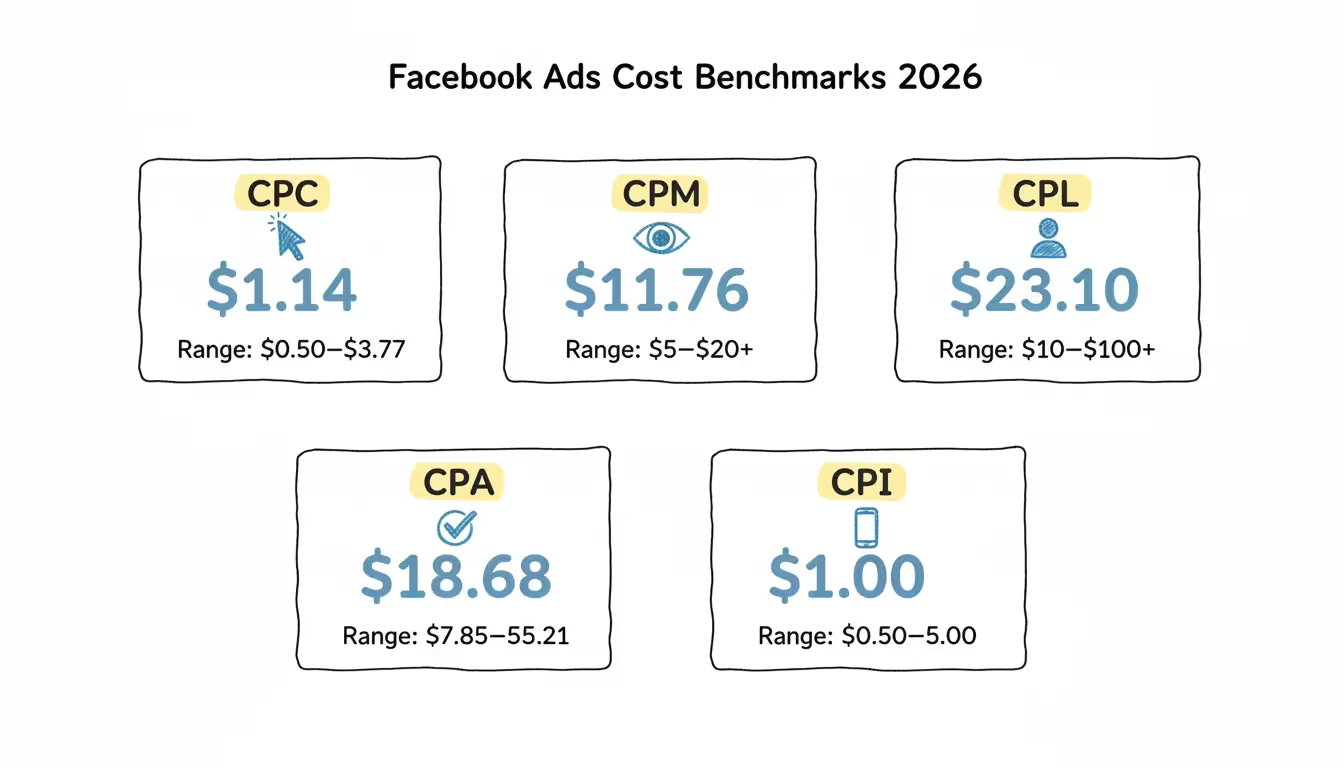
The key to understanding LinkedIn is that it sells access to a verified professional audience, which justifies its premium CPM. That is the core reason LinkedIn ads cost vs Facebook ads cost looks skewed at the surface level but less so when evaluated through pipeline efficiency. Facebook, on the other hand, sells reach and algorithmic optimization based on behavioral data, which explains its low CPM and high scalability.
Why You Can't Compare These Numbers Directly
Any discussion of Facebook ads vs LinkedIn ads cost becomes misleading the moment CPL is treated as the final business metric. The CPL gap between LinkedIn and Facebook favors Facebook by a factor of 3–5. However, these figures only reflect the cost of a completed form, not a qualified lead. LinkedIn leads convert into B2B pipeline opportunities two to three times more effectively than leads from other social platforms.
A simple example shows why this comparison breaks down. $1,000 spent on Facebook at a CPL of $20 yields 50 leads. At a 1% lead-to-customer conversion rate, that budget produces the equivalent of 0.5 customers on average. The same $1,000 spent on LinkedIn at a CPL of $100 yields 10 leads. With an 8% conversion rate, this amounts to 0.8 deals. In other words, LinkedIn generates more closed deals with the same budget, but the CPL is three times higher.
The reason lies in the nature of targeting: Facebook attracts people based on behavioral signals, not job title or company size. Consequently, some leads are individuals who don't make purchasing decisions or match the ICP. Each such lead not only incurs the CPL cost, but also the SDR’s time spent on qualification. LinkedIn allows you to filter the audience using profile data. Therefore, CPLs cannot be compared without taking SQL conversion into account.
Lead Quality: Conversion Rates and Pipeline Impact
This is the part of the comparison where LinkedIn ads vs Facebook ads lead quality matters more than top-line efficiency metrics. In B2B SaaS with a long sales cycle and high ACV, an unqualified lead does more than fail to convert; it burdens SDRs, distorts the pipeline, and inflates actual CAC. A more expensive lead can be more cost-effective if it is more likely to reach the SQL stage and close a deal.
The key difference between LinkedIn and Facebook lies precisely at this level. LinkedIn filters its audience based on professional data initially, whereas Facebook optimizes based on behavioral signals. This affects less the volume of leads than their progression through the funnel.
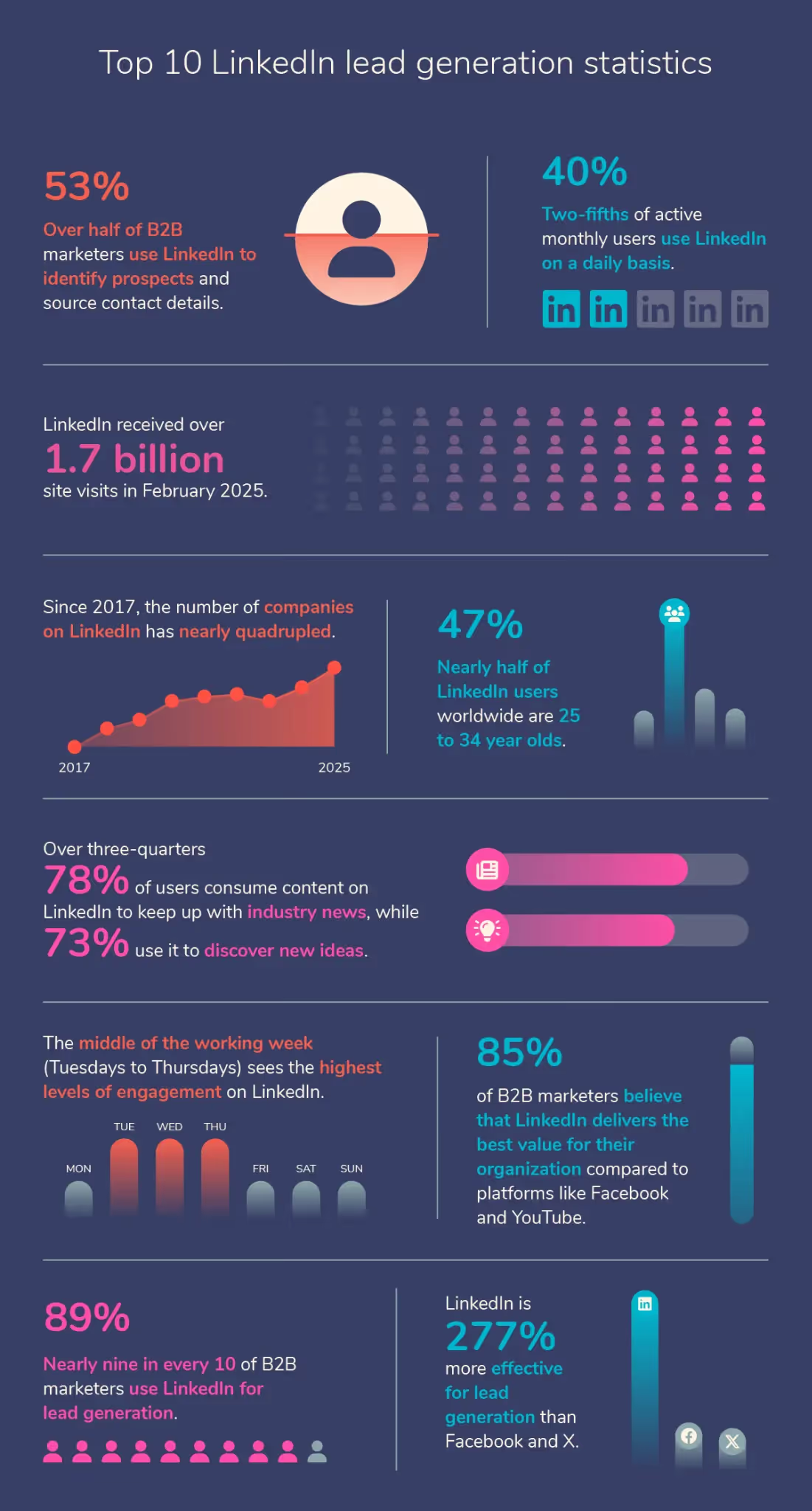
Another argument in favor of LinkedIn relates to the quality of the data itself. LinkedIn’s Lead Gen Forms automatically pull information from users' profiles, including work email, company, and job title. This reduces friction during form completion while simultaneously increasing data accuracy. Facebook Lead Ads also use autofill but rely on personal profiles that are updated less frequently. For B2B SaaS, this means a higher risk of receiving incorrect or irrelevant leads.
Lead Gen Forms also bridge the conversion gap with landing pages. They convert at a rate of 13%, compared to 2.35–4% for external landing pages.
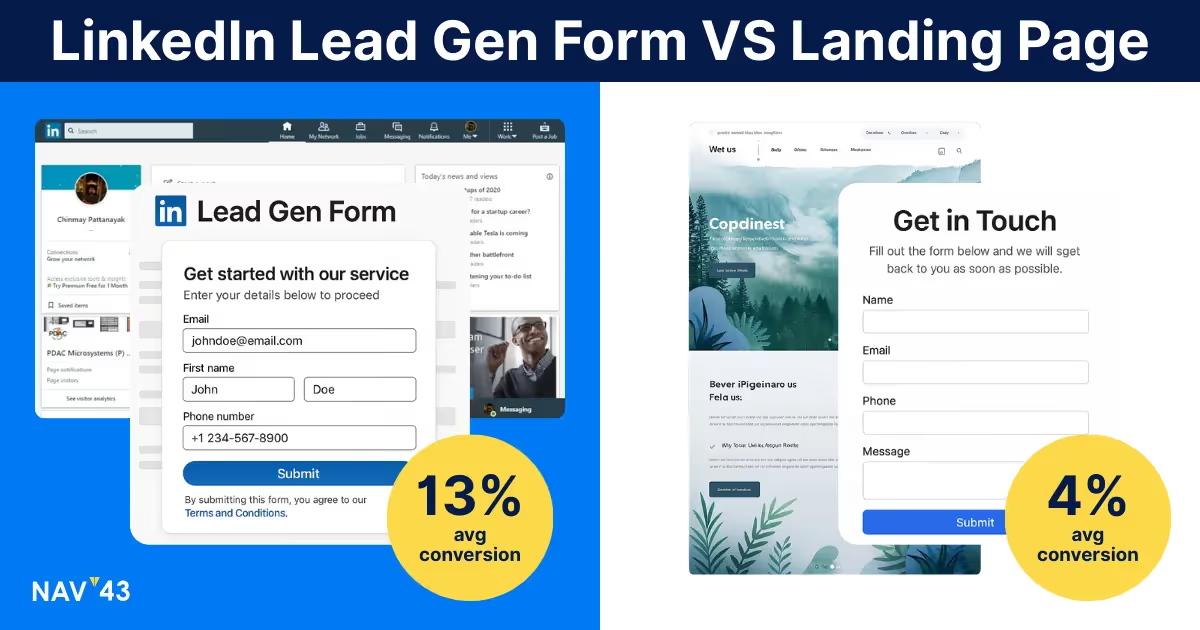
However, it's important to note that landing pages have a 20–40% higher SQL conversion rate than lead generation forms. Visiting the website, reading the content, and manually filling out a form are extra steps that act as an intent filter. Those who go through this process are more likely to be genuinely interested.
In B2B SaaS, lead generation forms are optimal for TOFU activities, such as content offers, webinars, and reports. For BOFU, such as demo requests and pricing consultations, a landing page with stricter qualifications is preferable because it yields a higher-quality mix of leads in the pipeline, even if the volume is lower. In those cases, a conversion rate optimisation agency can have more impact on pipeline quality than another round of audience expansion.
The low-friction nature of Lead Gen Forms does not fully eliminate the risk of attracting non-target leads. However, the structural filter of professional data significantly narrows the gap between the form and a qualified lead compared to Facebook, whose targeting is based on behavioral signals. This approach requires stronger post-lead qualification, which increases the real cost of acquisition.
Scalability: Where Each Platform Has Limits
In practice, Facebook vs LinkedIn advertising becomes a question of scale ceiling versus qualification ceiling. Before deciding how to allocate your budget, it’s important to understand each platform’s limitations–otherwise, both channels will perform worse than they could.
LinkedIn's Ceiling: When ICP Size Becomes a Constraint
LinkedIn has 1 billion users, compared to Facebook’s 3+ billion. For most B2B SaaS companies, the issue isn’t the number of users, but the ICP size. Narrow targeting yields an audience of 10,000–50,000 people. This is sufficient for BOFU campaigns with high ACV but insufficient for large-scale TOFU campaigns.
At a standard impression frequency, such an audience becomes saturated within four to six weeks. CTR drops, CPM rises, and targeting remains unchanged. For many B2B SaaS campaigns, budgets below $1,000–$3,000 per month per campaign often make it difficult to collect statistically useful data. With a smaller budget, campaigns cannot move past the learning phase of the algorithm, so the data cannot be considered representative.
Facebook's Advantage: Scale, Lookalikes, and Retargeting Mechanics
At this stage, Facebook vs LinkedIn is less about which platform is better and more about which one can sustain volume without breaking efficiency. Facebook addresses the issue of scale with two tools: Lookalike Audiences and retargeting.
With Lookalike Audiences, you can build audiences based on seed data from your CRM. This can include uploaded customer lists or Meta Pixel data. The minimum size of the seed audience for creating a Lookalike is 100 contacts, and the optimal size is between 2,000 and 5,000 contacts. A budget of around $500 per month can be enough to begin testing Lookalike audiences on Facebook in early-stage scenarios. But without disciplined Facebook ads optimization, low entry cost often turns into low-quality scale.
Retargeting on Facebook is more advanced than on LinkedIn. The platform allows you to segment audiences based on specific actions.
- Visiting the pricing page
- Watching a demo video
- Incomplete trial registration
Facebook retargeting delivers a CPL that is 40–60% lower than that of cold campaigns. For B2B SaaS with a 3–6 month sales cycle, this makes it possible to maintain engagement with a warm audience throughout the entire cycle. At the same time, costs will be significantly lower than when relaunching a campaign on LinkedIn.
The Budget Threshold Where the Trade-Off Changes
This is usually the point where teams stop asking "Should I advertise on Facebook or LinkedIn?" in abstract terms and start asking what each platform can realistically support at the current spend level. The choice of platform for scaling is often determined by budget rather than strategy.
With a budget of up to $3,000 per month, for example, LinkedIn leaves virtually no room for testing because most of the funds will go toward the algorithm’s learning phase, which occurs without sufficient data for optimization. With the same budget, however, Facebook allows you to test multiple audiences and formats simultaneously.
With a budget of $5,000 or more per month, a combined approach makes more sense. At that point, the question is no longer which is better LinkedIn ads or Facebook ads, but how to divide funnel responsibility between them. Facebook can handle TOFU and retargeting, while LinkedIn can cover BOFU and ABM campaigns targeting specific accounts.
Ad Formats and Their SaaS-Specific Use Cases
The ad format you choose directly impacts CPL, lead quality, and how ads perform at different stages of the funnel. Knowing which format addresses which objective is a fundamental operational consideration. Without this knowledge, even the most precise targeting will yield mediocre results. Below are the LinkedIn and Facebook formats that matter most in B2B SaaS, with examples of where each one fits.
LinkedIn Feed and Inbox Formats: Different Jobs at Different Funnel Stages
Before expanding beyond feed formats, it also helps to understand what is LinkedIn audience network and where it fits relative to core LinkedIn inventory. The format on LinkedIn affects not only the CPL but also the type of engagement with the audience. This is particularly important for B2B SaaS because one format is better suited for scalable MOFU activities, another is better for content-driven lead nurturing, and a third is better for targeted ABM outreach.
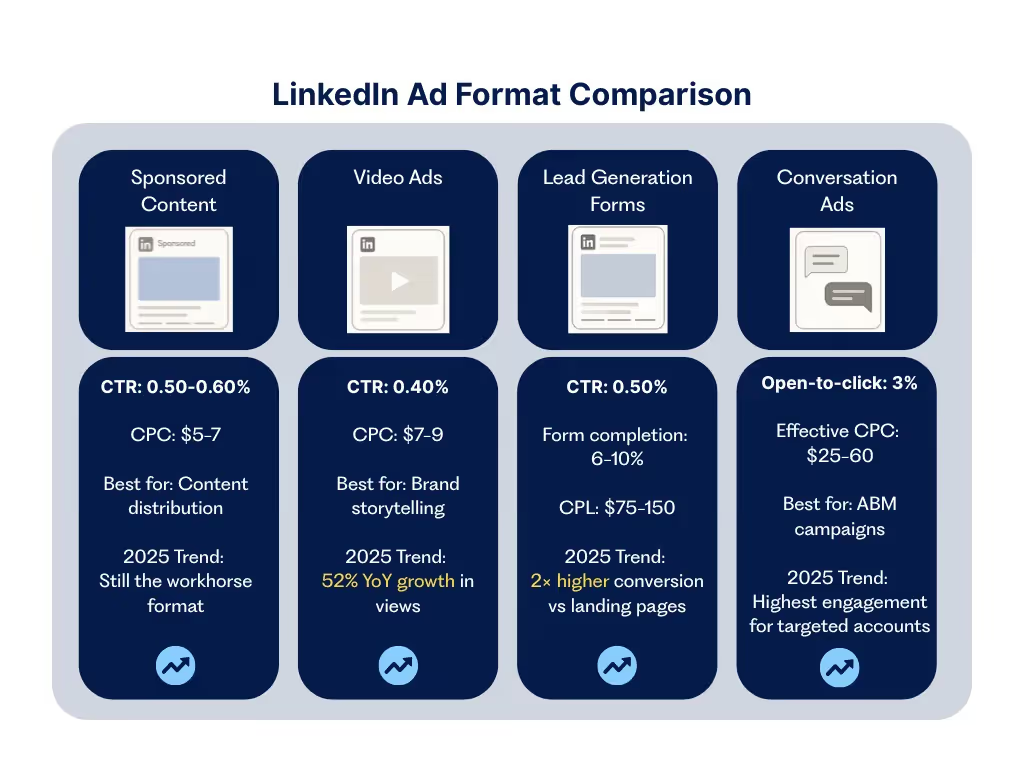
Sponsored Content – LinkedIn’s standard feed format and the foundation of most B2B SaaS campaigns. It strikes a balance between reach and engagement, works at all funnel stages, and supports Lead Gen Forms.
Document Ads – a less obvious but effective format for MOFU. This is a native document viewer right in the feed: the user reads a whitepaper, benchmark report, or case study directly in the feed without leaving LinkedIn. They often outperform more standard creative approaches, including many LinkedIn carousel ads examples, when the goal is deeper content engagement rather than visual variety. According to an analysis of 1,240 SaaS and tech campaigns, Document Ads and Single Image Ads, when paired with Lead Gen Forms, consistently deliver the lowest CPL among all feed formats. Moreover, a user who has taken the time to read a document in the feed demonstrates a more qualified signal of intent than someone who clicked on a banner.
For B2B SaaS with a long sales cycle, this translates to a specific scenario: a Document Ad featuring a benchmark report or industry study + a Lead Gen Form is an effective way to capture the MOFU audience with verified profile data and a relatively low CPL by the platform’s standards.
Conversation Ads are personalized messages in the LinkedIn Inbox with branching response paths. Their logic is very different from LinkedIn Video ads examples, which are better suited to broader message delivery than inbox-based ABM touchpoints. Users receive a message and can choose from several response options, each of which leads to different content or an offer. This format has an open rate of 50–60%, a CTR of 2–5%, and a CPS of $0.50–$3.00. These benchmarks make Conversation Ads relevant for narrow ABM campaigns, provided that personalization is strong.
However, there are limitations to Conversation Ads: a single user can receive only one message within this format every 30 days. This makes the format sensitive to message quality and leaves no room for error. If the frequency is too aggressive or the personalization is poor, the format is perceived as spam and backfires. The optimal scenario for SaaS is an ABM campaign targeting a specific list of accounts, personalized by role and industry.
Facebook Ad Formats for B2B SaaS: What Each One Is For
At the format level, LinkedIn vs Facebook ads for lead generation is not a platform-only comparison; it is also a question of whether the format supports qualification or just form completion. Depending on the stage of the sales funnel, Facebook's various ad formats perform differently for B2B SaaS.

Similar to LinkedIn Lead Gen Forms, Lead Ads open directly within Facebook without redirecting to a website and are partially auto-filled using profile information. Lead Ads often convert 30–50% better than campaigns that send traffic to an external landing page. That is one reason Facebook ad best practices in 2026 put so much emphasis on form structure and post-submit follow-up
Video ads are effective for the top of the funnel (TOFU) and middle of the funnel (MOFU). They explain the product, demonstrate use cases, and build brand awareness. Videos up to 30 seconds long have a completion rate of 35–45%, whereas videos longer than 60 seconds have a completion rate below 20%.
Carousel ads are effective for the middle and bottom of the funnel. They allow you to showcase multiple selling points, feature scenarios, or customer reviews in a single ad.
Facebook Retargeting Formats: Pricing-Page Visitors and Trial Drop-Offs
In terms of retargeting capabilities, Facebook surpasses LinkedIn. This is particularly important for B2B SaaS because Meta allows for the flexible segmentation of warm audiences based on specific behavioral signals. It also allows for the display of different creative content depending on the stage of the sales funnel. In practice, three audience segments typically deliver the greatest value.
Visitors to the pricing page have the highest commercial intent. Retargeting this group with case studies, ROI messaging, or demo offers yields significantly higher conversion rates than targeting a cold audience.
Users who started a trial but didn’t complete onboarding represent a separate segment with confirmed interest in the product. For this group, videos or carousel creatives featuring specific use cases, onboarding value, and next steps within the product work best because the goal is to reduce drop-off and increase activation, not to generate interest.
Visitors to specific feature pages provide another strong signal of intent. If a user has explored a particular feature, you can personalize retargeting for a specific task rather than displaying a generic brand message.
For such mid- and bottom-of-funnel scenarios, the ad format is particularly important. According to available B2B SaaS benchmark data, Carousel ads deliver a 4.2x return on ad spend (ROAS) compared to 3.1x for single image ads. This makes carousel ads a strong format for retargeting when you need to showcase multiple value propositions, use cases, or feature scenarios in a single ad.
The issue of attribution deserves special attention. Any experienced Facebook ads management agency will treat CAPI as infrastructure, not as an optional enhancement. Without the Conversions API, Facebook loses conversion signals due to browser restrictions and ad blockers. For B2B SaaS, this is critical because the sales cycle is long and there are few events; every lost signal degrades the algorithm’s training. CAPI transmits data directly from the server, bypassing the browser. Using CAPI with Meta Pixel improves attribution by 18–22%, depending on the number of recorded touchpoints.
Head-to-Head: Key Metrics for B2B SaaS
Before we move on to the platform selection model, let's compare LinkedIn and Facebook based on the key metrics that directly influence B2B SaaS decisions. This is where LinkedIn ads vs Facebook ads ROI starts to look very different from a simple CPL comparison.
The gap in Facebook vs LinkedIn ads conversion rate is meaningful, but it only matters when read together with lead qualification and downstream pipeline movement.
When to Use LinkedIn, Facebook, or Both
LinkedIn excels in lead quality and targeting accuracy. Several metrics demonstrate this, including an ROAS of 113% for B2B SaaS, 80% of B2B social leads, and a 13% conversion rate for Lead Gen Forms. Facebook, on the other hand, excels in scale, cost of reach, and retargeting, making it an indispensable tool for PLG products and for maintaining engagement throughout long sales cycles.
However, the choice of platform depends on your goals and initial data. What is your ACV? How precisely is your ICP defined? At which stage of the funnel are you losing money right now? These questions cover most use cases. Let's break each one down.
Where LinkedIn Wins: High ACV, Narrow ICP, BOFU
LinkedIn is the right choice when the cost of error is too high. In other words, LinkedIn ads vs Facebook ads for SaaS depends heavily on whether your funnel punishes bad-fit leads or needs cheap volume. With an ACV of $10K+, a single unqualified lead in the pipeline isn’t just wasted CPL – it’s also the SDR’s time spent on qualification, a distorted funnel forecast, and an inflated actual CAC. Verified LinkedIn profile data acts as a safeguard against this problem.
Specific scenarios where LinkedIn excels:
- Narrow ICP by job title and industry: Facebook cannot verify profiles as effectively as LinkedIn
- ABM strategy: uploading a list of target accounts and targeting decision-makers within specific companies. This is one of the patterns frequently highlighted by top LinkedIn ads agencies because the targeting logic is difficult to replicate elsewhere. LinkedIn allows you to upload up to 300,000 accounts to Matched Audiences
- BOFU campaigns: demo requests, trials for high-ACV products, direct access to the buyer without a chain of approvals
- Sales cycle 3+ months: LinkedIn Insight Tag shows which industries, job functions, and regions your website visitors come from, even when they do not click on an ad directly. For SaaS teams with a long sales cycle, this gives sales an extra layer of intent data for outbound follow-up
Where Facebook Wins: TOFU, Retargeting, PLG, and Low-ACV SaaS
This is the section where LinkedIn Ads vs Facebook ads has to be read through product economics rather than platform prestige. Facebook is the right choice when you need to scale up, test quickly, or reach a large audience. For ACVs up to $5k and self-serve or product-led growth (PLG) models, Facebook’s behavioral targeting is sufficient for finding the right audience. Detailed user verification does not fundamentally alter the economics of the deal.
In our experience, we often encounter situations in which SaaS teams switch from Facebook to LinkedIn after unsuccessful tests, only to end up with a CPL that is several times higher. In many cases, the issue is not the channel itself, but the way it is being used. That misalignment is exactly where a specialized LinkedIn advertising agency or cross-channel B2B team can prevent expensive testing errors. Facebook isn’t designed to capture ready demand from a cold audience. However, when used correctly throughout the funnel and retargeting, it can generate a real pipeline.
Facebook excels in specific scenarios:
- TOFU demand generation: Broad reach at a CPM three to five times lower than on LinkedIn
- Retargeting throughout the entire deal cycle: Segmentation by visitors to pricing pages, feature pages, and trial drop-offs, with personalized creative for each segment
- Hypothesis testing on a limited budget: Starting at $500 per month, you can gather enough data to draw conclusions about your audience and creative
- Broad or undefined ICP: During the product-market fit phase, Facebook provides more signals for the same budget
The Combined Model: Facebook for Demand Creation, LinkedIn for Higher-Intent Capture
For many SaaS teams, the real answer to Facebook vs LinkedIn is not replacement, but role separation. The most effective B2B SaaS teams don’t choose between platforms; they allocate roles. Here’s the structure we use when working with clients: Facebook handles TOFU and broad-audience retargeting, while LinkedIn handles BOFU and ABM targeting specific accounts. With budgets above $5K per month, this model often outperforms a single-platform setup.
When using a combined model, however, you need to account for the nuances of attribution. LinkedIn’s CPM has increased by 28% over the past year because more and more B2B budgets are shifting to the platform. That pricing pressure is also part of why more teams now compare LinkedIn ads vs Reddit ads and other specialist B2B channels before committing top-of-funnel budget. At current CPM levels, using LinkedIn primarily for awareness is often hard to justify economically. The platform should be used where its targeting advantage maximally converts into the pipeline, i.e., at the BOFU stage.
The Bottom Line: Platform Choice Is a Business Decision, Not a Media Preference
LinkedIn and Facebook are not competitors; they are tools with different areas of focus. When developing a marketing strategy, it’s important to determine which platform is best suited to your ACV, ICP, and current stage in the sales funnel. For example, LinkedIn is not the right tool when the main goal is broad reach, and Facebook is not the right tool when the job requires reliable job-title verification.
Based on the 2025–2026 data reviewed here, several conclusions are clear:
- CPL on LinkedIn is 3–5 times higher than on Facebook, but LinkedIn leads convert into pipeline opportunities 2–3 times more effectively. Optimizing for CPL without considering downstream conversions leads to poor budget decisions
- For ACV of $10K+ and a narrow ICP, LinkedIn has a structural advantage because job title and company size verification are not available on Facebook at the profile data level
- For ACV up to $5k, PLG models, or a broad ICP, Facebook provides more data for the same budget and allows for faster hypothesis testing
- Retargeting is Facebook’s domain, regardless of the model. CPL is 40–60% lower than in cold campaigns with more sophisticated segmentation mechanics
- A combined model (Facebook for TOFU + LinkedIn for BOFU) with a budget of $5K+ per month consistently outperforms single-platform campaigns in terms of both pipeline quality and final CAC
- The correct comparison metric is not CPL but rather the cost of a closed deal. The platform that minimizes this cost for your ACV and ICP is the right choice
At Aimers, we work with B2B SaaS companies on both platforms. This comparison reflects the same logic we apply across our SaaS digital marketing services when channel role matters more than raw media cost. If you’d like help determining which model is right for your product, you can schedule a free consultation with our experts.
FAQs
Which is better for B2B SaaS: LinkedIn Ads or Facebook Ads?

Why are LinkedIn Ads more expensive than Facebook Ads?
Are LinkedIn leads better than Facebook leads?
Should I compare LinkedIn and Facebook Ads by CPL?
Can LinkedIn and Facebook Ads work together for SaaS?